The BELA Form Asks for "Extra-Mural Activities." Do You Know What to Write?
You pulled your child out of a system that wasn't working. The academics are sorted — you've got a curriculum, a schedule, and a plan. But then the registration form lands in your inbox, and there it is: "Full details of the educational programme... extra mural activities." And you freeze.
It's not that your child doesn't do things. They swim. They read. They play with the neighbours' kids. But is "plays with the neighbours' kids" what you write on a provincial government form? Is swimming lessons at the local pool the kind of "extra-mural activity" that satisfies the Department of Education? And when Ouma asks at the next braai — "But what about socialization?" — do you want to recite a blog post about how socialization is a myth, or do you want to hand her a list of SACSSA sports fixtures, ATKV competition dates, and a President's Award progress log?
You're not looking for another philosophical defence of homeschooling. You've read those. You know the research. What you need is a system — a province-by-province directory of every sport, club, and competition your child can actually enter as an independent homeschooler, plus the templates to document it all so professionally that no official, no family member, and no university admissions office can question your child's social development.
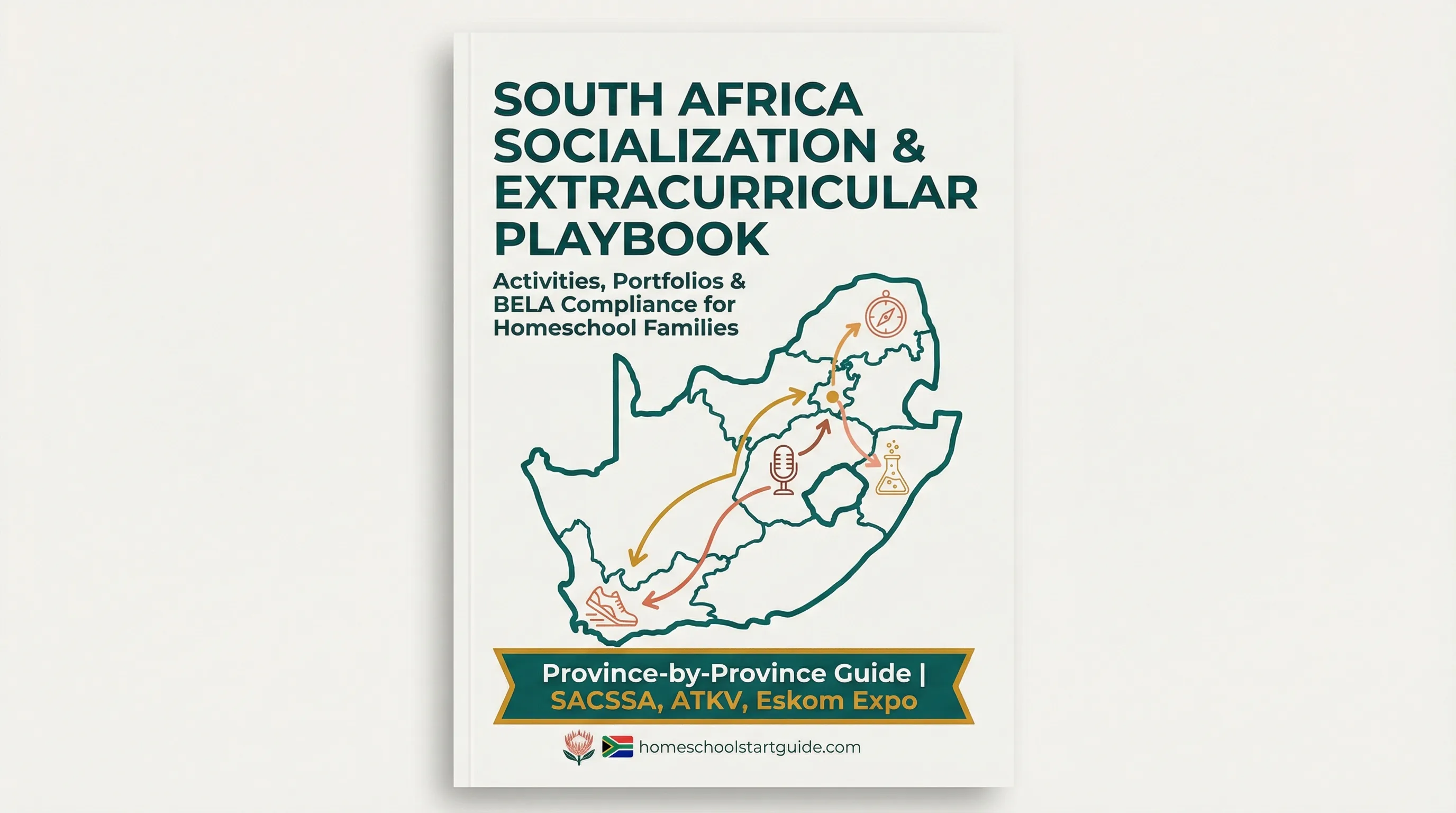
That's what this Playbook is. Not theory. Not reassurance. A tactical operating manual for building a rich social life and a university-ready extracurricular portfolio — specifically for the South African context.
What's Inside the Playbook
The Province-by-Province Activity Directory
A verified directory of every major extracurricular pathway open to independent homeschoolers in South Africa — organised by province. Covers SACSSA sports (the primary route to provincial colours for homeschoolers), ATKV Redenaars (public speaking and culture competitions that accept private entries with a homeschool registration number), Eskom Expo for Young Scientists (open to private entries — high prestige for university applications), the President's Award (Duke of Edinburgh equivalent — can be done independently and is widely recognised by SA corporates and universities), and youth organisations like Voortrekkers and Landsdiens that have strong homeschool commando presence. Each listing includes contact details, entry requirements, fees, and key dates.
The BELA Compliance Cheat Sheet
Exact wording examples you can use when filling out the "extra-mural activities" section of your provincial registration form — whether WCED, Gauteng, Limpopo, or KZN. The Playbook shows you how to frame everyday activities in the formal language that education officials expect, so your registration isn't delayed or queried because the activities section looked thin. This isn't legal advice — it's the practical formatting that gets your form approved without follow-up questions.
The Socialization Transcript Template
A professional-looking template for logging your child's extracurricular hours across four categories: Community Service, Sport, Culture, and Leadership. It mimics the structure of a school report card but is designed specifically for homeschoolers. Use it for BELA compliance, for university portfolio submissions, and for the next time someone questions whether your child "gets enough socialization." The transcript turns anecdotal activities into documented evidence.
The University Portfolio Bridge
UCT, Stellenbosch, Wits, and UP all require homeschoolers to submit a "portfolio of evidence" that goes beyond academic transcripts. Admissions committees look specifically for social competence, leadership roles, and sustained extracurricular engagement. This section maps specific activities to university admission requirements — for example, completing the President's Award Gold Level counts as "leadership" for UCT admissions, and placing in Eskom Expo demonstrates "independent research capability" for science faculties. No existing guide makes these connections explicit.
The Social Skills Framework
Not an etiquette checklist — a practical framework for assessing whether your child is building genuine peer connections or just performing well in adult-supervised settings. Covers the blind spots that show up in homeschooled children: difficulty reading unspoken group hierarchies, "autopilot" social processing where every interaction feels draining, and the gap between being articulate with adults and navigating the unstructured dynamics of same-age peers. Includes age-specific benchmarks from primary school through matric so you can see exactly where your child stands.
Conversation Scripts for Family Critics
Five verbatim scripts for the conversations that drain you — the braai interrogation from Ouma, the "concerned" WhatsApp from your sister-in-law, the school-gate parent who asks "But don't they need real friends?", the Department official who questions your programme, and the most difficult one: the conversation with your own child when they say they feel lonely. These aren't argumentative essays — they're calm, specific responses you can memorise and use tonight.
The Extracurricular Planning Calendar
A fillable annual planner aligned to the South African school calendar (four terms, not US semesters). Maps SACSSA fixtures, ATKV entry deadlines, Eskom Expo regional dates, President's Award milestone timelines, and Voortrekker/Scouts event calendars so you can plan your child's social year the way you plan their academic year — intentionally, with deadlines visible and registration windows marked.
Who This Playbook Is For
- Parents in Gauteng, Western Cape, KZN, or any province who need to fill out the BELA registration form's "extra-mural activities" section and want professional, compliance-ready wording — not guesswork
- Families who are confident in their homeschool academics but privately worry about whether their child is building real peer connections — not just behaving well around adults
- Parents facing the "socialization question" from extended family and want more than reassurance — they want a documented Socialization Transcript that proves the social infrastructure is real and intentional
- Families with children approaching Grade 8-9 who suddenly realise that informal playdates won't satisfy UCT or Stellenbosch portfolio requirements — and need to build a credible extracurricular record before matric
- New homeschoolers (post-COVID or post-BELA) who left the school system and need to rebuild their child's entire social calendar from scratch in a South African context — not from US-centric advice
- Black middle-class families who chose homeschooling for quality and safety, and want their child to access prestige extracurriculars (Eskom Expo, President's Award, SACSSA provincial colours) that build a university-ready portfolio
After Using the Playbook, You'll Be Able To
- Fill out the BELA registration form's extra-mural section with confidence — using the exact wording formats that provincial education departments expect to see
- Register your child for SACSSA sports, ATKV Redenaars, Eskom Expo, and the President's Award as an independent homeschooler — with step-by-step instructions for each organisation's entry process
- Distinguish between a child who is introverted (a personality trait that needs no fixing) and a child who is missing social cues (a skill gap that benefits from intentional practice)
- Build a Socialization Transcript that documents Community Service, Sport, Culture, and Leadership hours in a format that satisfies both BELA compliance and university admissions requirements
- Map your child's current extracurricular activities to specific university admission criteria — knowing which activities UCT, Stellenbosch, and Wits value most for portfolio-based homeschooler admissions
- Answer the socialization question at the next braai with specifics, not platitudes — because your child's social calendar, activity portfolio, and development benchmarks are documented and intentional
Why Not Just Piece This Together for Free?
You can try. The information exists — scattered across Pestalozzi Trust legal bulletins, Cape Home Educators newsletters, Facebook group threads where advice is contradictory ("You don't need to register" vs. "Register now!"), and blog posts that defend homeschool socialization philosophically but don't tell you how to register for SACSSA athletics or what to write on a WCED form.
- Facebook advice is anecdotal. "My kid plays tennis and he's fine" doesn't give you a replicable pathway. It doesn't tell you which competitions accept homeschool entries, which organisations require an EMIS number (and which don't), or how to document tennis hours in a format that UCT admissions will accept.
- Pestalozzi Trust covers defence, not strategy. They're excellent at protecting your right to homeschool. But their content focuses on why you don't need school socialization, not how to build a thriving social life and extracurricular portfolio. Legal defence and social planning are two different problems.
- Shirley Erwee's books are theory, not directories. They're the best general homeschooling guides in SA — but they're 250-page textbooks that dedicate a chapter to socialization, not a province-by-province directory with contact details, entry fees, and registration deadlines. You read the chapter and still have to Google every organisation yourself.
- Data costs are real. Hours of mobile browsing on scattered websites — at South African data rates — costs more than this Playbook. One consolidated reference saves you the time, the data, and the frustration of contradictory advice.
A single term of swimming or ballet costs R1,500+. Shirley Erwee's book costs R175-R250 and doesn't include a directory. Curriculum packages from Impaq or CambriLearn cost R15,000-R30,000/year and parents still complain they don't solve the local social connection problem. This Playbook bridges the gap that no existing product fills — the practical "where to go, what to do, and how to document it" guide, built entirely for the South African context.
— Less Than One Term of Extramurals
A single term of swimming lessons costs R1,500+. A single Exclusive Books paperback runs R250-R350. The annual cost of a curriculum that still doesn't solve your child's social life runs into tens of thousands. This Playbook is a one-time investment that ensures every rand you spend on extramurals goes to the right activities — the ones that build genuine friendships, satisfy BELA compliance, and strengthen your child's university portfolio.
The Playbook includes the full guide plus 8 standalone printable reference cards and templates: the Quick-Start Checklist, the Socialization Transcript template, the BELA Compliance Cheat Sheet, the province-by-province Activity Directory, the University Portfolio Mapper, the Social Skills Framework, the Conversation Scripts, and the SA School Term Planning Calendar. 9 files total — instant download, no account required.
30-day money-back guarantee. If the Playbook doesn't give your family a clearer path to genuine social connection and extracurricular access, email us and we'll refund you. No questions asked.
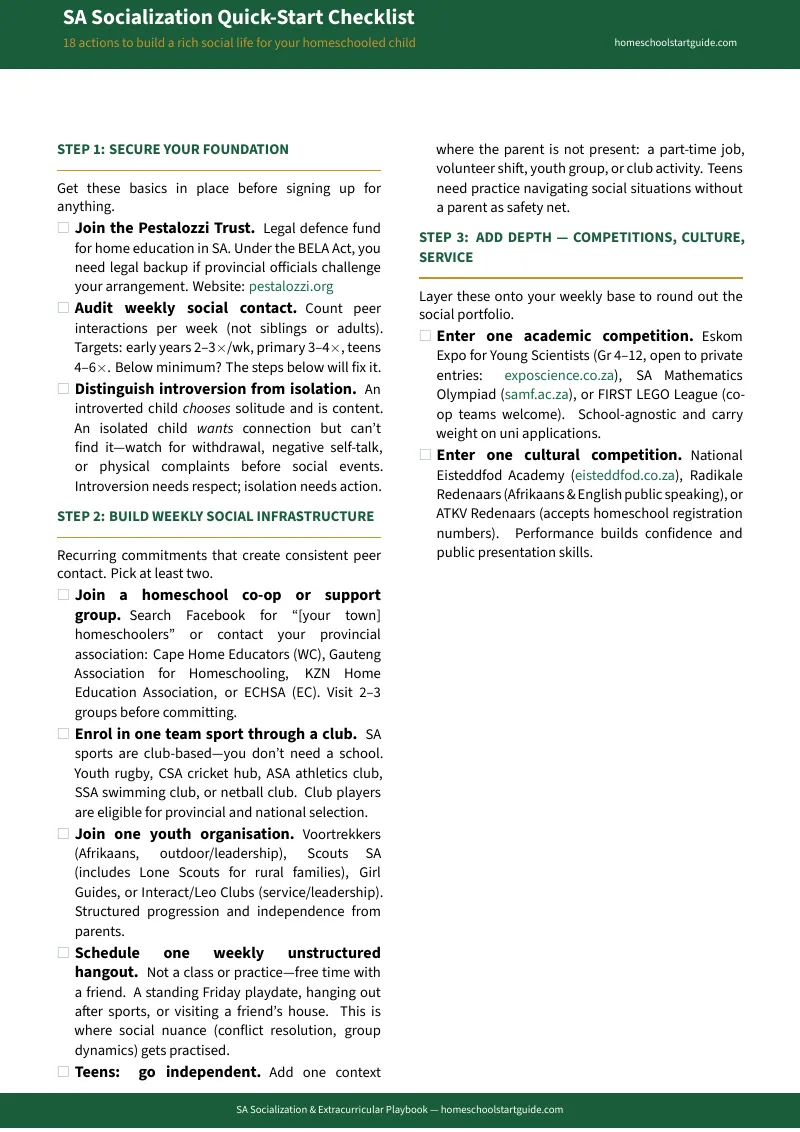
Not ready for the full Playbook? Download the free Socialization & Extracurricular Quick-Start Checklist — a one-page overview of the key action items: identify your province's top homeschool-friendly organisations, assess your child's social development by age, and pick the first three activities to pursue. It's the starting point, and it's free.
Your child's education already proves they can learn anything. The Playbook makes sure they also have the social connections, the extracurricular achievements, and the documented portfolio to show every university, every official, and every Ouma exactly what they've built — on their own terms.