You've done everything right. Now the system is telling you it wasn't enough.
Your child has spent years learning outside the classroom — reading deeply, pursuing real interests, developing the intellectual independence that universities claim to want. And now you've opened the UCAS portal and discovered that the system has no idea what to do with you.
No school buzzword. No head of sixth form. No one to write the academic reference, because the only person who knows your child's academic work is you — and UCAS explicitly forbids family members from writing it. No institutional mechanism for generating predicted grades. And a web portal that triggers error messages the moment you type "home education" into a field designed for school codes.
This is the moment every home-educating family hits. You're not doing anything wrong. The system just wasn't built for you.
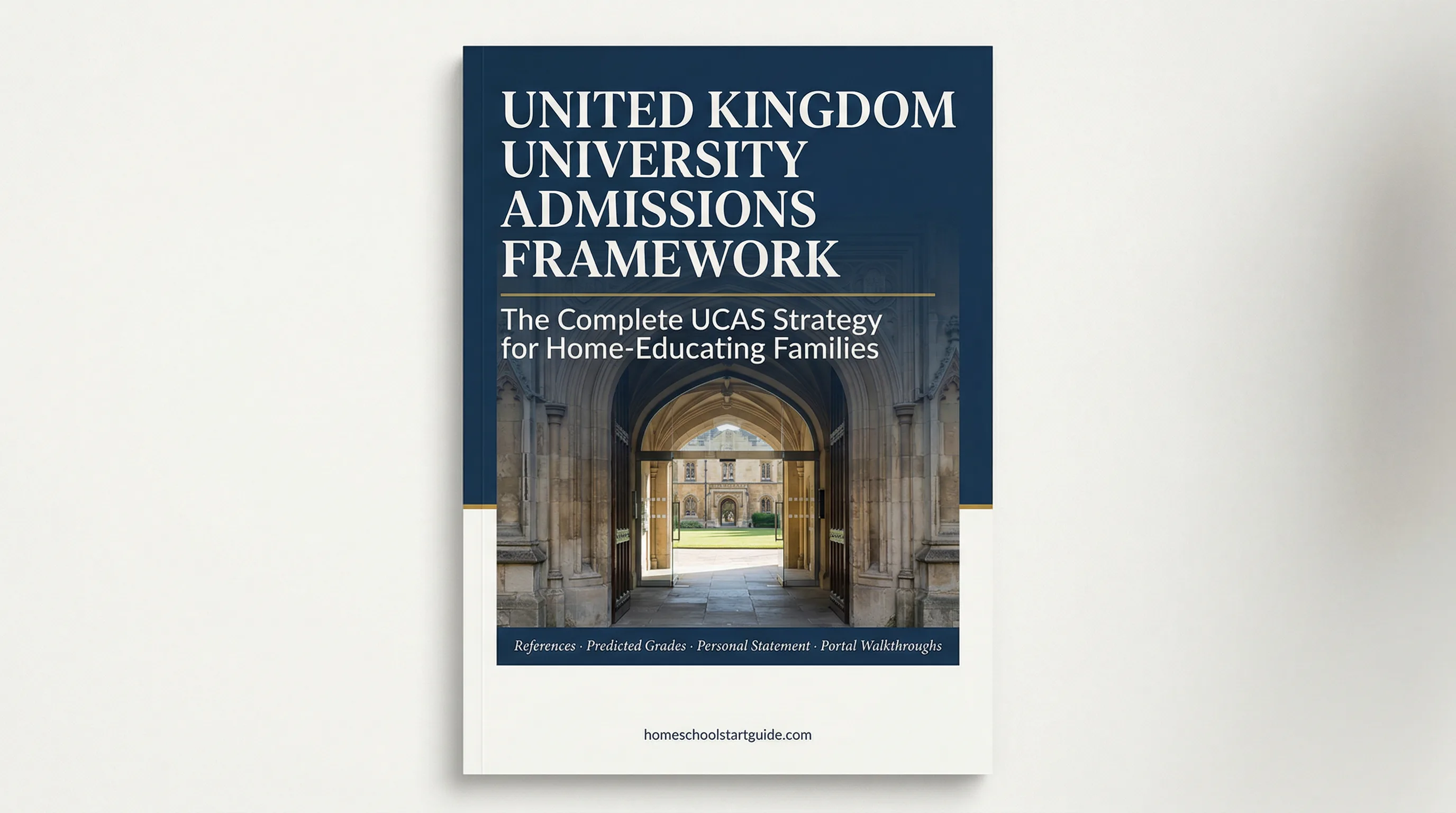
The Independent Applicant System inside the United Kingdom University Admissions Framework was built for exactly this moment — a complete strategy for navigating the three structural barriers that stop home-educated students from submitting a competitive UCAS application: the reference, the predicted grades, and the portal itself.
What's Inside the Independent Applicant System
A complete, chronological A-to-Z framework — from Year 11 IGCSE decisions all the way to pressing Submit on the UCAS application. Every chapter is written for families with no school behind them.
- The Referee Briefing Pack. UCAS will cancel the application if a family member writes the reference — but you're often the only person who knows your child's academic work. This is a printable document you hand directly to a qualified, non-family referee (Duke of Edinburgh leaders, private tutors, diagnostic assessors, employers), with exact instructions for writing the new three-section UCAS reference format (School Context, Extenuating Circumstances, Applicant Specific Information) within the 4,000-character limit. Your referee doesn't need to figure out the format alone — and you don't need to discover after submission that the reference was flagged.
- The Predicted Grades Procurement Strategy. Universities won't issue a conditional offer without predicted grades, and "my parent thinks I'll get an A" isn't a credible prediction. A concrete roadmap for generating legitimate predicted grades without a school: booking early AS-level sits to establish a formal baseline, using distance-learning tutor assessments, and engaging private diagnostic examiners whose reports carry institutional weight with admissions tutors.
- The UCAS Portal Cheat Sheet for Independent Applicants. The portal was built for schools — and the moment you try to apply without one, it breaks. Step-by-step walkthroughs of every screen that assumes you're a school student, including the space-bar workaround for the centre buzzword field, how to enter multiple private exam centres without triggering timetable conflict errors, and the correct approach to the Unique Learner Number (ULN) field as an independent candidate.
- The Chronological Roadmap. Most families discover the October Oxbridge deadline in September — after it's too late to prepare. A month-by-month timeline from Year 10 through the January UCAS deadline, with early October deadlines clearly flagged for Oxbridge, Medicine, Dentistry, and Conservatoire applications. No more discovering a deadline the week it closes.
- The Personal Statement — Home Education Edition. Generic advice says "mention your school activities and teacher recommendations" — neither of which you have. Specifically how to frame autonomous learning, self-directed research, and non-standard extracurriculars as institutional assets — the language admissions tutors use when they read contextual information, and how to make your child's background land as a strength rather than an anomaly.
- Science Practicals and NEAs. STEM university offers are contingent on passing Practical Endorsements — but you can't do them at a kitchen table. A strategy for finding and vetting private exam centres that offer Practical Endorsements and Non-Examined Assessments, essential for applicants targeting Medicine, Natural Sciences, and Engineering.
- Full UK Coverage. All four nations: English A-Levels, Scottish Highers and Advanced Highers, the Welsh Baccalaureate, and CCEA qualifications in Northern Ireland. No chapter assumes you're in England.
- Updated for the Current Cycle. Includes the brand-new three-section UCAS reference structure, updated Oxbridge admissions tests (ESAT, TMUA, UCAT), and current contextual admissions policies — not recycled advice from five years ago.
Standalone Printable Tools Included
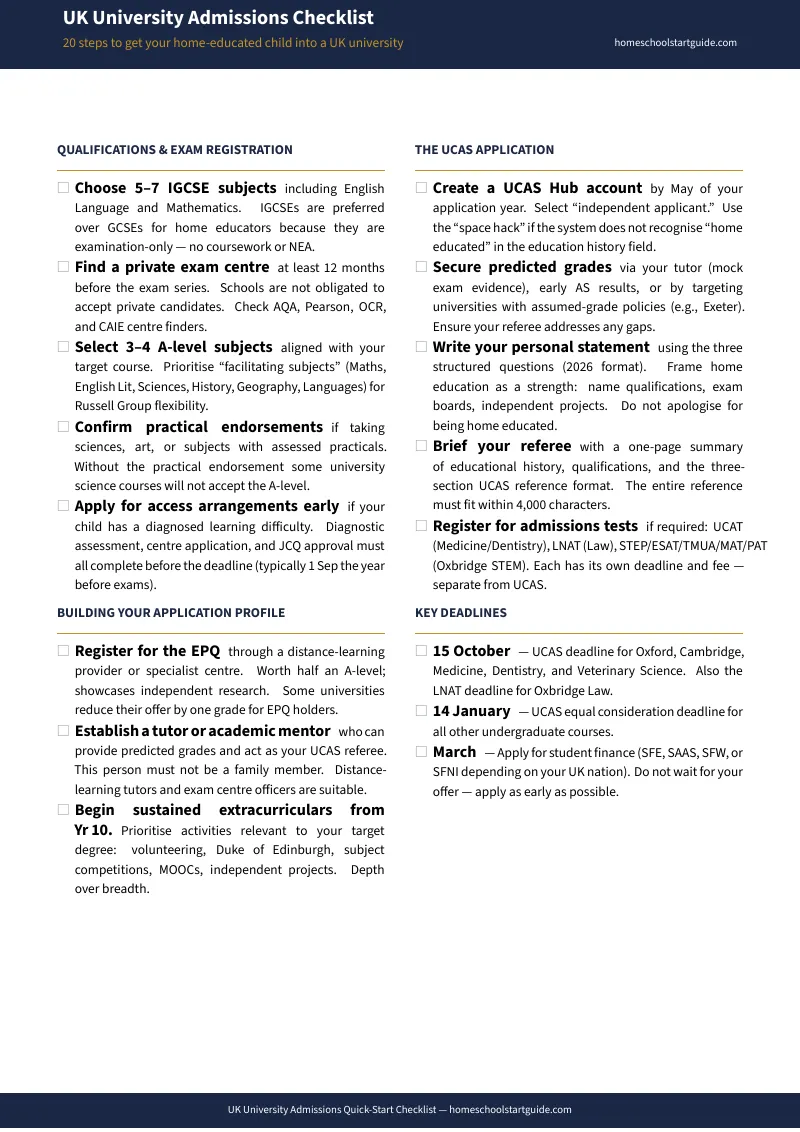
In addition to the comprehensive guide, the framework includes 5 standalone printable PDFs — each designed to be used independently, without needing the full guide open.
- Referee Briefing Pack. Print this and hand it directly to your referee. Explains the three-section UCAS reference format, the 4,000-character limit, and includes a fillable section for your child's details. Your referee does not need to read the full guide.
- UCAS Portal Cheat Sheet. Keep next to the computer when filling in UCAS Hub. Covers the buzzword "space hack," ULN field, multiple exam centre entry, and every critical deadline on one reference card.
- Year-by-Year Timeline. A wall-friendly planning document from Year 10 through university entry. Checkbox tasks for every milestone — pin it to a wall or keep it in a binder.
- Admissions Tests Quick Reference. One-page table of UCAT, LNAT, ESAT, TMUA, MAT, and PAT — registration windows, test dates, and fees.
- University Contact Directory. Contact details for 20 universities with notes on their home education policies, plus a full resources directory.
Why Free Resources Won't Get You There
You've probably already tried. Most home-educating families spend weeks on the same circuit before landing here. Here's why each stop leaves you short:
- UCAS official guidance tells you the rules, but every page assumes you have a head of sixth form to translate them. The portal doesn't have a "home education" dropdown — it has a buzzword field designed for school codes, and no documentation explaining what independent applicants should do when it throws an error.
- Education Otherwise, HEAS, and the charity leaflets are excellent at defending your legal right to home educate under the Education Act. They are not admissions consultants. Their guidance stops at deregistration and local authority dealings — and fundamentally abandons you at the moment your child turns 17 and needs to apply to university.
- The HE Exams wiki has genuinely useful peer-to-peer survival knowledge — the space hack, exam centre tips, jargon definitions. But it's crowdsourced, occasionally outdated, and requires hours of browsing to piece together a coherent strategy. Some of the reference-writing advice still describes the old free-form format that UCAS replaced this cycle.
- Mumsnet, Reddit, and The Student Room are where most of the anxiety lives. Contradictory advice, undated posts, and well-meaning parents who navigated a different version of the system two or three years ago.
None of these resources are wrong, exactly. They're just incomplete — and in a system where a single formatting error on the reference or a missed field on the portal can cost your child an academic year, incomplete is not good enough.
Who This Is For
- Parents who have home-educated since early childhood and are now facing the UCAS system for the first time.
- Families who withdrew their child from school at secondary level — due to SEN failures, bullying, or neurodivergence — and are now navigating A-Levels and university entry independently.
- Parents whose child wants to apply to a Russell Group university, Oxbridge, or a specialist conservatoire, and who need to compete on equal terms with traditionally schooled applicants.
- Families whose child is aiming for any university at all — the UCAS mechanics are identical whether the goal is Oxford or a local specialist college.
- Any parent who has spent hours on Mumsnet, Reddit, and The Student Room trying to piece together a coherent strategy from contradictory forum posts written years apart.
The Real Cost of Getting This Wrong
A single administrative error on the UCAS portal — an incorrectly formatted reference, missing predicted grades, a portal error left unresolved — doesn't cost money. It costs your child an entire academic year. A year of their life, a gap year they didn't choose, a conditional offer withdrawn because the reference arrived in the wrong format.
The alternative to this framework is spending hundreds of pounds on a private admissions consultant, or thousands on a distance-learning school enrollment just to get access to an institutional referee. For , the Independent Applicant System gives you the complete insider strategy — the same knowledge premium advisors charge by the hour to dispense.
Satisfaction Guarantee
If you read the framework and feel it hasn't given you a clear, actionable path forward, email us at any time for a full refund. No questions. We are confident this is the most comprehensive resource available for home-educating families navigating UK university admissions — but we'd rather refund you than have you feel stuck.
Questions before buying? Email [email protected].
Frequently Asked Questions
What if the rules change after I buy?
We update the guide when the rules change. Email us any time, even years later, and we'll send you the current edition free.