You've Left a System That Didn't Fit Your Child. Don't Buy a Curriculum That Doesn't Either.
You made one of the bravest decisions a parent can make: you deregistered your child from a school that was failing them. Maybe it was a SENCO who couldn't deliver on an EHCP. Maybe it was a Year 8 child who stopped eating from the anxiety. Maybe you simply looked at the classroom and realised your child would never thrive inside it.
Now you're three weeks into home education and you've opened 47 browser tabs. You've asked in three Facebook groups and received 63 conflicting answers. You've read blog posts from American families who use terms like "Middle School" and "High School Diploma" that mean nothing in the UK. You've downloaded the GOV.UK guidance page, which told you to provide a "suitable, efficient, full-time education" without telling you what any of those words mean in practice.
You didn't leave a one-size-fits-all school to buy a one-size-fits-all curriculum.
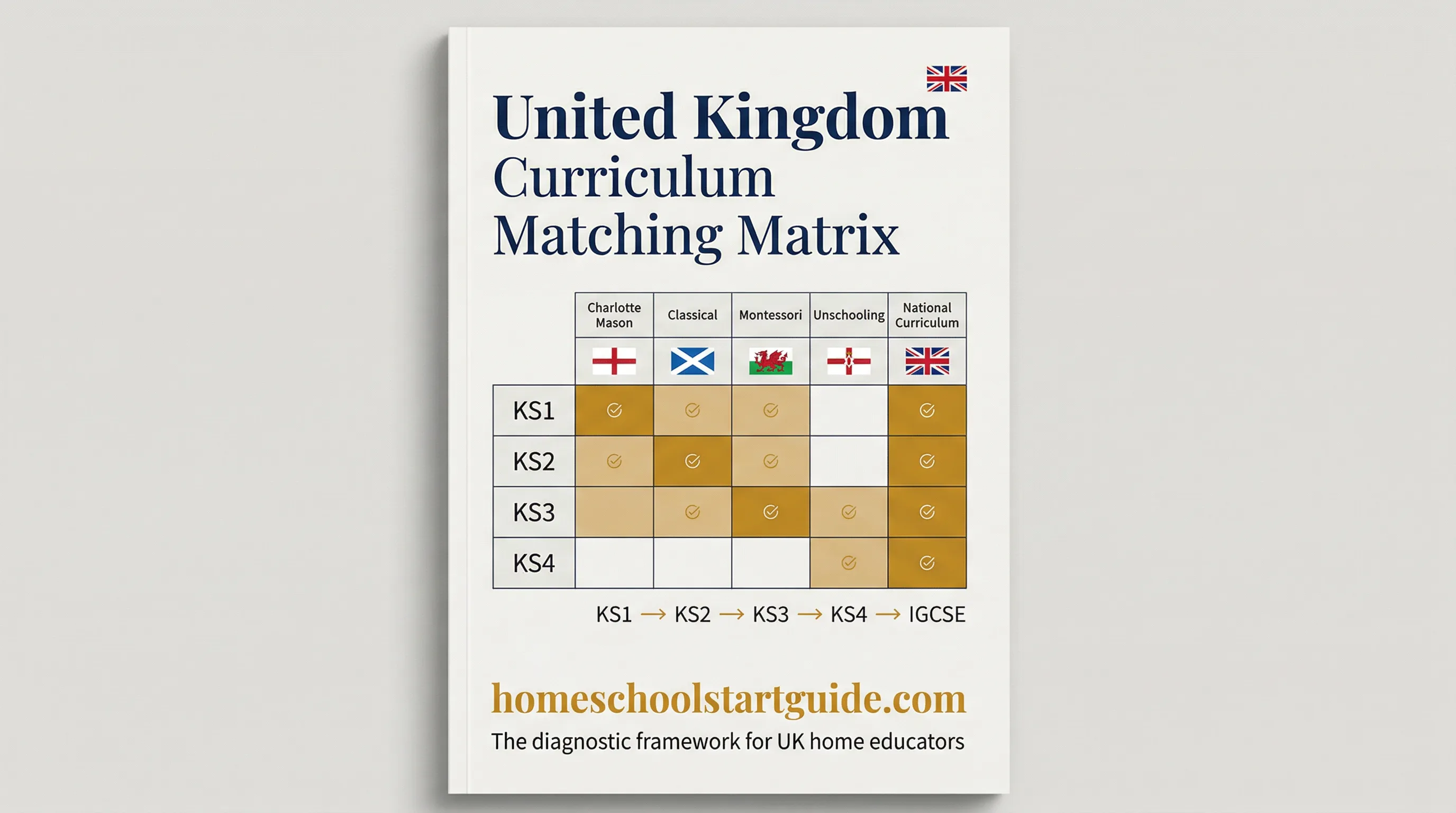
The problem isn't that you don't know enough. The problem is that every resource you've found works backwards — it describes curricula and leaves you to figure out which one fits. The United Kingdom Curriculum Matching Matrix works the other way round. We call it the Profile-First Filter: instead of listing 20+ approaches and hoping you'll spot the right one, it starts with your child's sensory profile, structure tolerance, legal position, budget, and qualification pathway — then eliminates everything that doesn't fit. You end up with two or three options that actually work for your family, within the UK legal framework, across all four nations, from Early Years through IGCSE.
What's Inside the Matrix
The Sensory and Cognitive Diagnostic — because choosing a curriculum based on a Facebook recommendation rather than your child's actual learning profile is how families waste £200 on materials that end up in a cupboard.
A self-assessment that identifies your child's dominant learning profile across two axes: sensory input preference (kinesthetic, visual, auditory, reading/writing) and structure tolerance (from high-structure Classical to low-structure Autonomous Learning). The result filters the entire curriculum matrix to your shortlist. This is the element every competing guide lacks — they describe curricula, but they never tell you which one fits your specific child.
The Four-Nation Legislative Map — because England, Wales, Scotland, and Northern Ireland have different legal requirements for home education, and most curriculum guides treat the UK as a single country.
England requires no permission for deregistration from state school — but parents must know how to respond to Local Authority contact and what "suitable education" means legally. Scotland requires formal LA consent if withdrawing from a state school. Wales is implementing the Curriculum for Wales framework with distinct learning areas. Northern Ireland requires Education Authority notification. The matrix covers all four nations' legal realities, including what to expect from EHE officers and how devolved curriculum frameworks affect your approach choices — something no US-built guide can offer and no UK competitor has consolidated in one place.
The Curriculum Comparison Grid — because reading twelve separate blog posts about twelve separate curricula still doesn't tell you how they compare on the variables that actually matter to your family.
Side-by-side comparison of 20+ curriculum approaches rated across: structure level, UK availability and cost in GBP, secular or faith-integrated worldview (on a four-point spectrum, not a binary toggle), SEN compatibility, recommended Key Stage range, parental preparation time, and typical annual cost. Approaches covered include Charlotte Mason, Classical/Trivium, Montessori, Unschooling/Autonomous Learning, the National Curriculum framework, Structured Eclectic, project-based learning, and hybrid online/offline models including UK-based online academies. No affiliate relationships — no curriculum is rated more favourably because it pays a commission.
The UK Qualification Pipeline Map — because "will they still be able to take GCSEs?" is the question that keeps home-educating parents awake at night.
A visual roadmap showing exactly how each curriculum approach in the primary and early secondary years connects to formal UK qualifications — IGCSE via Cambridge International or Pearson Edexcel as a private candidate, A-Levels, BTECs, T-Levels, and Access to HE routes. It shows precisely which early-years methodology choices support or complicate later qualification pathways, so you can choose your child's primary curriculum with confidence about where it leads.
The SEN and Neurodivergent Flags — because the fastest-growing group entering UK home education is parents who pulled their child after the school's SEN provision failed, and the last thing they need is another system that assumes a neurotypical learner.
Every curriculum approach is assessed for compatibility with ADHD (high movement need, low sustained focus), Autism Spectrum (routine, predictability, sensory regulation), Pathological Demand Avoidance (low-demand, child-led, no imposed schedules), and dyslexia (phonics approach quality, audiovisual alternatives to print). This is built as a primary filter, not a token sidebar.
The Worldview Spectrum Rating — because buying a "neutral" curriculum and discovering it embeds a theological worldview three weeks in is a particular kind of frustrating.
Every approach placed on a four-point spectrum: Scripture-integrated (faith is the organising principle), Christian worldview (faith-aligned but academically broad), Faith-neutral (no religious content, no anti-religious stance), and Strictly secular (explicitly non-religious, critical thinking framework). The matrix gives you a precise classification so you're not buying a curriculum that turns out to embed assumptions you didn't sign up for.
The Budget Reality Checker — because "affordable" means something very different when a curriculum publisher's affiliate partners are the ones writing the reviews.
Realistic annual cost range in GBP for every approach, distinguishing between programmes that require purchasing boxed materials, subscription platforms (with current UK pricing), library-led approaches that cost almost nothing, and hybrid models using a combination of free and paid resources. No affiliate relationships distorting the numbers.
The Decision Flowchart — because you've already opened 47 browser tabs and you still don't know where to start.
A visual step-by-step diagnostic: answer eight questions about your child's profile, your family's constraints, your nation's legal context, and your qualification goals — and the flowchart eliminates approaches that won't work before you spend a penny on materials. Twenty minutes from "I have no idea" to "here are my top three."
Who This Matrix Is For
- Parents in England who have deregistered or are about to, and need to respond to Local Authority contact from knowledge rather than anxiety
- Parents in Scotland navigating the formal Local Authority consent process and needing to demonstrate what "suitable education" looks like under Scots law
- Parents in Wales mapping their approach to the Curriculum for Wales framework's Areas of Learning and Experience
- Parents in Northern Ireland understanding Education Authority notification requirements and choosing an approach that will satisfy EHE reviews
- Families withdrawing a child at Key Stage 2 or 3 due to school anxiety, mental health crisis, or SENCO failure, who need a structured plan quickly rather than six months of trial and error
- Parents of neurodivergent children — ADHD, Autism, PDA, dyslexia — who need to filter for sensory compatibility and structure tolerance before they buy anything
- Families in the Early Years making a proactive choice to home educate from the start and wanting a solid pedagogical foundation from day one
- Christian families who need faith-integrated options rated clearly, and secular families tired of buying "neutral" resources that embed religious assumptions
- Parents who have already wasted money on an incompatible curriculum and need a systematic framework before they spend again
After Using the Matrix, You'll Be Able To
- Narrow 20+ curriculum approaches to your top two or three in under an hour — using a structured diagnostic built for UK families, not American states
- Know exactly what your legal rights and obligations are in your nation of the UK, so when your Local Authority sends a letter, you respond with confidence rather than panic
- Understand precisely how your chosen approach connects to IGCSEs, A-Levels, or alternative qualifications — so you can commit to a primary years philosophy without fearing it closes doors
- Confirm a curriculum aligns with your child's sensory and cognitive profile before you spend £200 on materials that end up in a cupboard
- Set a realistic annual budget in GBP — not USD — and know which approaches cost under £50 a month and which require substantial upfront investment
- Give your child's learning style a professional pedagogical framework — so when extended family or a Local Authority officer asks, you have a structured, evidence-backed answer
- Stop the buy-try-reject cycle that costs UK home educators hundreds of pounds per year on materials that didn't fit the child who was supposed to use them
Why Not Just Use the Free Resources?
You can. But here's what "free" actually costs:
- GOV.UK tells you what the law requires — not what to actually do. The official guidance confirms you must provide a "suitable, efficient, full-time education." It does not define suitable, does not compare any curriculum approaches, and does not tell you how to structure a day, a week, or a year.
- Facebook groups give you 60 answers, none of which apply to your child. Every family recommending Charlotte Mason has a different child with different sensory needs, a different budget, and a different relationship with their Local Authority. The recommendations aren't wrong — they just aren't calibrated to your child, your nation's legal framework, or your qualification goals.
- UK blogs are excellent on philosophy and terrible on comparison. You can read a brilliant post about Charlotte Mason on one tab and an equally compelling case for Classical education on another. Neither will tell you which one fits a kinaesthetic, PDA-profile nine-year-old in Scotland who needs to sit IGCSEs in four years.
- American guides are built for American families. They compare against US state standards, price in USD, and use terms — Middle School, AP courses, High School Diploma — that have no equivalent in the UK system. They don't address IGCSEs, the Curriculum for Wales, or what "deregistration" means.
- Etsy planners shift the research burden back to you. A "curriculum comparison chart" at the £3–£6 price tier is almost always a blank table with column headers. You fill in the data yourself — which means you still need 40 hours of research to populate it. You're paying for a spreadsheet template, not an analysis.
- Subscription platforms help you execute, not choose. EdPlace, Twinkl, and IXL are excellent at delivering daily lessons — but they don't help you decide whether you should be using the National Curriculum in the first place, or whether Charlotte Mason, a Classical approach, or autonomous learning would suit your child better. They're Step 2. The matrix is Step 1.
Free resources tell you what curricula exist. The Profile-First Filter tells you which one fits your child — in your nation, within your budget, on the path to the qualifications they'll need.
— Less Than One Incompatible Curriculum Box
A single incompatible curriculum package costs £150–£500 in the UK. A private educational consultant charges £80–£160 per hour to give you exactly the kind of personalised diagnostic that this matrix delivers in a single sitting. The average family that tries one curriculum before settling on a second spends £300–£600 more than they needed to — not because they made a bad decision, but because no structured matching tool existed to prevent the mismatch before they bought.
The matrix includes everything in one download: the main curriculum comparison guide, the diagnostic assessment, the four-nation legislative map, the qualification pipeline visual, the budget reality checker, and the decision flowchart. Instant download, no account required.
Money-back guarantee, no time limit. If the matrix doesn't give you a clear shortlist, email us and we'll refund you. No questions asked.
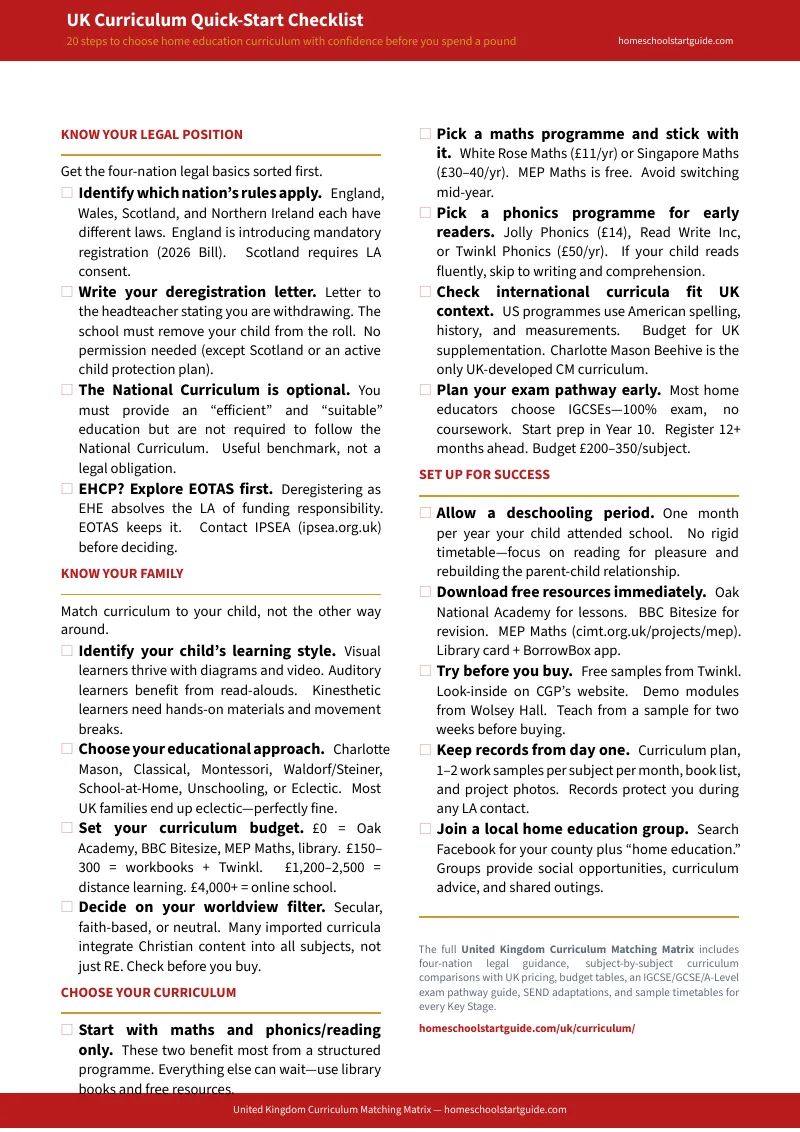
Not ready for the full matrix? Download the free UK Curriculum Matching Quick-Start Checklist — a one-page decision framework with the ten questions to ask about any curriculum before you commit, plus a brief overview of the five most popular approaches used by UK home educators. It's enough to avoid the most expensive first mistakes, and it costs nothing.
Your child doesn't need the most popular curriculum in the world. They need the one that fits how their brain works, what your family can sustain, and where you live in the UK. The Profile-First Filter finds it — so you can stop researching and start teaching.
Frequently Asked Questions
What if the rules change after I buy?
We update the guide when the rules change. Email us any time, even years later, and we'll send you the current edition free.