Your Child Is Homeschooled. Will a South African University Accept Them?
You chose to homeschool on your own terms. But now the university question looms: Will UCT accept Cambridge AS-Levels from a homeschooler? Does Wits calculate APS the same way as UP? Has the GED path been shut down completely? What on earth is "Senate Discretionary" admission?
Every university has different rules. Every Facebook group gives you a different answer. Every curriculum provider only explains their pathway. And the consequences of getting it wrong are severe: one incorrect subject combination in Grade 10 can close the door to Engineering, Medicine, or Law — permanently. One missed USAf exemption deadline means a gap year your child did not plan for.
The information exists — scattered across 100-page prospectuses, bureaucratic USAf documents, and outdated blog posts from 2019. What has never existed is a Cross-Pathway Decoder: a single, unbiased resource that maps every exam body against every major SA university, translates every exemption rule into plain English, and connects it all into one coherent system. Until now.
What's Inside the Cross-Pathway Decoder
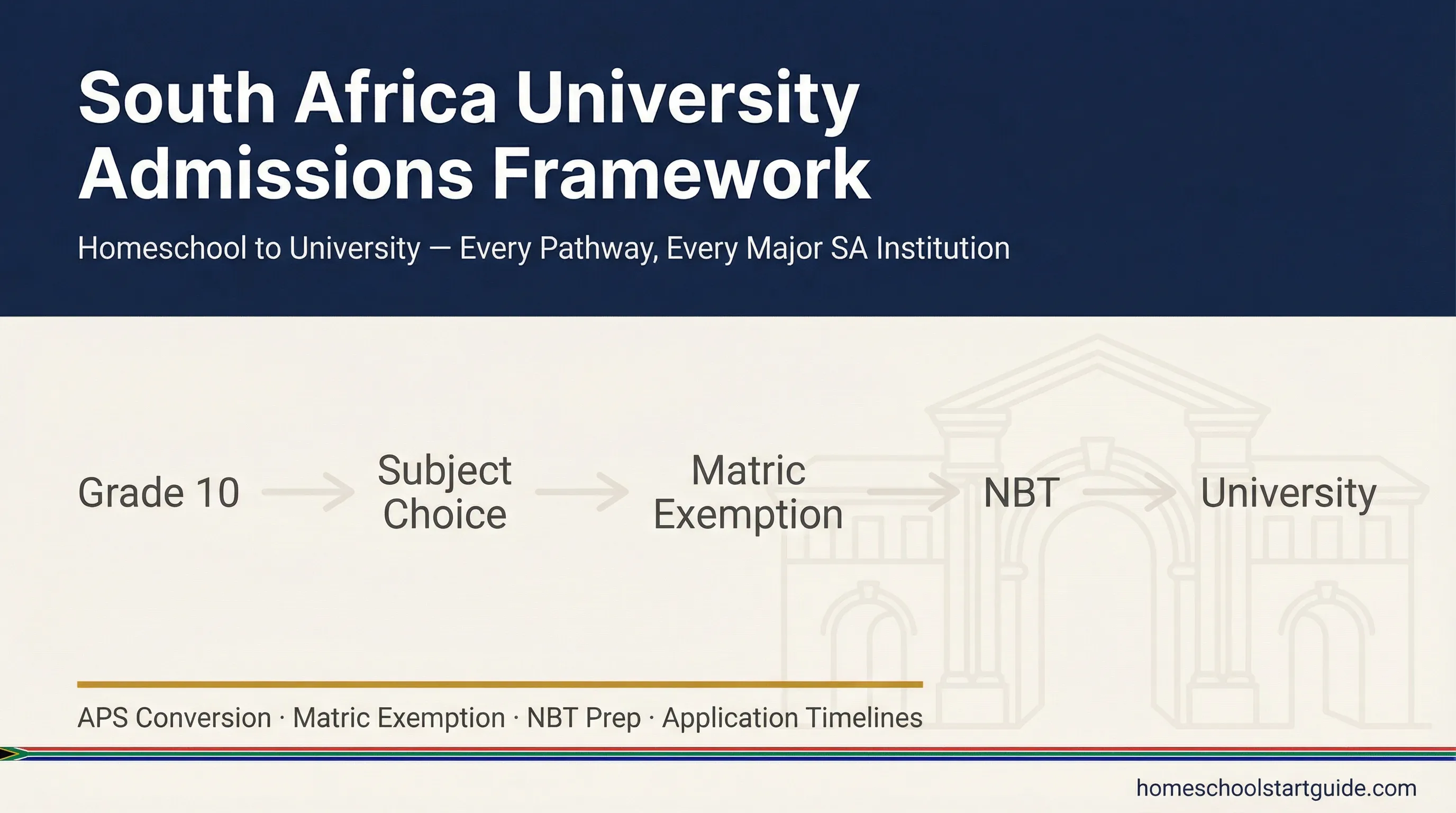
The Framework is a complete admissions roadmap: a main guide plus standalone tools, designed to take you from anxious to informed in one evening.
The Main Guide
- Cross-pathway university comparison — because Impaq only knows SACAI, CambriLearn only knows Cambridge, and neither will tell you when the other pathway is the better fit. The actual admission policies for Cambridge AS/A-Levels, IEB, SACAI, GED, and AHSD at UCT, Wits, UP, Stellenbosch, UJ, and UKZN — decoded into plain English, not marketing claims
- APS conversion tables by university — because UCT doubles Maths and Science, Wits does not, and UP's Cambridge conversion table differs from Stellenbosch's. Eyeballing it across five prospectuses is how families discover too late that their child's APS is ten points lower than they assumed. Side-by-side tables for every major university
- The GED reality check — because USAf quietly stopped granting Foreign Conditional Exemption to SA-based GED holders, and families who discover this in Grade 12 face an extra year and tens of thousands of rands before they can even apply for a degree. The only remaining viable path mapped out: GED → NQF 5 Higher Certificate → degree
- Matric exemption explained — because the R1,000+ USAf application fee is non-refundable, and applying under the wrong exemption category means losing it. The M30 process, the four categories, and the documents you need — in plain English, not Government Gazette
- NBT preparation guide for homeschoolers — because there is no school to organise this for you, and a missed Health Sciences deadline at UCT (31 July) ends the application regardless of APS. How to book, where to write, and how NBTs affect the Faculty Points Score at competitive faculties
- Senate Discretionary admission — because most parents have never heard of the route that lets universities admit students who don't fit the standard exemption categories. If your child's pathway is non-standard, this may be the way in — who qualifies and how to approach the admissions office
- Financial aid for homeschoolers — because the NSFAS form asks for "School Name" and homeschoolers have no standard report card. Documentation workarounds, affidavit requirements, and university-specific bursary pathways open to homeschooled applicants
- Application timeline — because UP opens in April, competitive programmes at UCT and Wits close in July, and USAf exemption cutoffs slip past families who only check in Grade 12. All deadlines on a single timeline so nothing falls through
Worksheets and Decision Tools
- APS Calculator Worksheet — enter your child's subjects and grades (NSC, Cambridge, or IEB) and calculate the APS score for each target university. No more manual cross-referencing across five different conversion tables
- University Shortlist Planner — a structured framework for narrowing from "everywhere" to 3-4 realistic targets based on programme, language of instruction, location, and admission competitiveness. Cuts through the information overload that paralyses most families at the start
- Application Document Checklist — every document you need for the USAf exemption application, university applications, NBT registration, and NSFAS. One missing document means a rejected application — tick them off as you gather them
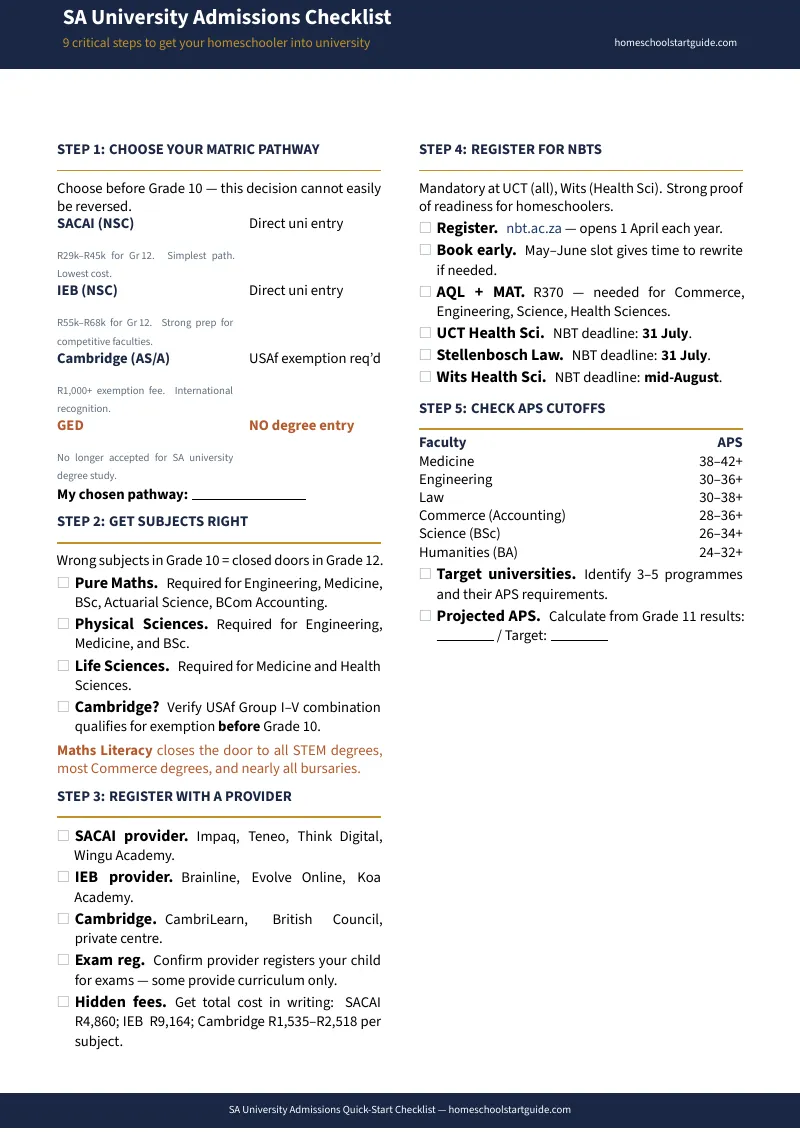
- Quick-Start Checklist — the essential steps for homeschoolers beginning to plan university admission, in the correct sequence
Who This Is For
- Parents of homeschooled children in Grades 8-12 who need to understand university admission before subject choices lock them in
- Parents using Cambridge, IEB, SACAI, GED, or any other pathway who need to know exactly how SA universities treat their child's qualification
- Parents who have called university admissions offices and received generic answers that do not address the homeschool situation
- Parents who have been told "just do a GED, it's easy" and need to understand why that advice is now dangerously outdated
- Afrikaans-speaking families targeting Stellenbosch, NWU, or UFS who need to navigate language policy alongside admission rules
- Parents of Grade 9 learners at the subject-choice crossroads — the single decision that has the largest impact on university options
After Reading This, You Will Be Able To:
- Calculate your child's APS score accurately — for their specific curriculum, at their specific target university, accounting for the weighting rules that differ between institutions
- Choose subjects strategically — knowing which combinations keep the most university doors open and which close them permanently
- Apply for matric exemption correctly — with the right documents, the right exemption category, and the confidence that you will not waste the R1,000+ non-refundable USAf fee
- Prepare for NBTs without a school — knowing when to book, where to write, and how the results affect admission to competitive faculties
- Meet every deadline — university applications, USAf exemption windows, NBT registration, and financial aid submissions are all mapped on a single timeline
- Stop relying on Facebook advice — because policies change every year, and an anecdote from 2019 is not a strategy for 2026
Why Not Just Google It?
You can. Here's what you'll find:
- The USAf website publishes exemption regulations in language like "Foreign Conditional Exemption" and "Regulation 28." It lists the rules but never tells you which subject combination is safest for your child's target faculty. You can read it three times and still not know whether your child qualifies for a Complete Exemption or only a Conditional one.
- University prospectuses each use a different scoring system. UCT's Faculty Points Score. Wits' APS with bonus points. Stellenbosch's percentage conversion. UP's separate Cambridge table. Comparing your child's chances across four universities means downloading four PDFs and reconciling four incompatible systems.
- Facebook groups have thousands of posts — including "just do the GED, it's easy" from 2020, sitting next to current advice with no way to tell them apart. USAf changed the GED exemption rules in 2019. Families who follow expired advice discover this in Grade 12.
- Curriculum provider blogs explain "BELA Act impact" and "Cambridge vs CAPS" — but they are also sales pages. Impaq will never tell you when Cambridge is cheaper. CambriLearn will never tell you when SACAI is equally accepted. No provider has an incentive to compare their pathway honestly against a competitor's.
The Cross-Pathway Decoder connects what these sources leave disconnected. Your child's exam body → subject combination → exemption application → APS at each target university — one coherent system instead of fifty tabs and a prayer.
A private homeschool consultant charges R500–R2,250 per session and only knows the pathways they've personally guided students through. The framework covers more universities, costs a fraction of one session, and you can reference it for every child, every application cycle.
Updated for 2026
USAf exemption rules, BELA Act changes, GED pathway closures, and university-specific policy updates from the current admissions cycle. Printed books on Takealot and undated blog posts do not reflect these changes. We do.
What You Get
- Main guide PDF — the Cross-Pathway Decoder covering all pathways, all major SA universities, APS conversions, matric exemption, NBT prep, financial aid, and application deadlines
- APS Calculator Worksheet PDF — fillable worksheet for calculating your child's APS across different universities
- University Shortlist Planner PDF — structured decision framework for narrowing target universities
- Application Document Checklist PDF — every document for USAf exemption, university applications, NBT registration, and NSFAS
- Quick-Start Checklist PDF — essential first steps for homeschoolers planning university admission
All files are instant PDF downloads. No subscription, no upsell, no provider affiliation. — less than the R1,000 USAf exemption fee you will pay regardless, less than one hour of consultant time, and the only thing standing between you and a clear, confident university admissions strategy for your homeschooled child.
Frequently Asked Questions
What if the rules change after I buy?
We update the guide when the rules change. Email us any time, even years later, and we'll send you the current edition free.