Your Child Is Homeschooled. Will a Canadian University Accept Them?
You chose to homeschool on your own terms. But now the university question looms: What does "Group B" mean on the OUAC application? Will UBC accept a parent-created transcript? Does McGill still want SAT scores from homeschoolers? What exactly is a "course description" supposed to look like — and will admissions officers take one seriously if a parent wrote it?
Every university has different rules. Every province has a different application portal. Every Facebook group gives you a different answer. And the stakes are brutal: one missing prerequisite discovered in Grade 12 means a gap year your child did not plan for. One poorly formatted transcript means your child's years of rigorous homeschool work gets dismissed as "mommy grades."
The information exists — scattered across 50-page prospectuses, cryptic OUAC documentation, and forum posts from 2019 that still reference the retired "105 application." What's never existed is an Admissions Decoder — a resource that doesn't just list what universities want, but shows you exactly how to create every document they're asking for. Every province, every portal, every template. Until now.
What's Inside the Canada University Admissions Framework
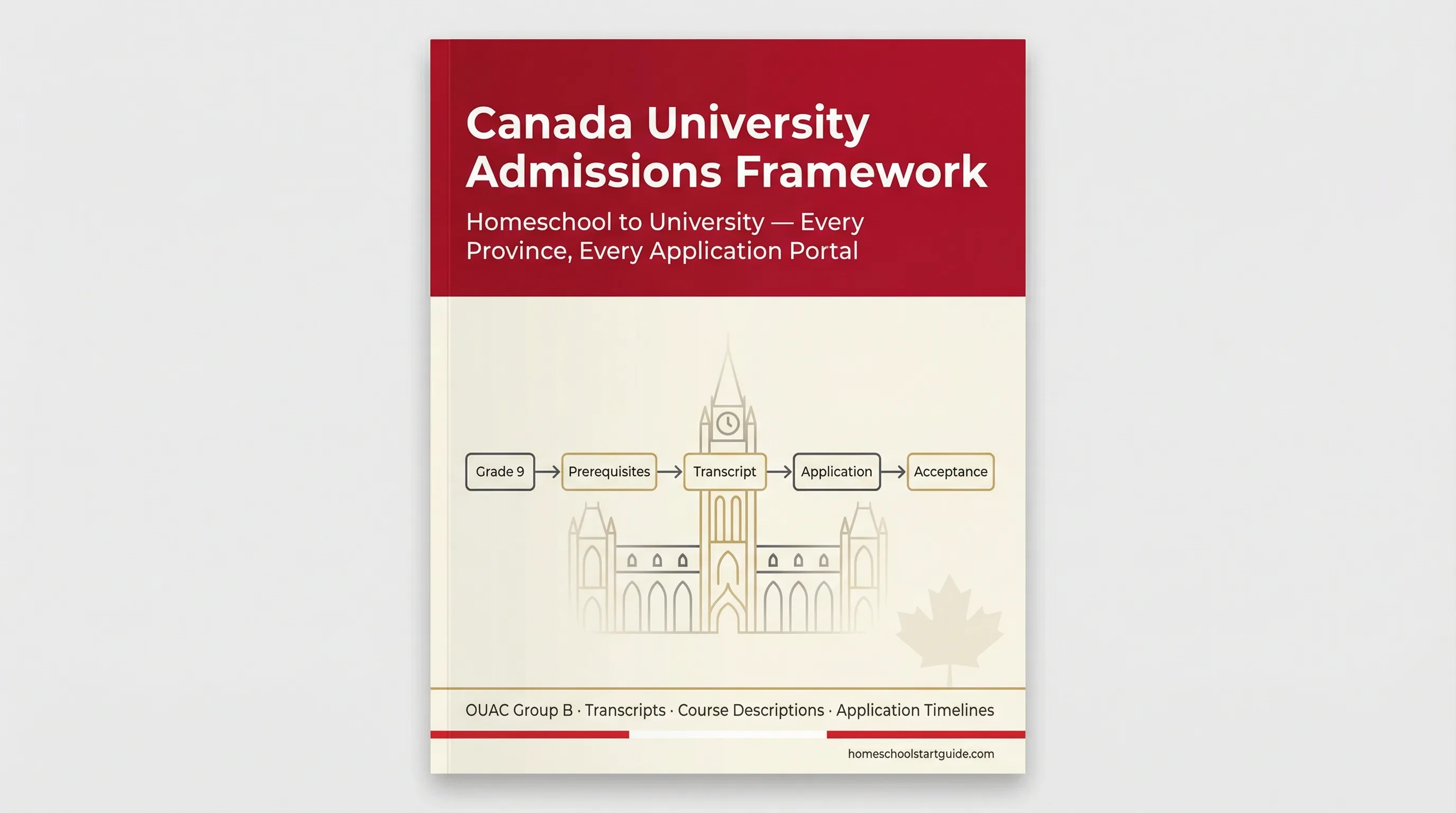
The Admissions Decoder is a main guide plus standalone tools, designed to take you from anxious to informed in one evening. It works because it connects every piece — your transcript feeds into your course descriptions, which feed into your portfolio, which feed into your OUAC or ApplyAlberta submission — instead of leaving you to assemble fragments from 50 different sources.
The Main Guide
- The OUAC "Group B" walkthrough — Ontario retired the "105 application" and replaced it with Group A and Group B. Homeschoolers in Ontario are Group B, alongside out-of-province and international applicants. Almost every existing homeschool resource still references "OUAC 105." This guide walks you through the current Group B workflow step by step, so you are not guessing at an unfamiliar portal with your child's future on the line
- Province-by-province application portal guide — OUAC for Ontario, ApplyAlberta for Alberta, EducationPlannerBC for British Columbia, plus Atlantic and Prairie province procedures. Each portal has different requirements, different timelines, and different ways of handling homeschool applicants. The guide maps them all
- University-specific requirements decoded — how U of T, UBC, McGill, Waterloo, Dalhousie, U of A, and other major institutions treat homeschool applicants. The actual published admission policies, translated into plain English — because "evaluated on an individual basis" at UBC means something fundamentally different from "minimum 1200 SAT" at McMaster, and the difference determines whether your child needs months of test prep or a strong portfolio
- Course description swipe file — five complete, university-ready course description examples (English Literature, Biology, Canadian History, Mathematics, and a self-directed project) that translate "we read books on the couch" into "English Literature 12: Analytical study of classical and contemporary texts with emphasis on critical essay writing." Adapt them to your child's actual coursework — no more staring at a blank page wondering what admissions officers expect
- The "Hybrid Transcript" strategy — many homeschooled students take 80% of courses at home and 20% through an online provider like Ontario eSecondary, TVO ILC, or Virtual High School. The guide shows you exactly how to merge a parent-issued transcript with an accredited transcript into one cohesive application package — because mixing two transcript formats without a clear GPA presentation creates the exact credibility questions that stall your child's file in an admissions sub-committee
- Transcript formatting guide — the exact layout, column structure, and language conventions that make a parent-created transcript look professional to admissions officers. Not a blank template — a guide that explains what to write in each field and why, so your transcript signals competence instead of raising red flags
- The "No Diploma" pathway — thousands of homeschoolers enter Canadian universities annually without a provincial diploma (OSSD, Dogwood, Alberta Diploma). The guide maps the Portfolio, Mature Student, and Transfer pathways that bypass the diploma requirement, province by province — because the most expensive mistake in homeschool admissions is paying $4,000+ for accredited online credits your child may not need
- Financial aid for homeschoolers — OSAP, provincial student loans, and university-specific scholarship documentation when you cannot produce a standard school transcript. The paperwork is different for homeschoolers, and a missing verification document means delayed funding when tuition deposits are already due
- Grade 9-10 prerequisite planning — the specific Grade 12 courses required for Engineering, Nursing, Business, and Computer Science at Canada's top universities. If you do not track prerequisites starting in Grade 9, your child may hit the "prerequisite wall" in Grade 12 — and discover they are missing Physics or Chemistry for their dream programme
Worksheets and Decision Tools
- Transcript Template — a professionally formatted, editable transcript that follows the standard academic layout admissions officers expect. Includes the column structure, GPA calculation method, and course numbering conventions used by Canadian universities
- University Shortlist Planner — a structured framework for narrowing from "everywhere" to 3-4 realistic target universities based on programme, province, admission competitiveness, and homeschool-friendliness
- Application Document Checklist — every document you need for OUAC/ApplyAlberta/EPBC applications, supplementary applications, and financial aid. Tick them off as you gather them — no scrambling the week before the deadline
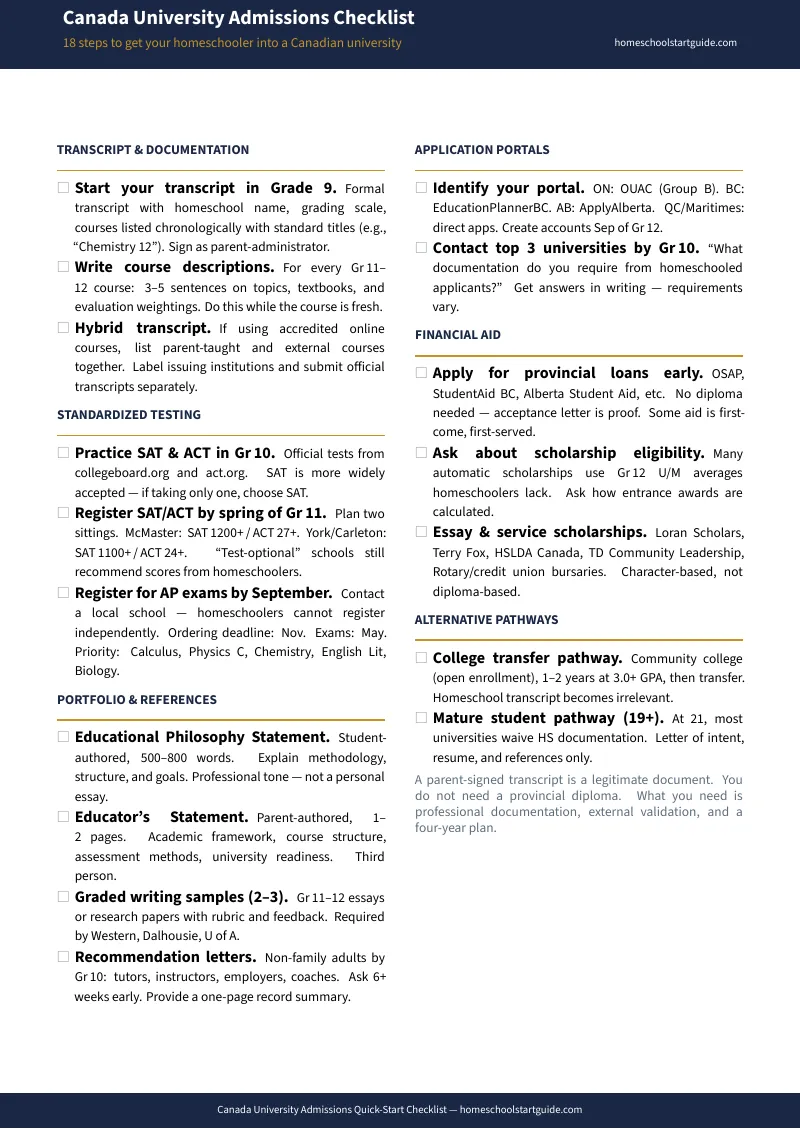
- Quick-Start Checklist — the essential steps for homeschoolers beginning to plan university admission, in the correct sequence
Who This Is For
- Parents of homeschooled children in Grades 9-12 who need to understand university admission before prerequisite choices lock them out of programmes
- Ontario parents navigating the OUAC "Group B" application for the first time — especially those who have been searching for "OUAC 105" information and finding only outdated resources
- Parents in BC, Alberta, or Atlantic Canada who need province-specific portal guidance, not generic "how to apply to university" advice
- Parents who follow a structured curriculum, Charlotte Mason, classical, or eclectic approach and need to translate that work into the formal language universities expect
- Parents considering paying $500 per credit at an online school "just to be safe" and want to understand whether they can present their existing homeschool work instead
- Parents who have called university admissions offices and received generic answers that do not address the homeschool situation
- Parents of Grade 9 students at the prerequisite crossroads — the planning decisions made now have the largest impact on which university doors remain open in Grade 12
After Reading This, You Will Be Able To:
- Create a professional transcript with credible course descriptions — with the correct format, GPA calculation, and outcome-based language that admissions officers recognise as rigorous, not "mommy grades"
- Navigate any province's application portal confidently — whether it is OUAC Group B in Ontario, ApplyAlberta, or EducationPlannerBC, including hybrid transcript merging for applications that combine parent-taught and online courses
- Plan prerequisites from Grade 9 — knowing exactly which Grade 12 courses keep the most university doors open and which combinations close them permanently
- Stop relying on outdated advice — OUAC changed its entire system, several universities updated their homeschool policies, and an anecdote from 2021 is not a strategy for 2026
Why Not Just Use Free Resources?
You could try. Here is what you will find:
- University admissions pages tell you what they need — "course outlines, textbooks used, method of evaluation" — but never show you what a finished course description actually looks like. You get the requirements list without a single example of what meets the standard
- HSLDA Canada covers your legal rights and lists "homeschool-friendly" institutions, but does not walk you through the OUAC Group B workflow or explain how to format a hybrid transcript
- Provincial support groups (OFTP, BCHEA) maintain helpful university lists — but many links still reference the retired "OUAC 105" system and have not been updated for the current Group A/B structure
- Etsy transcript templates ($3–$13) give you a professional-looking shell. They do not tell you what to write in the course description field, how to assign credit values without following a provincial curriculum, or how to present a GPA that McGill will accept without follow-up questions
- Reddit and Facebook groups give you anecdotes — "my daughter got into UBC in 2021." But OUAC has changed its system since then, several universities updated their SAT policies, and one family's experience in BC does not tell you what Ontario requires
"University websites tell you what they need. They never tell you how to create it." — The gap every homeschool parent discovers too late
An independent education consultant charges $150–$300 per hour. The most popular book on homeschooling to university is philosophical — it validates the choice to homeschool but will not tell you how to fill out the OUAC Group B form or what to write in a course description field. The Admissions Decoder gives you both the strategy and the execution tools — and you can read it tonight.
Updated for the 2025–2026 Application Cycle
Current OUAC Group A/B structure, university-specific homeschool policy changes, and SAT/ACT requirements as of this admissions cycle. Older resources — including popular books and undated forum posts — do not reflect these changes.
What You Get
- Main guide PDF — complete university admissions roadmap covering OUAC Group B, province-by-province portals, university-specific requirements, course description swipe file, transcript formatting, hybrid transcript strategy, the no-diploma pathway, financial aid, and prerequisite planning
- Transcript Template PDF — professionally formatted, editable transcript with the column structure and GPA conventions Canadian universities expect
- University Shortlist Planner PDF — structured decision framework for narrowing target universities
- Application Document Checklist PDF — every document for university applications, supplementary applications, and financial aid in one tick-off checklist
- Quick-Start Checklist PDF — essential first steps for homeschoolers planning university admission
All files are instant PDF downloads. No subscription, no upsell, no provider affiliation. — less than a single online school credit, less than one hour of consultant time, and the only Admissions Decoder that bridges the gap between "university websites say what they need" and "here is exactly how to create it."
Frequently Asked Questions
What if the rules change after I buy?
We update the guide when the rules change. Email us any time, even years later, and we'll send you the current edition free.