Your Child Aces Every Assessment. But Do They Have Mates?
Your home educated child is thriving academically. They read voraciously, explain concepts with a clarity that impresses adults, and the registration officer nodded approvingly at their work samples. Grandma says they're "so articulate." The co-op parents comment on how well they participate.
But at Saturday footy, they hang back. At the park, they gravitate toward you instead of the other kids. At the home ed group, they're friendly enough — but nobody calls during the week. And when your mother-in-law asks "but what about socialisation?" for the hundredth time, you have the studies memorised. But you don't have an answer for the quiet voice in your own head that wonders whether your child is building real, lasting friendships — or just performing well in adult-supervised settings where the rules are explicit.
And then there's the infrastructure side. Your 10-year-old wants to play Auskick, but you're not sure how home educated children register for community sport. You've heard about Active Kids vouchers but the application process for non-school families isn't clear. Your NESA registration is due and you need to demonstrate socialization and community engagement — but you're not sure how to map swimming squad and Scouts to the Australian Curriculum learning areas. You've been scrolling Facebook groups for weeks and found plenty of opinions but no actual system.
You don't need another blog post telling you socialization is a myth. You need an Australian-specific blueprint that handles both sides — the social skills your child needs to develop and the practical infrastructure of sports access, subsidies, co-ops, and registration compliance that makes it all work.
What's Inside the Playbook
The Community Sports Integration System
A complete walkthrough of how home educated children access community sport in Australia — not through school, but through local clubs that register by address, not enrolment. Covers AFL (Auskick from age 5), soccer (MiniRoos), netball (NetSetGO), cricket (Woolworths Cricket Blast), Little Athletics, swimming squads, Nippers, and surf lifesaving. Each sport includes registration pathways, typical costs, season timing mapped to school terms, and how to frame the activity for your state registration assessment.
The Registration Translation Matrix
The asset that practically does your NESA, VRQA, or HEU registration paperwork for you. A plug-and-play matrix that maps every extracurricular activity to Australian Curriculum learning areas — AFL and swimming to Health and Physical Education, Scouts to HPE plus Humanities and Social Sciences, art class to The Arts, library programmes to English. Present this to your Authorised Person and watch the socialization section of your assessment become the easiest part of the interview.
The Government Subsidies Guide
NSW Active Kids ($100) and Creative Kids ($100) vouchers. QLD FairPlay (up to $150). SA Sports Vouchers ($100). The Playbook walks through the exact application process for each state subsidy as a registered home educator — including which provider systems accept the vouchers and how to apply before popular programmes are exhausted. These subsidies can offset the cost of the Playbook several times over.
The Social Skills Diagnostic
Not an etiquette checklist — a developmental framework for distinguishing between healthy introversion and genuine social gaps. Mapped to Australian school years from Foundation through Year 12. Covers the specific blind spots that show up in home educated children: difficulty reading unspoken group dynamics, "autopilot" social processing where every interaction feels effortful, and the gap between performing well with adults and navigating the unstructured chaos of peer groups. Includes target interaction frequencies by age and red flags to watch for.
Scouts, Guides, Cadets, and Youth Organisations
Scouts Australia (co-ed, ages 5–25), Girl Guides Australia (ages 5–17), and Australian Cadets (Air Force, Army, Naval — ages 13–18, completely free). The Cadets section alone could justify the Playbook: free uniforms, free equipment, free training, structured leadership development, and a community that actively welcomes home educated teenagers. Plus Duke of Edinburgh's International Award pathways through Open Award Centres — the gold standard for university applications.
The Co-op Finder & Starter Guide
How to find home education co-ops and groups in your area using Facebook search conventions, state association directories, and library notice boards. How to evaluate a group before committing — ethos, structure, insurance coverage, parent expectations. And if nothing suitable exists nearby, a step-by-step guide to starting your own: HEA public liability insurance ($20M coverage for member events), venue booking, activity planning, and the leadership rotation models that prevent burnout.
The "Socialization Conversation" Scripts
Word-for-word scripts for every version of the question. The grandmother who worries at Christmas dinner. The GP who raises it at a check-up. The neighbour who comments when your child is home on a Tuesday. The registration officer who probes your socialization provision. Each script is calibrated for Australian cultural norms — confident without being preachy, specific without being defensive, warm without being apologetic.
Who This Playbook Is For
- Parents who are confident in their home education academics but privately worry about whether their child is building genuine peer friendships — not just performing well in adult-supervised settings
- Families facing NESA, VRQA, or HEU registration assessments who need to demonstrate socialization and community engagement in their educational programme
- New home educators who left the school system in the past two years and need to rebuild their child's social infrastructure from scratch — especially post-pandemic families who lost community connections during the transition
- Parents who want their child in community sport but don't know how home educated children register for Auskick, Little Athletics, netball, or swimming without a school affiliation
- Families facing the "but what about socialization?" pressure from grandparents, in-laws, and well-meaning relatives who equate school attendance with a social life
- Parents of neurodivergent children (ASD, ADHD, anxiety) who need low-sensory, gradual integration strategies — not generic "just join a co-op" advice
- Rural and regional families who don't have the co-op density of Sydney or Melbourne and need strategies that work with limited local resources
After Using the Playbook, You'll Be Able To
- Register your child for community sport — AFL, netball, cricket, soccer, swimming, Little Athletics — through the correct local club pathway, without needing a school affiliation
- Claim government sports and arts subsidies (Active Kids, Creative Kids, FairPlay, SA Sports Vouchers) as a registered home educator, using the exact application steps for your state
- Present a Registration Translation Matrix to your NESA, VRQA, or HEU assessor that maps every extracurricular activity directly to Australian Curriculum learning areas — turning the socialization section of your assessment from a stress point into a strength
- Distinguish between a child who is introverted (a personality trait that needs respect) and a child who is isolated (a situation that needs intervention) — using age-specific benchmarks mapped to Australian school years
- Answer the socialization question at the next family gathering with specifics, not platitudes — because your child's social calendar, activity portfolio, and community engagement are documented and intentional
- Build an extracurricular portfolio from Year 9 onward that Australian universities recognise — community service, Duke of Edinburgh, Cadets leadership, sustained sport commitments
Why Not Just Piece This Together for Free?
You can try. The information exists — scattered across HEA's directory pages, state association websites that only cover their own jurisdiction, Facebook groups that cycle between inspirational posts and outdated threads, government subsidy portals buried three levels deep in Service NSW or the Queensland Government website, and American homeschool blogs that recommend "4-H clubs" and "Tim Tebow laws" to an audience that has never heard of either.
- Sports registration is straightforward — once you know the system. Community clubs register by address, not school enrolment. But the AFL, netball, and cricket registration portals don't have a "home educated" checkbox. The Playbook tells you exactly what to select, which club finder to use, and how to handle the "which school does your child attend?" question on the form.
- Government subsidies have specific requirements for home educators. The NSW Active Kids voucher requires a valid home education registration certificate. The QLD FairPlay voucher has a different eligibility pathway. Each state's process is different, and the information is buried in government FAQ pages that assume school enrolment. The Playbook consolidates all of it.
- "Socialization is a myth" doesn't help a lonely child. The research is overwhelmingly in your favour. But research averages don't help the parent whose specific child hasn't been invited to a birthday party in six months. The generic advice — "just join a co-op" — doesn't address what to do when the co-op doesn't exist in your area, doesn't suit your family's values, or your child has social anxiety that makes a room full of strangers overwhelming.
- Most homeschool socialization resources are American. They reference "middle school," "sophomore year," "HSLDA membership," and sports access laws that don't exist in Australia. This Playbook is written for Australian school terms, Australian sporting culture, Australian registration authorities, and Australian government subsidies. Every chapter, every script, every resource directory is Australian.
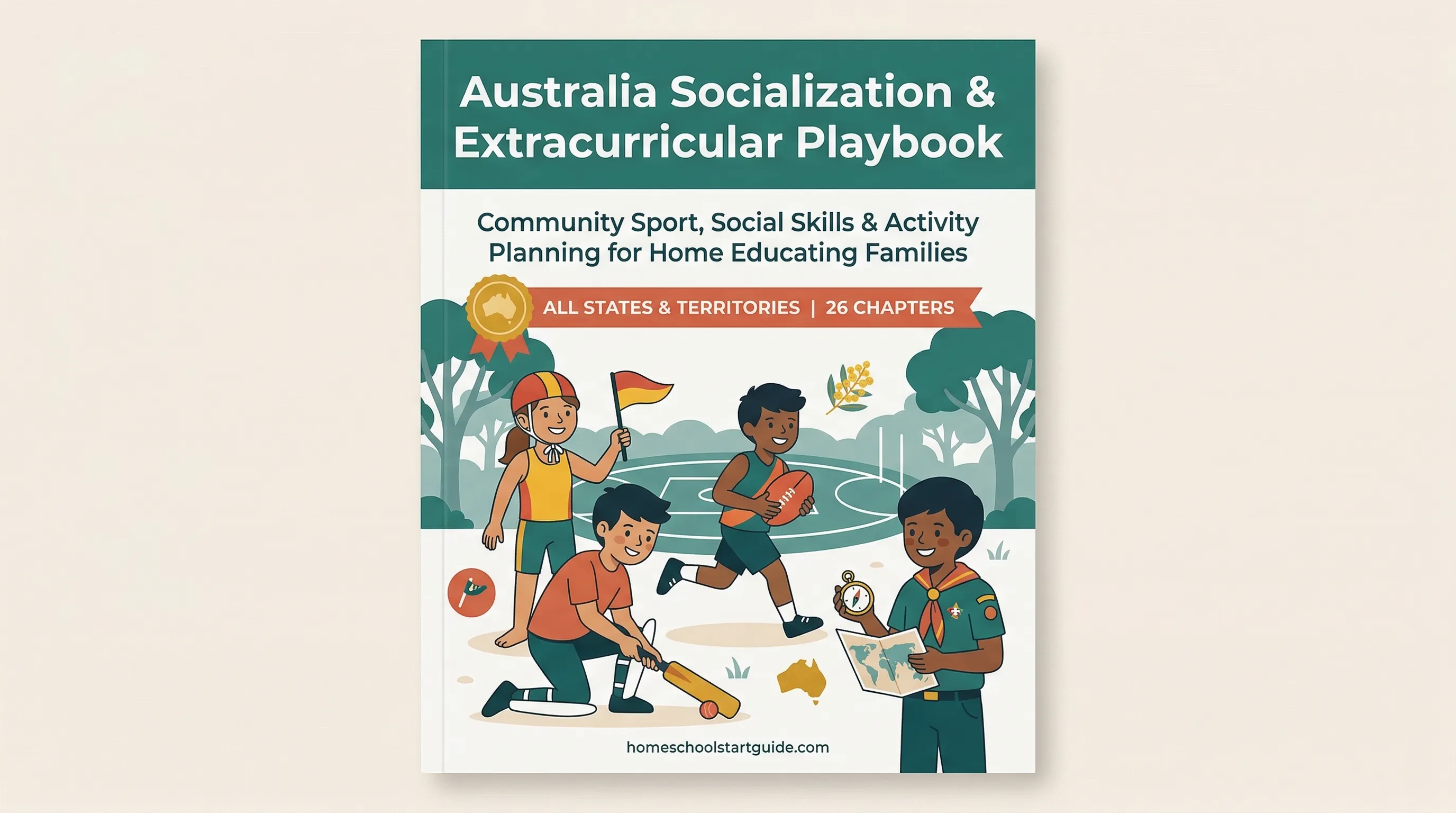
Fearless Homeschool membership costs $37 AUD per month for a comprehensive library. Etsy trackers cost $5–$10 for a beautiful blank grid with zero strategy. This Playbook sits in the gap: a one-off purchase that gives you the complete Australian socialization system — 26 chapters of tactical guidance, activity-to-curriculum mapping, subsidy application walkthroughs, conversation scripts, and a registration-ready documentation framework.
— Less Than One Season of Auskick Fees
A single season of community sport costs $100–$300 in registration, equipment, and transport. A Fearless Homeschool membership runs $37 AUD per month. A single government sports voucher (Active Kids, FairPlay) that you didn't know you were eligible for is worth $100–$150. The subsidy guide alone could pay for the Playbook several times over.
The Playbook includes the full 26-chapter guide, 9 standalone printable tools (Registration Translation Matrix, Conversation Scripts, Activity Directory, Subsidies Guide, Social Skills Framework, Co-Op Toolkit, Planning Calendar, Age-by-Age Roadmap, and University Portfolio Planner), and the Quick-Start Socialization Checklist — 11 PDFs total. Instant download, no account required.
Money-back guarantee, no time limit. If the Playbook doesn't give your family a clearer path to genuine social connection and community engagement, email us and we'll refund you. No questions asked.
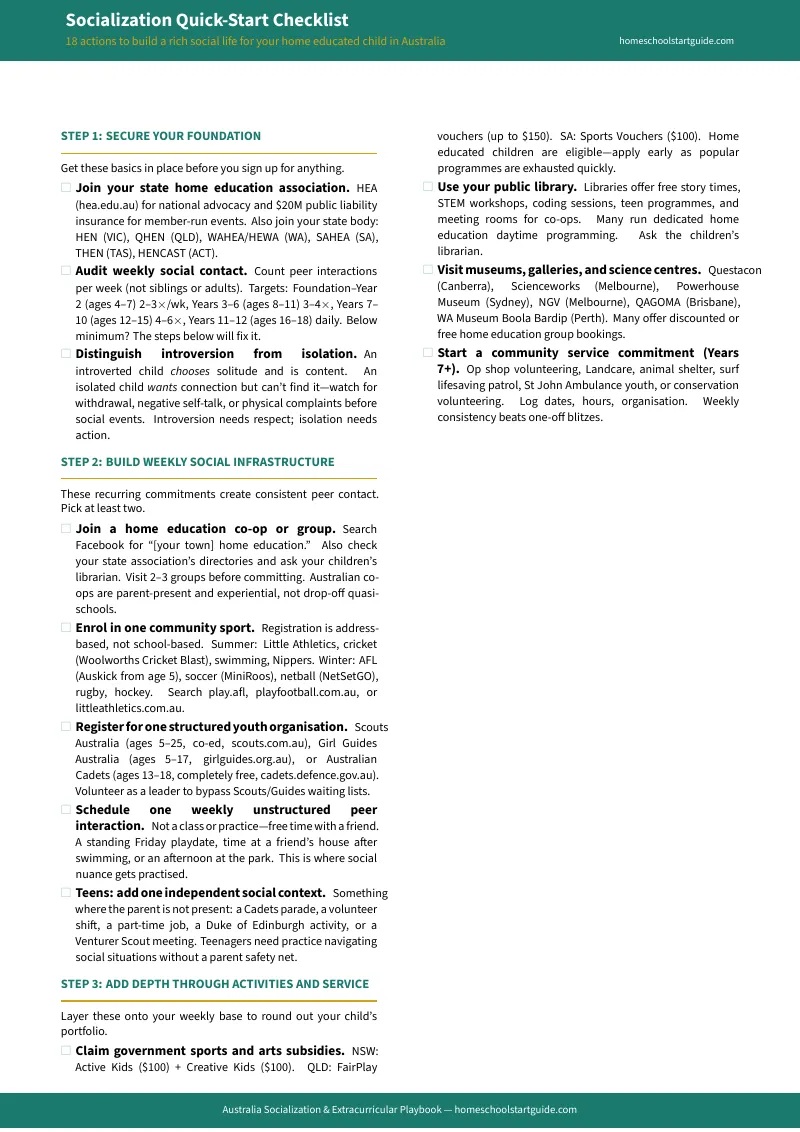
Not ready for the full Playbook? Download the free Socialization & Extracurricular Quick-Start Checklist — an 18-item action plan covering state association membership, social audit, community sport registration, government subsidies, and documentation. It's the starting point, and it's free.
Your child's education already proves they can learn anything. The Playbook makes sure they also have the mates, the community, and the extracurricular portfolio to show the world what they've built — on their own terms.
Frequently Asked Questions
What if the rules change after I buy?
We update the guide when the rules change. Email us any time, even years later, and we'll send you the current edition free.