You've Read 47 Blog Posts. Watched 12 YouTube Flip-Throughs. You Still Don't Know What to Buy.
You've spent the last three weekends in Facebook groups asking strangers which math curriculum won't make your child cry. You've got 23 browser tabs open, a Pinterest board called "Homeschool Stuff" that you haven't looked at since Tuesday, and a growing suspicion that every recommendation you've received is either an affiliate link or advice from someone whose kid is nothing like yours.
One parent swears by The Good and the Beautiful. Another says it's "too light." Someone recommends Saxon because "it builds mastery," and someone else says Saxon made their child hate math permanently. A third parent links to a $47/month online program and says it "teaches itself" — but the fine print mentions $800 in annual consumables and a required teacher's manual sold separately.
You don't need more opinions. You need a filter.
The United States Curriculum Matching Matrix is built on a 5-Variable Filter — learning style, true cost, worldview, prep time, and neurotype — that lets you compare 200+ homeschool curricula by the dimensions that actually predict whether a program will work in your home. Instead of reading reviews one at a time and holding the comparisons in your head, you set your family's variables and see which programs pass all five gates. It's the tool you wish existed when you first typed "best homeschool curriculum" into Google and got 4 million results.
What the 5-Variable Filter Covers
Side-by-Side Comparison Matrices
Every major curriculum — from Abeka to Waldorf — compared in a scannable table format. Because the alternative is opening 20 tabs, reading 20 individual reviews, and trying to reconstruct the comparison from memory by the time you reach tab number seven. Each entry includes the publisher, grade range, subject coverage, worldview classification, and approach (mastery vs. spiral, textbook vs. hands-on, online vs. print).
The "True Cost" Column
Publishers list the sticker price. We list the system price: base package + teacher guide + consumable workbooks + required manipulatives + average shipping. Saxon Math looks like $100 on the website. Add the teacher manual, test booklet, and student workbook refills, and you're closer to $180. Sonlight's catalogue is beautiful — but the full 4th-grade package with readers and science kits can top $900. Every entry in the matrix includes both numbers, because the biggest "hidden cost" in homeschooling isn't the curriculum. It's the surprise that comes three months after you've already committed.
Learning Style Matching Filters
A kinesthetic learner in a textbook-heavy program won't look "behind" because they can't learn — they'll look behind because the delivery method doesn't match their brain. A visual learner in an audio-based program will zone out and get labelled unfocused. The matrix tags every curriculum for visual, auditory, reading/writing, and kinesthetic learners, plus a quick self-assessment to identify your child's dominant style. You'll know the match is wrong before checkout — not three frustrated months later when the workbooks are non-returnable.
Worldview Spectrum Ratings
Not just "religious" or "secular." That binary is what causes the mid-year surprises. The matrix uses a four-point spectrum: Scripture-integrated, Christian worldview, faith-neutral, and strictly secular. Each entry is tagged so you can filter immediately. No more accidentally buying a "neutral" science program that opens with Genesis, or a "secular" history curriculum that skips every religious influence on Western civilisation.
Parental Prep Time Scores
Every curriculum rated on a three-tier scale: Open-and-Go (no preparation), Light Prep (15-30 minutes), and Teacher-Intensive (requires daily lesson planning). Because if you're homeschooling multiple kids, working part-time, or running on four hours of sleep, a high-prep curriculum will break you by October — and you'll blame yourself instead of the mismatch. The prep time column eliminates the 60% of curricula that require more energy than you actually have.
ADHD and Neurodiverse Compatibility Tags
Curricula tagged for short lesson length, high movement, multi-sensory approach, and minimal sustained writing. Generic reviews don't systematically track whether a program works for a wiggly kid with a 15-minute attention span. You'd have to read hundreds of parent reviews and hope someone with your child's neurotype happened to try that exact program and happened to mention it. The matrix tags it directly — so you can filter to ADHD-friendly, dyslexia-appropriate, or gifted/2e programs in seconds instead of hours.
Subject-by-Subject Guides
Separate chapters for math, language arts, science, history, and electives — because the best math curriculum for your family almost certainly comes from a different publisher than the best science program. Most families end up mixing 2-4 publishers, but nobody tells you which ones pair well together. The subject guides include mix-and-match recommendations so you build a coherent curriculum stack, not a random pile of mismatched programs.
The Decision Flowchart
A visual step-by-step tool that walks you from "I don't know where to start" to "here are your top 3 options" in under 10 minutes. Answer 6 questions about your family's priorities, and the flowchart narrows 200+ options down to a shortlist you can actually evaluate. If the matrix is the full filter, the flowchart is the fast-track version for parents who need a decision this week.
Who This Matrix Is For
- First-year homeschoolers who are paralysed by the sheer number of options and terrified of spending $200-$500 on a curriculum package their child will reject by October
- Mid-year switchers whose current curriculum isn't working — the child is struggling, the tears have started, and you need to pivot without wasting another semester or another $300
- Parents of neurodivergent learners (ADHD, dyslexia, autism, giftedness) who need to filter for specific learning accommodations that generic reviews never systematically address
- Secular families who keep accidentally buying "faith-neutral" curricula that turn out to be faith-based, and religious families who need specific worldview alignment — not just a vague "Christian" label
- Budget-conscious families who need to see the true total cost of a curriculum system before committing — not just the advertised price on the publisher's homepage
- Experienced homeschoolers adding a new subject or new child who don't want to repeat the research marathon for every grade transition
After Using the Matrix, You'll Be Able To
- Narrow 200+ curriculum options to your top 3 in a single sitting — using structured comparison instead of crowd-sourced opinion
- See the real cost of every curriculum before you buy, including the consumables, manipulatives, and shipping that publishers don't put on the product page
- Match curriculum to your child's actual learning style instead of buying based on what worked for a stranger's child in a Facebook group
- Filter by worldview on a spectrum — not a binary toggle — so you find curricula that genuinely align with your family's values, not ones that surprise you in Chapter 3
- Identify ADHD-friendly, dyslexia-friendly, and sensory-aware programs without reading hundreds of reviews and hoping someone mentions your child's specific needs
- Stop curriculum hopping — the cycle of buy, try, reject, repeat that costs families $500-$1,000+ per year in wasted materials
- Walk into a homeschool convention or browse a publisher's website with a shortlist instead of a panic attack
Why Not Just Use the Free Resources?
You can. The information exists — scattered across Cathy Duffy's 1,000+ individual review pages, dozens of YouTube channels, hundreds of Reddit threads, and thousands of Facebook group posts. Here's what it actually costs to assemble it yourself:
- 40+ hours of research. Cathy Duffy has over 1,000 reviews, but each one is a separate page. You click in, read a narrative review, click back, click into the next one, and try to hold the comparison in your head. Her search tool gives you a list of links — not a side-by-side table. YouTube flip-throughs average 15-20 minutes each. Multiply by the 30+ curricula you'd need to evaluate, and you've lost a full work week to reading reviews one at a time.
- No hidden cost data anywhere. No free resource — not Cathy Duffy, not Reddit, not any blog — systematically lists the true system cost of every curriculum. Publishers show the base price. Nobody compiles the consumable workbook refills ($10-$20 per level per year), required manipulatives ($30-$80), and shipping ($15-$35 per order) into a single comparable number. You discover those costs after you've committed.
- Conflicting advice without context. "We love Math-U-See!" from a parent of a visual learner and "Math-U-See was terrible" from a parent of a kinesthetic learner are both honest — and both useless without knowing which learner type your child is. Facebook groups give you 30 opinions from 30 parents with 30 different children. That's not research. It's noise.
- No neurodivergent filtering. If your child has ADHD, dyslexia, or a processing difference, no free resource systematically tags curricula for short lesson length, high movement, or Orton-Gillingham foundations. You'd have to read hundreds of individual reviews and hope a parent whose child has the same needs as yours happened to post about the exact program you're considering.
- Etsy templates are blank. The $5-$15 "curriculum comparison sheets" on Etsy give you a formatted grid — but the cells are empty. You still have to do all the research to fill in every row. You're buying the structure, not the data. The matrix is pre-filled with 200+ entries across every variable.
- Outdated pricing. Blog posts from 2020 still rank on Google with prices that are 30-40% lower than today's actual cost. The Matrix reflects current 2025-2026 pricing — not a snapshot from three inflation cycles ago.
Cathy Duffy gives you a library of 1,000 individual reviews. The Matrix gives you a map that shows where they all sit relative to each other — by cost, style, and worldview — so you can find the one you need without reading the other 999.
— Less Than One Wrong Curriculum
A single curriculum package costs $200-$500. Returns to publishers like Sonlight cost $35+ in shipping alone — if they accept returns at all. A homeschool educational consultant charges $100-$200 per hour to do what this matrix does on paper: narrow the field based on your child's learning style, your family's budget, and your worldview preferences. The average curriculum-hopping family buys and abandons 2-3 programs before finding one that sticks — that's $400-$1,500 in wasted materials sitting in a closet.
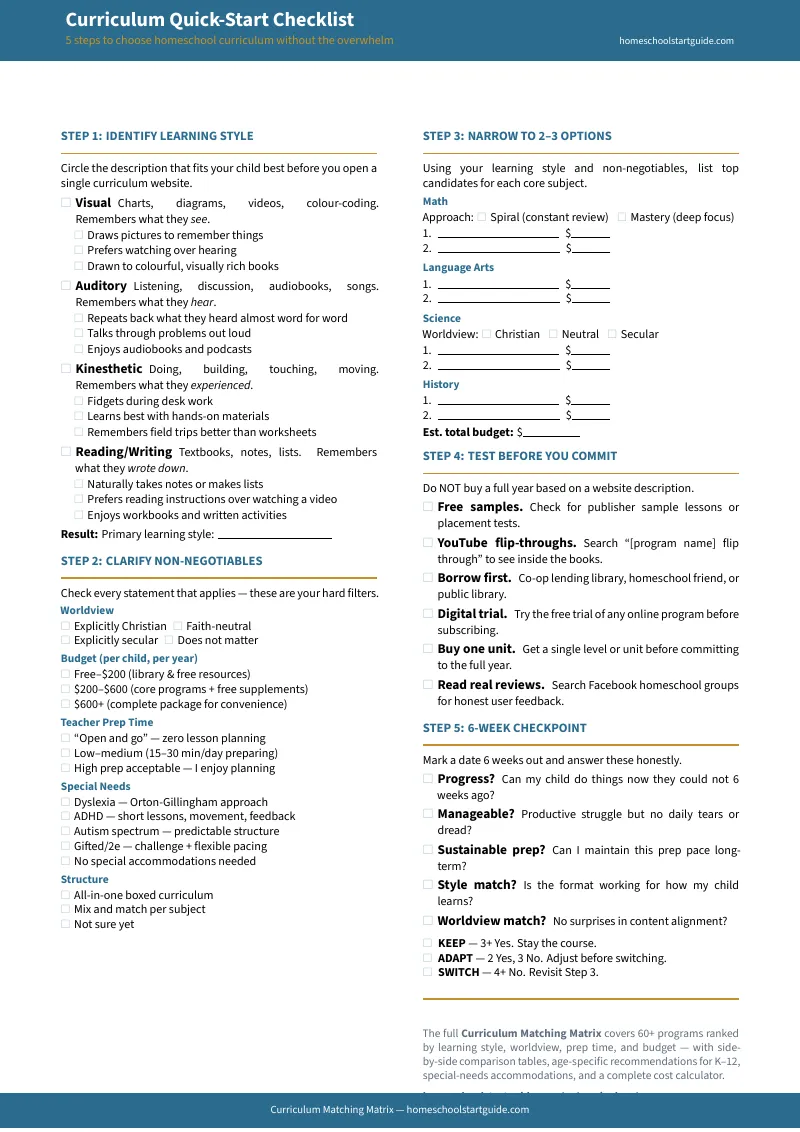
The matrix includes 11 PDFs: the full 91-page comparison guide, 9 standalone printable reference cards (subject comparison tables for math, language arts, science, and history — plus a learning style assessment, decision flowchart, budget planning worksheet, special needs quick reference, and quick reference tables), and the Quick-Start Checklist for families who need to make a decision this week. Instant download, no account required.
Money-back guarantee, no time limit. If the matrix doesn't help you narrow your options, email us and we'll refund you. No questions asked.
Not ready for the full matrix? Download the free Curriculum Matching Quick-Start Checklist — a one-page decision framework with the top 10 questions to ask about any curriculum before you buy, plus a mini comparison of the 5 most popular "open-and-go" programs. It's enough to avoid the most common mistakes, and it's free.
Your child doesn't need the "best" curriculum. They need the right one — the one that matches how they learn, what you believe, what you can afford, and how much time you have. The Matrix helps you find it without losing another weekend to Google.
Frequently Asked Questions
What if the rules change after I buy?
We update the guide when the rules change. Email us any time, even years later, and we'll send you the current edition free.