Your Child's Academics Are Sorted. Now You Need a Social Logistics System — Not Another Article Defending Your Choice
You didn't pull your child out of school on a whim. You researched curricula, read the provincial regulations, and built a schedule that actually works. The academics are handled. But then your mother-in-law asks at Thanksgiving dinner — "But what about socialization?" — and you find yourself reciting a defensive blog post you read at midnight about how socialization is actually a myth.
Except it isn't a myth. It's a real logistical challenge. Your child isn't struggling because homeschooling is wrong — they're struggling because nobody gave you an actual system for the logistics of building a social life outside the school system. The advice online is either defensive philosophy ("Research proves homeschoolers are fine!") or vague commands ("Just find a co-op!") or American ("Sign up for 4-H in your county!" — you live in Saskatchewan). And the Canadian homeschool resources that do exist — even excellent ones like The Canadian Homeschooler — treat socialization as a single chapter in a broader "How to Homeschool" course. They'll tell you why socialization isn't a problem. They won't tell you how to negotiate a daytime rate at your local martial arts studio, which provincial athletic association form lets your child try out for the school team, or how to start a co-op without it collapsing from administrative chaos by Term 2.
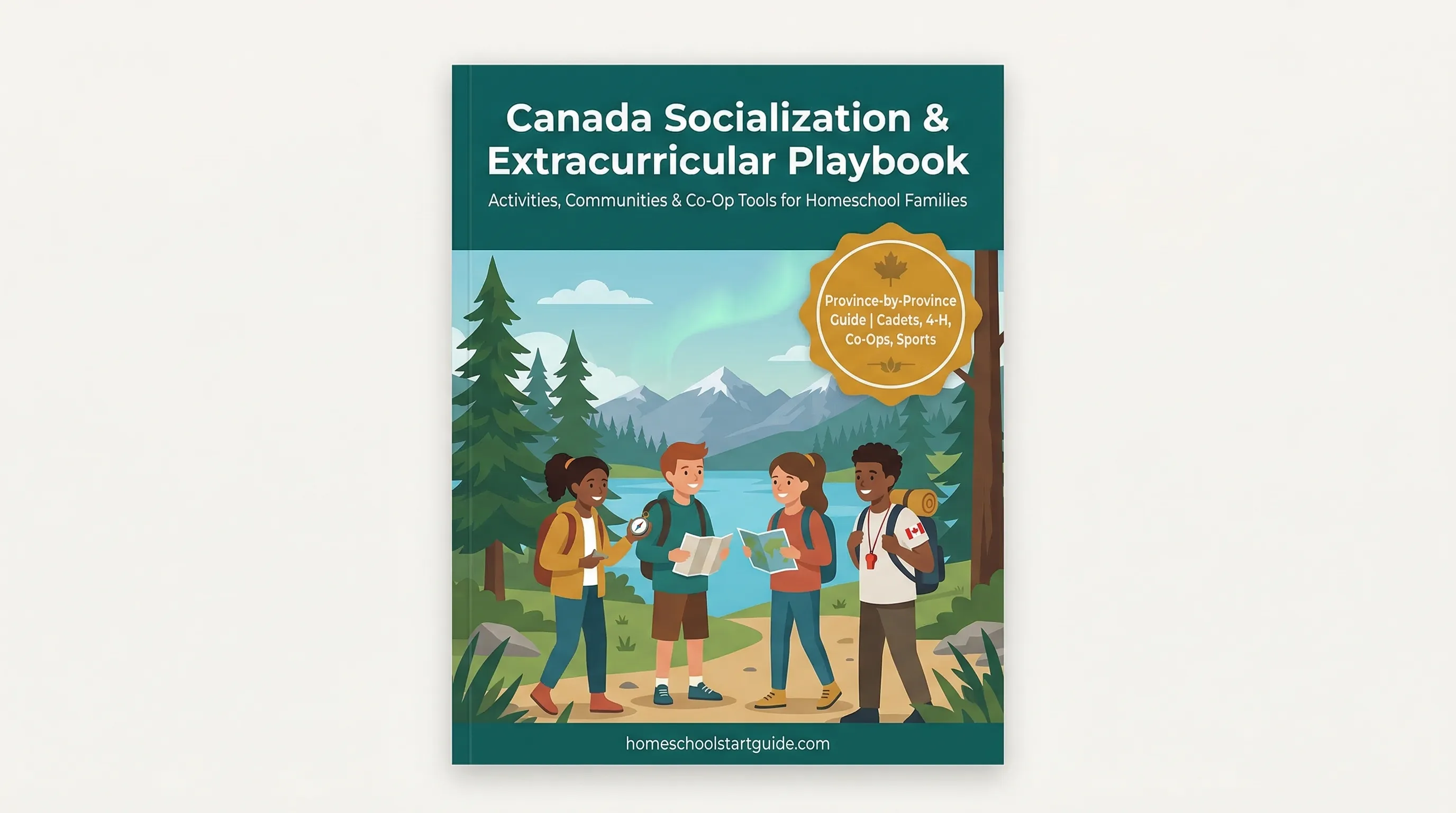
That's the gap this Playbook fills. It's a Social Logistics System — the operational infrastructure for building a rich, connected social life for your homeschooled child, specifically engineered for the Canadian landscape. Not philosophy. Not reassurance. The forms, the scripts, the templates, the schedules, and the strategic frameworks that turn socialization from something you worry about into something you operate.
What's Inside the Playbook
The Province-by-Province Activity Directory — because the hardest part isn't choosing activities, it's knowing which ones actually accept homeschool registrations in your province
A curated directory of every major extracurricular pathway open to independent homeschoolers across Canada — organised by province. Covers Cadets (free, government-funded, open in every province), 4-H Canada, Scouts and Girl Guides, provincial sports associations, community theatre, science fair circuits, and cultural organisations like Alliance Française. Each listing includes how to register as a homeschooler, age requirements, typical costs, and the best time of year to sign up. No more discovering that your preferred activity closed registration two months ago because the deadline was buried on page 47 of a provincial athletic association constitution.
The Co-Op Founding Toolkit — because co-ops don't die from philosophical disagreements, they die from administrative friction
HSLDA Canada warns that administrative burnout is the #1 killer of homeschool co-ops. Bloggers enthusiastically tell you to "just start one!" but give you nothing to keep it running past Term 1. This section provides the actual infrastructure: a customisable organisational charter template, conflict-resolution protocols for managing disputes between families, a transparent cost-sharing spreadsheet, liability waiver templates, and a scheduling framework. Whether you're joining an existing co-op or founding one from scratch, you'll have the paperwork that prevents the group from imploding when two families disagree about snack policy in Week 6.
The Off-Peak Negotiation Scripts — because every gym, dojo, and dance studio near you has empty mats from 10 AM to 3 PM, and you're the person who can fill them
Every martial arts studio, gymnastics academy, dance school, and indoor climbing gym in Canada has idle equipment during school hours on weekdays. This section provides verbatim email templates and phone scripts for pitching a daytime "Homeschool Class" at a negotiated discount. You're not asking for charity — you're solving their dead-hour revenue problem. The scripts frame your proposal as a business opportunity for them, not a favour for you. No existing homeschool resource teaches this.
The Urban Hub vs. Rural Anchor Framework — because advice built for downtown Toronto is useless in small-town Saskatchewan
Canada is the second-largest country on Earth, and existing socialization advice treats it as a monolith. A family who can take the TTC to the ROM, the AGO, and three co-ops before lunch lives in a fundamentally different reality from a family in rural Alberta where the nearest co-op is an hour's drive. This section provides two distinct strategic frameworks: the Hub Strategy for urban families (leveraging transit, municipal programmes, and dense co-op networks) and the Anchor Strategy for rural families (building deep, multi-generational ties through 4-H, agricultural societies, church groups, and regional homeschool gatherings). Both are Canadian-specific, not repurposed American advice.
The Social Skills Assessment Framework — because "they seem fine" isn't a measurement, and the real gaps don't show up in adult-supervised settings
Not an etiquette checklist — a practical framework for evaluating whether your child is building genuine peer connections or just performing well when grown-ups are watching. Covers the blind spots that show up specifically in homeschooled children: difficulty reading unspoken group dynamics, "flat register" where they speak the same way to a five-year-old and a grandparent, and the gap between being articulate with adults and navigating the unstructured chaos of same-age peers. Includes age-specific benchmarks from primary years through high school so you can distinguish healthy introversion from a genuine skill gap that benefits from intentional practice.
Conversation Scripts for Family Critics — because you shouldn't have to improvise a philosophical defence of your educational choice every holiday season
Five verbatim scripts for the conversations that drain your energy — the Thanksgiving interrogation, the "concerned" relative text, the playground parent who asks "But don't they need real friends?", the partner who's wavering on the decision, and the hardest one: the conversation with your own child when they say they feel lonely. These aren't argumentative essays — they're calm, specific responses grounded in Canadian research (Fraser Institute, CCHE studies) that you can rehearse and use tonight.
The Extracurricular Planning Calendar — because homeschool parents who plan their child's academic year down to the week somehow wing the social year entirely
A fillable annual planner aligned to the Canadian school year (September start, two semesters). Maps Cadets enrolment windows, 4-H registration deadlines, Scouts programme start dates, science fair submission timelines, provincial sports registration periods, and community theatre audition seasons so you can plan your child's social year with the same intentionality you plan their academics. Prevents the panic of discovering your preferred activity closed registration two months ago.
Who This Playbook Is For
- Parents who are confident in their homeschool academics but privately worry about whether their child is building real peer connections — not just behaving well around adults at co-op meetings
- Families tired of the "socialization question" from extended family and who want more than philosophical reassurance — they want a documented activity calendar and a concrete plan they can point to
- New homeschoolers (post-2020 or newly decided) who left the school system and need to rebuild their child's entire social infrastructure from scratch — using Canadian-specific resources, not American advice
- Rural families in Alberta, Saskatchewan, Manitoba, or the Maritimes who feel isolated and need strategies designed for geographic distance — not advice that assumes you live 15 minutes from a co-op
- Working homeschool parents who are already stretched thin and need a system that creates a sustainable social calendar without turning every weekday into a 90-minute drive to the next activity
- Parents with teenagers approaching high school who realise that informal playdates and library visits won't build the kind of extracurricular depth that university applications require
After Using the Playbook, You'll Be Able To
- Identify every Cadets squadron, 4-H club, Scouts troop, sports league, and community organisation in your province that accepts independent homeschool registrations — without hours of Googling and dead-end Facebook group searches
- Start or join a homeschool co-op with professional organisational infrastructure — charter, liability waivers, cost-sharing agreements, and conflict-resolution protocols that prevent the group from collapsing
- Negotiate daytime "homeschool class" rates at local gyms, dojos, dance studios, and climbing walls using scripts that position your proposal as a business opportunity for the facility owner
- Distinguish between a child who is introverted (a personality trait that needs no fixing) and a child who is missing social cues (a skill gap that benefits from intentional practice) — with age-specific benchmarks
- Build a sustainable extracurricular calendar that balances genuine social connection with family rest — using strategic scheduling methods that prevent the burnout cycle of over-committing and then withdrawing
- Answer the socialization question at the next family gathering with specifics, not platitudes — because your child's social calendar, activity enrolments, and development milestones are documented and intentional
Why Free Resources Fall Short
The information exists — but the way it exists is the problem.
- Provincial associations defend your right, not your strategy. The OFTP publishes excellent research proving homeschoolers socialise just fine — citing studies by Bruce Arai and Larry Shyers. HSLDA Canada provides legal defence and co-op burnout warnings. But the tone reads like a legal brief prepared for a social worker's visit, not a proactive playbook for building community. They tell you socialization isn't a problem. They don't help you solve the logistics when it actually is.
- The Canadian Homeschooler is excellent — but socialization is one chapter. Lisa Marie Fletcher's course ($14.95) and book ($14.99) are the gold standard for "How to Homeschool in Canada." But socialization gets a single module inside a 2.5-hour course that also covers curriculum, legal compliance, and household management. When your specific problem is building a social life from scratch, you need depth that a sub-chapter can't provide.
- YouTube creators share real tactics — scattered across years of content. Raising A to Z shows how to use errands as conversation practice. Apologia teaches the "Amoeba Method" of attending activities as a whole family. Genuinely useful — but synthesizing it into a coherent plan takes dozens of hours of watching, filtering, and note-taking.
- Facebook groups are where advice goes to contradict itself. One parent recommends a co-op; the next warns you away. Local group directories link to pages that haven't been updated since 2021. The signal-to-noise ratio isn't worth the time of a parent who's already teaching, managing a household, and possibly working.
- Municipal programs exist in isolation. The Alberta Aviation Museum offers homeschool days. The Calgary Zoo runs educational programmes. Your local YMCA might have "Homeschool Gym & Swim" if you call and ask. But there's no centralized database. You're individually navigating dozens of institutional websites to build a calendar nobody aggregated for you.
A single term of hockey or gymnastics costs $200-500+. Popular homeschool curricula run $500-2,000/year and parents still say they don't solve the social connection problem. This Playbook bridges the gap no existing resource fills — the practical logistics of where to go, what to join, how to negotiate, and how to sustain it, built entirely for the Canadian context.
— Less Than One Season of Extramurals
A single season of recreational hockey costs $200-500. A term of gymnastics runs $150-300. The annual cost of a curriculum that still doesn't solve your child's social life runs into the thousands. This Playbook is a one-time investment — the Social Logistics System that ensures every activity you choose, every co-op you join, and every hour you spend driving actually builds genuine connection instead of just filling a calendar.
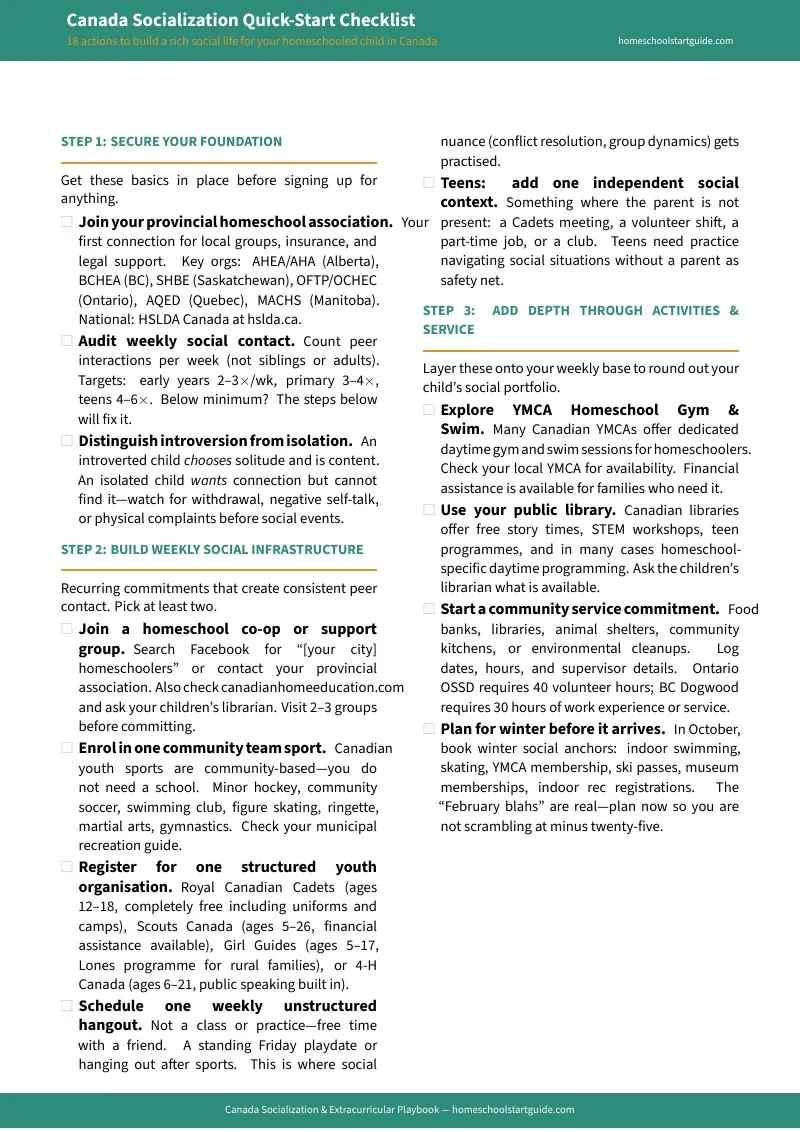
The Playbook includes the full guide plus standalone printable reference cards and templates: the Quick-Start Checklist, the Province-by-Province Activity Directory, the Co-Op Founding Toolkit (charter, waivers, cost-sharing templates), the Off-Peak Negotiation Scripts, the Social Skills Assessment Framework, the Conversation Scripts for Family Critics, the Canadian School Year Planning Calendar, the University Extracurricular Portfolio Template, and the Age-by-Age Activity Roadmap. Instant download, no account required.
Money-back guarantee, no time limit. If the Playbook doesn't give your family a clearer path to genuine social connection and a sustainable extracurricular calendar, email us and we'll refund you. No questions asked.
Not ready for the full Playbook? Download the free Socialization & Extracurricular Quick-Start Checklist — a one-page overview of the key action items: identify your province's top homeschool-friendly organisations, assess your child's social development by age, and pick the first three activities to pursue. It's the starting point, and it's free.
Your child's education already proves they can learn anything. The Playbook makes sure they also have the friendships, the community, and the social confidence to match — built on Canadian soil, on your family's terms.
Frequently Asked Questions
What if the rules change after I buy?
We update the guide when the rules change. Email us any time, even years later, and we'll send you the current edition free.