Your Child Isn't Broken. The System Was Never Built for Them.
You've sat through the IEP meetings. You've watched your child hold it together all day at school and then fall apart the moment they walk through the door — the meltdowns, the shutdowns, the school refusal that gets worse every week. You've tried changing teachers, switching classrooms, requesting accommodations that get approved on paper and ignored in practice. You've watched your child's confidence erode, one bad day at a time.
Or maybe you've already pulled them out. And now you're sitting at the kitchen table, staring at a blank calendar, thinking: "I'm not a teacher. I have ADHD myself. How am I supposed to do this?"
So you did what every overwhelmed parent does: you searched online. You joined Facebook groups where half the posts say "unschool everything!" and the other half say "you need structure!" You opened Reddit threads that spiral into arguments about curricula you've never heard of. You found Etsy planners that are colour-coded and pretty — but just blank boxes with zero instructions on how to fill them for a child who melts down at the sight of a worksheet. You found $200-$500 curricula that assume your child learns the way the program was designed, not the way your child's brain actually works.
Here is the gap nobody fills: there is plenty of advice on what neurodivergence is and plenty of products to buy for it. What doesn't exist is a single, affordable guide that bridges your child's diagnosis to your actual Tuesday morning — how to handle the meltdown that erupts during math, how to schedule a day when you can't stick to a schedule yourself, how to choose between five different reading programs when your child has both ADHD and dyslexia, and how to do all of this without burning out by October.
The Neurodivergent Homeschooling Hack is built around what we call the Neurotype Matching System — instead of generic "neurodivergent" advice, every chapter maps your child's specific brain wiring (ADHD, autism, dyslexia, giftedness, PDA, or any combination) to the exact schedule type, curriculum, environment setup, and executive function tools that fit their profile. It's a 17-chapter guide that treats these not as separate diagnostic categories but as overlapping realities in the same household — because the family dealing with AuDHD or dyslexia-plus-ADHD doesn't need five different books for five different labels.
What's Inside the 17-Chapter Guide
The Neurodivergent Education Crisis (Chapter 1)
The data, the patterns, and the research that validates what you already know in your gut — why the traditional system systematically fails neurodivergent children. Including the global snapshot: US, UK, Australia, Canada, and New Zealand. Because the guilt of pulling your child out is real, and the evidence that you made the right call should be the first thing you read.
Understanding Your Child's Profile (Chapter 2)
A practical (not clinical) breakdown of ADHD, autism, dyslexia, twice-exceptional, and PDA profiles — focused on what each neurotype needs from a learning environment, not what a diagnostic manual says. Includes the "multi-profile" reality of AuDHD, dyslexia + ADHD, and other common overlaps that most single-diagnosis resources ignore entirely.
The 30-Day Deschooling Transition (Chapter 3)
The counterintuitive first step: do no academics for 30 days. Because every parent's instinct is to panic-buy curriculum the week they withdraw — and that's how you end up doing "school-at-home" with a traumatised child who now associates you with worksheets. A structured plan for resetting your child's nervous system, with specific activities, milestones, and guidance on when to gently reintroduce learning.
Designing Daily Rhythms (Chapter 4)
Because rigid time-blocked schedules are the #1 reason "school-at-home" fails for ADHD families. Energy mapping, loop scheduling, spoon check-ins, and flexible rhythm-based routines that replace the colour-coded timetable your child shredded on day one. Includes sample daily rhythms matched to different neurotypes and age ranges.
Sensory-Friendly Learning Environments (Chapter 5)
A room-by-room sensory audit: lighting, sound, seating, visual clutter, temperature, and proprioceptive input. Because fluorescent lights and visual clutter aren't "distractions" — they're neurological stressors that deplete your child's capacity before the first lesson starts. Specific product recommendations at multiple price points, from free hacks to purpose-built tools.
Executive Function Frameworks (Chapter 6)
Goblin Tools, body doubling, visual timers, the Two-Minute Start rule, and other concrete strategies that help your child (and you) initiate, sustain, and complete tasks without the daily fight. Because "just try harder" was never the problem — these are cognitive prosthetics for brains that need external scaffolding, not motivation.
Curriculum Recommendations by Profile (Chapter 7)
The chapter that prevents the $200 mistake. Specific, named programs — Math-U-See, Beast Academy, Teaching Textbooks, Barton Reading, All About Reading, Brave Writer, and more — matched to the neurotype they actually work for, with notes on what fails for each profile and why. Because the reading program that transformed your friend's neurotypical child will predictably fail your dyslexic child, and you deserve to know that before you buy it.
AI Tools for Executive Function and Planning (Chapters 8 + 15)
How to use Goblin.tools "Magic To-Do" for task breakdown, ChatGPT as a personalised Socratic tutor matched to your child's interests, and other AI workflows that reduce your planning and grading load. Because your daily planning shouldn't depend on executive function you don't have. Two dedicated chapters because this changes everything.
Documentation and Portfolio Building (Chapter 9)
What to document, how often, and in what format — to satisfy legal requirements, build a record of progress, and create a portfolio that proves mastery better than any report card. Because "she played with magnets for two hours" absolutely counts as physics — you just need to know how to document it.
Support Networks and Socialization (Chapters 10 + 11)
How to find your people — online communities, local co-ops, interest-based groups — and how to answer the "What about socialization?" question from every relative who asks. Because for ND kids, forced classroom socialisation was often the trauma — curated, interest-based connections are what actually works. Includes scripts for skeptical family members.
Multiple Neurodivergent Children (Chapter 12)
When you're homeschooling one ADHD child and one autistic child with opposite sensory needs and different energy cycles. Because the silence one child needs for focus is the void another child fills with stimming — and "just separate them" isn't a strategy when you're one parent in one house.
The Strewing Technique (Chapter 13)
The art of leaving interesting materials in your child's environment without comment or demand — and why it bypasses Pathological Demand Avoidance more effectively than any other approach. Because the moment you say "try this puzzle," the demand triggers refusal — but when the child finds it on the kitchen table, they're assembling it before lunch. Includes a strewing calendar and "50 Things to Strew for Under $5."
Legal Considerations by Country (Chapter 14)
What you're legally required to do in the US (by state category), UK, Australia, Canada, New Zealand, South Africa, Ireland, and Singapore. Notification requirements, portfolio obligations, and testing mandates.
Quick-Reference Tools (Chapter 16) + FAQs (Chapter 17)
Dopamine menus, low-spoon day plans, supply lists, a curriculum comparison table, and answers to the 20 questions every new ND homeschooling parent asks — including "Will they get into college?" and "What if I have ADHD too?"
Who This Guide Is For
- Parents of children with ADHD, autism, dyslexia, giftedness, PDA, or any combination — who are homeschooling now or considering pulling their child out of school
- Parents who have already tried "school-at-home" (desks, rigid schedules, curriculum boxes) and found it created more conflict than learning
- Parents who are neurodivergent themselves — this guide was written for brains that struggle with executive function, not just brains that teach children with it
- Parents drowning in Facebook group advice that contradicts itself and Reddit threads that spiral — who need one clear, structured roadmap instead of a thousand scattered opinions
- Parents who have spent hundreds on curricula that didn't match their child's neurotype — and want to know which specific programs work for which profiles before buying again
- Parents of multiple neurodivergent children with overlapping and sometimes conflicting needs in the same household
After Reading This Guide, You'll Be Able To
- Design a flexible daily rhythm using loop scheduling and energy mapping — so a bad morning doesn't derail the entire week, and you never "fall behind" because there's no rigid timetable to fall behind on
- Choose the right curriculum for your child's specific neurotype — not based on a Facebook recommendation, but based on the Neurotype Matching System that maps named programs to ADHD, autism, dyslexia, and 2e profiles
- Set up a sensory-friendly learning environment with a concrete room-by-room audit — covering lighting, sound, seating, visual clutter, and regulation spaces at every price point
- Use AI tools (Goblin.tools, ChatGPT) to break down overwhelming tasks, generate interest-based lesson plans, and reduce your daily planning load — especially on days when your own executive function is depleted
- Navigate the 30-day deschooling transition without panicking that your child is "falling behind" — with a structured plan for what to do (and what not to do) in the critical first month
- Handle the "What about socialization?" question with specific scripts and a practical plan for interest-based social opportunities that work better than forced classroom interaction
- Document your child's learning in a way that satisfies legal requirements in your country while building a portfolio that demonstrates mastery far more effectively than letter grades
Why Not Just Piece This Together From Free Resources?
You can try. Here's what that actually looks like:
- CHADD and the Autism Society publish authoritative fact sheets — for parents navigating the school system. Their advice ("create a schedule," "use a timer") doesn't help you design a homeschool day when you have ADHD yourself and can't stick to the schedule either.
- Facebook groups and Reddit give real-time, "in-the-trenches" advice — and every third post contradicts the last. "Unschool everything!" sits next to "You need structure or you're failing your child." For an ADHD brain already in decision paralysis, the result is 47 open tabs and zero action.
- Books like The Brave Learner are genuinely paradigm-shifting — and then you close the book and still don't know what to do Monday morning. Inspiring philosophy without daily logistics is frosting without the cake.
- Etsy planners are visually appealing and sometimes labelled "neurodivergent." But they're blank boxes — no instructions on how to fill them for an ADHD child versus a PDA child, no strategy for what happens when the plan falls apart by 9:15 AM.
- The $200 curriculum mistake. The most common pattern is panic-buying a reading program or math curriculum that doesn't match your child's neurotype. One wrong purchase wastes months of learning time and costs more than this entire guide.
Free resources explain what neurodivergence is. This guide tells you what to do about it on Tuesday morning — matched to your child's specific neurotype.
— Less Than One Bad Curriculum Purchase
A specialised curriculum runs $200-$500. A homeschool consultant charges $100-$200 per hour. An occupational therapy session costs $150-$300. This guide costs less than a single co-op registration fee — and it prevents the expensive mistakes that happen when you choose curriculum, schedules, and strategies without understanding how they interact with your child's specific neurotype.
Plus 10 Printable Standalone Worksheets
The guide is comprehensive. But you also need tools you can print and pin to the fridge, carry room to room, or hand to your child. Every paid download includes these 10 standalone PDFs alongside the guide and checklist:
- Energy Mapping Worksheet — A 5-day tracking sheet for logging your child's focus, energy, and regulation every 2 hours. Reveals their natural learning windows so you schedule demanding subjects in the right slots.
- Daily Rhythm Templates — Three sample daily rhythms (ADHD, ASD/PDA, Dyslexia) you can print and post on the wall. Loop-based, not time-blocked — nothing falls behind.
- Sensory Audit Checklist — A room-by-room walkthrough covering 6 sensory dimensions (lighting, sound, seating, visual clutter, temperature, proprioceptive input). Carry it through your home and check off what needs changing.
- Executive Function Toolkit — Wall reference for the 5 core strategies: task initiation, time awareness, organisation systems, working memory supports, and emotional regulation tools.
- Curriculum Comparison Table — 17 named programs across 5 subjects, matched to neurotype. Print it before you shop so you stop buying curriculum that doesn't fit.
- Strewing Ideas List — 50+ ideas organised by subject area. Pin it to the fridge and rotate materials weekly without turning it into a lesson.
- Low-Spoon Day Plan — The emergency fridge-magnet plan for days when neither you nor your child has the capacity for structured learning. Still counts as education.
- Essential Tools Checklist — A tiered shopping list: must-have, nice-to-have, and free alternatives. Prevents the $300 impulse order and the $0 guilt spiral.
- Legal Overview by Country — US, UK, Canada, Australia, and New Zealand homeschooling requirements in one table. Notification deadlines, portfolio obligations, testing mandates.
- Deschooling 30-Day Plan — A week-by-week wall poster for the first month after leaving school. Four phases from full decompression to gentle re-engagement.
The complete download includes 12 PDFs: the 17-chapter guide, the Quick-Start Checklist, and all 10 standalone printables. Instant download, no account required.
Money-back guarantee, no time limit. If you don't find it useful, email us and we'll refund you. No questions asked.
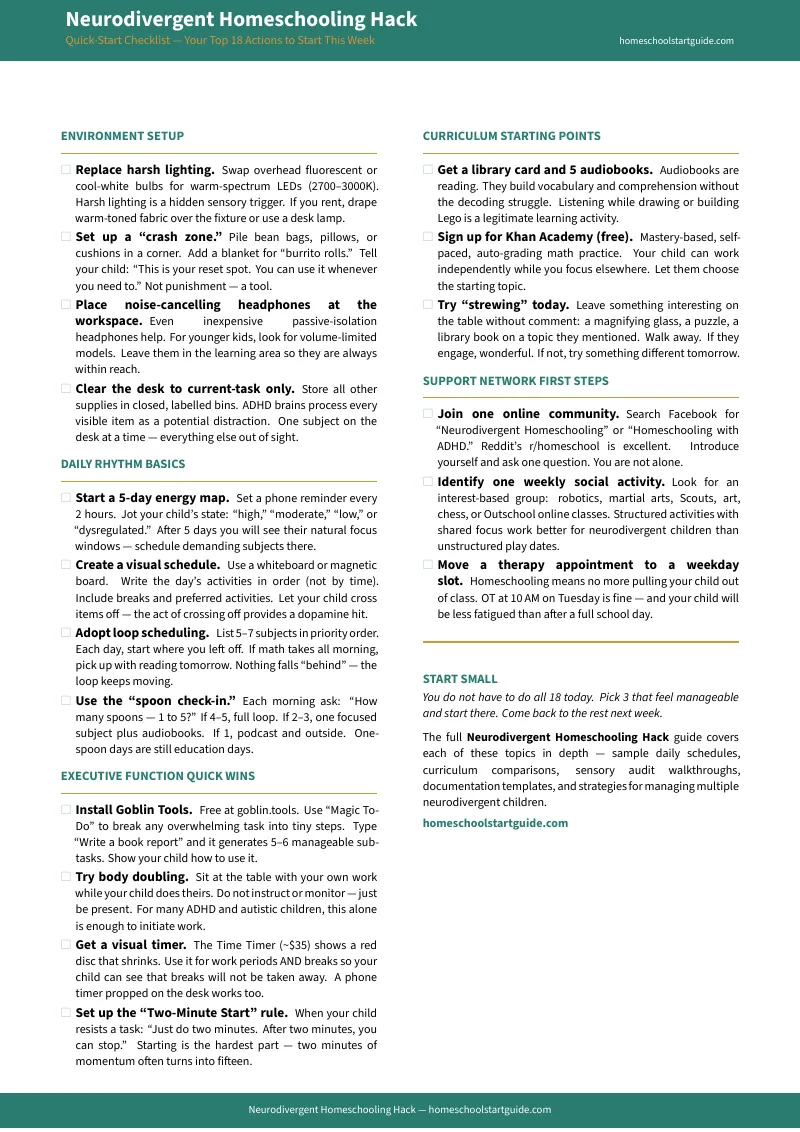
Not ready for the full guide? Download the free Neurodivergent Homeschooling Quick-Start Checklist — 18 specific actions across environment, daily rhythm, executive function, curriculum, and support networks that you can start this week, no curriculum purchase required.
Your child's brain isn't the problem. The environment was. You're building a new one now — and this guide shows you exactly how to do it, step by step, starting tonight.
Frequently Asked Questions
What if the rules change after I buy?
We update the guide when the rules change. Email us any time, even years later, and we'll send you the current edition free.