You Built an Extraordinary Education. Now the University System Wants Credentials You Were Never Set Up to Give Them.
You've done the hard part — years of intentional learning, real exploration, and an education shaped around your child's actual strengths. Charlotte Mason, classical, Steiner, unschooling, or a mix of everything that worked. Your child reads widely, thinks critically, and pursues interests with the kind of depth that school would never allow.
Then they hit Year 10, and suddenly the NCEA system looms over everything.
You start Googling. Every university website assumes your child sat NCEA externals at a registered school. The NZQA website talks about "consent to assess" — which you don't have. Te Kura looks promising, but then you read that enrolling in three subjects voids your MOE exemption and stops the supervisory allowance. The admissions staff you call say "you need University Entrance" because that's the default script. Relatives who never supported the homeschooling decision in the first place are now asking the question you dread: "But how will they get into uni?"
You turn to Facebook groups. One mum says her daughter got into Massey through Discretionary Entrance. Another says Discretionary Entrance doesn't work at Auckland. Someone recommends Cambridge exams for $800 per subject. Someone else says their son did Te Kura and got UE with no problems. A third parent warns about the new 60-credit rules. Everyone has a different story. No one has a complete picture.
Meanwhile, the American homeschool advice flooding Reddit and Etsy is completely irrelevant — parent-issued GPAs, the Common App, SAT vs ACT. None of it applies to NCEA, rank scores, or NZQA. An Etsy "homeschool transcript template" designed for the US system is useless for a New Zealand university application.
You don't need another anecdote. You need a system that maps every pathway, every university, every qualification — so you can stop guessing and start planning.
The University Entry Strategy System
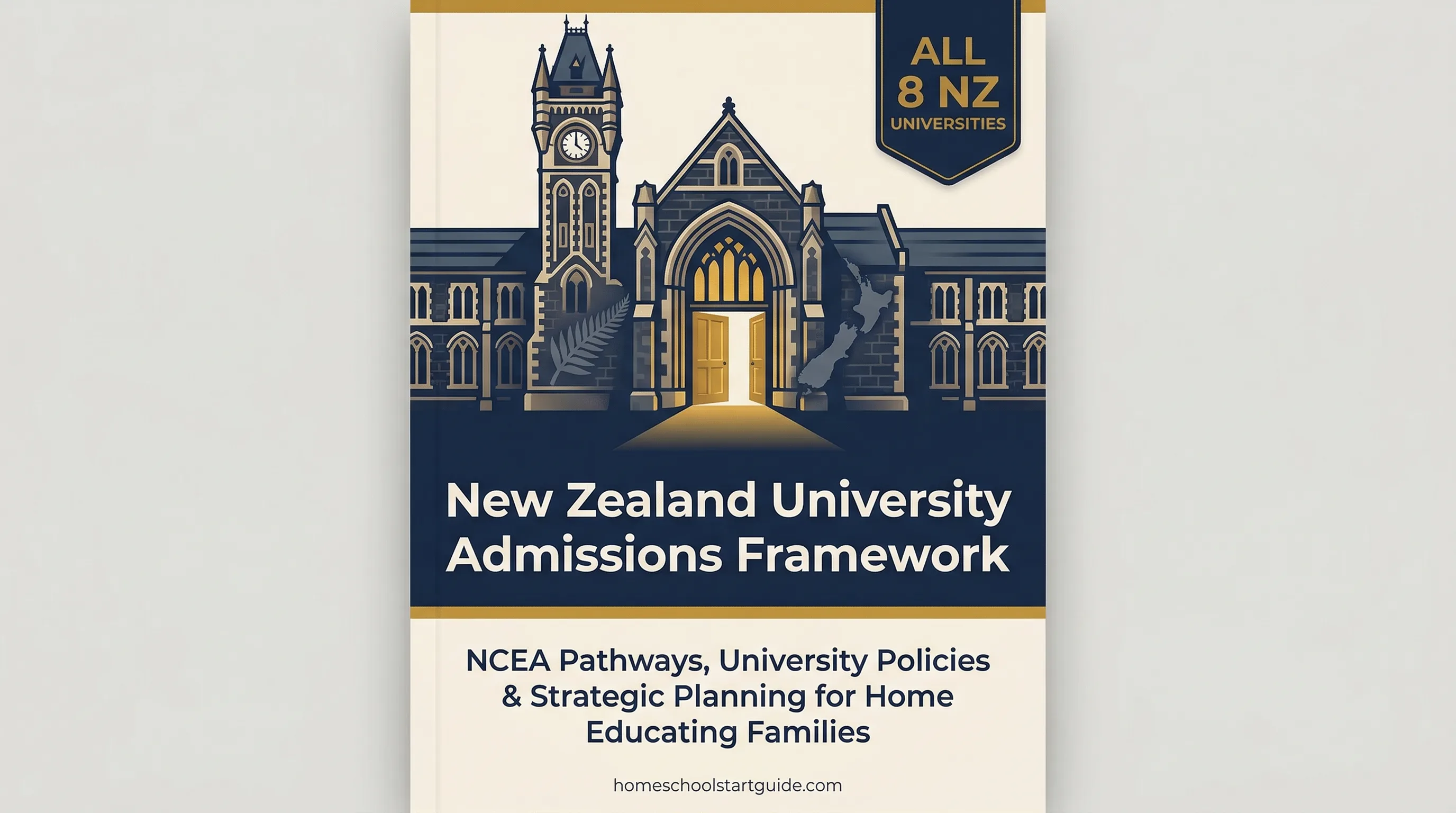
The New Zealand University Admissions Framework is the resource that should have existed years ago: a single, comprehensive guide that maps every pathway into New Zealand universities for home educated students — covering all eight universities, five qualification routes, and the NCEA reforms rolling out through 2029.
University Entrance dominates the national conversation, but here's what most parents don't realise: New Zealand has at least five distinct pathways into university for home educated students, and most of them don't require you to become a full-time Te Kura student or give up your homeschooling exemption. The system already has multiple doors open. The problem isn't that your child can't get in — it's that no one has shown you where those doors are, which ones fit your child, and how to walk through them without losing your MOE exemption in the process.
This Framework does exactly that. It covers the five core pathways recognised by New Zealand universities, maps institution-specific policies across all eight universities, and provides a year-by-year planning timeline from Year 9 through to university orientation — so you know exactly what to do and when.
What's Inside the Framework
The Five Pathways Explained
A clear breakdown of every route into university: NCEA through Te Kura (the free distance school), NCEA via a Link School (sitting exams through a local secondary), alternative qualifications (Cambridge International, IB, ACE, CENZ), Discretionary Entrance (the portfolio pathway for under-20s without UE), and foundation/bridging programmes. Each pathway includes what it costs, what's involved, who it suits, and the legal implications for your MOE exemption — because choosing the wrong combination can void your homeschooling status.
The Eight-University Admissions Matrix
Detailed entry policies for every New Zealand university — Auckland, AUT, Waikato, Massey, Victoria, Canterbury, Lincoln, and Otago. Each entry covers the specific alternative pathways that university accepts, their Discretionary Entrance requirements (which vary wildly — Massey wants 72 Level 2 credits, Otago wants 80), their stance on home educated applicants, and what actually happens when you call their admissions office. No more opening eight browser tabs and trying to reconcile contradictory information.
The Te Kura Strategic Balance Playbook
Te Kura is the most powerful free resource for NZ home educators — but it comes with a legal tripwire. Enrol in three or more subjects and your child crosses the full-time threshold, voiding your MOE exemption and terminating your supervisory allowance. This section covers exactly how to use Te Kura for one or two subjects (the difficult ones — lab sciences, digital technologies) while protecting your homeschooling status. It also covers the Young Adult gateway (free from age 16), dual enrolment strategy, and the Te Kura Summer School for catching up on credits.
Rank Scores and the Guaranteed Entry Score System
NCEA grades don't just get you in — they determine what you can study. The rank score system converts your NCEA Level 3 results into a competitive score that gates access to limited-entry programmes. This section explains how rank scores work, the Guaranteed Entry Score (GES) thresholds for competitive degrees at each university, and how to maximise your child's rank score strategically — including which standards to target and which to avoid.
Discretionary Entrance — The Portfolio Pathway
For home educated students under 20 who haven't achieved formal University Entrance, Discretionary Entrance offers a portfolio-based route. But every university sets its own rules. This section covers exactly what each university requires — credit thresholds, Merit/Excellence proportions, personal statements, registered teacher assessments — and how to build a portfolio that satisfies the most demanding admissions boards.
Professional Programme Pathways
Medicine at Otago and Auckland, law, engineering, health sciences — each has prerequisites beyond a rank score. UCAT testing, CASPer assessments, the Health Sciences First Year route at Otago, the Biomedical Science pathway at Auckland. If your child has a competitive career ambition, this section maps the specific entry route — including prerequisite subjects that must be chosen years before application.
The Year-by-Year Planning Timeline
A reverse-engineered chronological plan from Year 9 through to university orientation. It tells you exactly when to start Te Kura dual enrolment, when to contact Link Schools, when to register for Cambridge exams, when university applications open, and when StudyLink must be set up. Working backwards from the goal means nothing gets missed — and you have years of breathing room instead of a last-minute scramble in Year 13.
Creating Transcripts and Documentation
New Zealand universities have no standardised format for home education transcripts. This section covers how to create a professional transcript that admissions officers will take seriously, including what to include (course descriptions, grading scale, GPA, NSN number), how to present non-traditional learning, and the critical difference between a transcript that triggers follow-up questions and one that satisfies requirements on first review.
Crossing the Tasman — The Australia Pathway
Many NZ families also consider Australian universities, and NZ citizens have special access. This section covers how NCEA converts to Australian selection ranks, the UAC/VTAC/QTAC application process for NZ students, the STAT test option, and what Australian universities accept from New Zealand home educated applicants.
Funding, Scholarships, and Financial Aid
StudyLink student loans and allowances, fees-free eligibility, university merit and equity scholarships, Māori Education Trust awards, and Pacific scholarship programmes. University shouldn't be a financial barrier — and there are supports most home educating families don't know exist.
Who This Framework Is For
- Parents of Year 9–11 students who've been successfully home educating for years but are now facing NCEA — a system designed for schools, not families — and the anxiety of not knowing whether the university door is open or closed
- Families hitting "NCEA panic" — the moment when relatives, ERO reviewers, or the child themselves start asking hard questions about university entry, and the parent realises they don't have clear answers
- Unschooling, Charlotte Mason, classical, and Steiner families who refuse to abandon their pedagogical philosophy just to chase NCEA credits — and need to know that Discretionary Entrance, Cambridge, and foundation routes validate self-directed learning without becoming a full-time Te Kura student
- Parents who've called university admissions offices and been told "you need University Entrance" — and suspected there had to be more to the story, but didn't know the right questions to ask
- Families who've looked at Te Kura and realised the three-subject threshold puts their MOE exemption at risk — and need a strategic plan for using distance education without losing their homeschooling status and allowance
- Parents who've been burned by American homeschool advice (GPAs, transcripts, the Common App) that has zero relevance to the New Zealand Qualifications Framework
After Using the Framework, You'll Be Able To
- Explain exactly how your child will get into university — to relatives, to ERO reviewers, and to yourself — without hedging, hoping, or guessing
- Choose between Te Kura, Link Schools, Cambridge, Discretionary Entrance, and foundation programmes based on your child's specific age, interests, and career goals — not based on a single anecdote from a Facebook group
- Use Te Kura strategically for one or two subjects without crossing the three-subject threshold that voids your MOE exemption and stops your supervisory allowance
- Compare entry policies across all eight New Zealand universities without opening eight browser tabs and trying to reconcile contradictory information
- Create a home education transcript that meets the standards NZ admissions officers expect — not a US-style GPA document that no one here recognises
- Plan a year-by-year pathway from Year 9 through to university entry — knowing every deadline, registration date, and decision point in advance
- Navigate the NCEA reforms (the shift to 60-credit levels and mandatory Common Assessment Activities) with a clear understanding of what changes affect your child and what doesn't
- Stop worrying about whether home education has limited your child's options — because you'll have the evidence that it hasn't
Why Not Just Piece This Together for Free?
You can try. The information exists — scattered across NZQA policy documents, eight university admissions portals, Te Kura's enrolment pages, NCHENZ directories, Cynthia Hancox's blog posts, and hundreds of Facebook group threads where one parent's success story contradicts another's experience.
- University admissions pages are siloed by institution. Massey explains Massey's policy. Canterbury explains Canterbury's policy. Neither tells you that Otago requires 80 Level 2 credits for Discretionary Entrance while Massey requires 72, or that Auckland is far more rigid than either. Cross-university strategy doesn't exist in any free resource.
- Facebook advice is anecdotal and often outdated. One parent's Discretionary Entrance success at Canterbury doesn't mean the same approach works at Auckland. One parent's Te Kura experience in 2022 doesn't reflect the NCEA reforms rolling out through 2029. Anecdotes are not strategy — and when the stakes are your child's university admission, "I heard someone did it this way" is not a plan.
- American homeschool resources dominate Google results. Search "homeschool university admission" and you'll get pages of advice about GPAs, the Common App, the SAT, and "mom-made transcripts." New Zealand universities don't accept any of this. A parent who follows US advice wastes months heading in the wrong direction.
- The existing NZ guides focus on getting started, not getting in. Cynthia Hancox's excellent materials are weighted toward securing your MOE exemption — the beginning of the journey. NCHENZ lists the pathways but doesn't provide the step-by-step execution plan. Nobody has published the 8-university comparison matrix, because nobody has done the cross-referencing work.
- The stakes are higher than curriculum shopping. A wrong curriculum choice wastes a semester. A wrong pathway choice — starting Cambridge when Te Kura would have been better, missing the Discretionary Entrance documentation requirements, not knowing about the three-subject threshold until your exemption is voided — can cost a full year and your legal homeschooling status.
A private educational consultant in New Zealand charges $150–$300+ per hour. Crimson Global Academy's pathway planning runs into the thousands. Even Cynthia Hancox's excellent guides focus on the MOE exemption stage, not the university exit strategy. This Framework covers every pathway, every university, every qualification option, and a year-by-year timeline in one document.
— Less Than One Cambridge Exam Registration
A single Cambridge International exam registration costs $300–$500 through an NZ exam centre. One Te Kura course (if fees apply) is $200+. One hour with a private educational consultant runs $150–$300. A wrong pathway choice doesn't come with a receipt — it comes with a lost year and the quiet fear that you should have planned this differently.
The Framework includes the full guide covering all 16 chapters, plus 5 standalone printable tools — 6 PDFs, instant download, no account required:
- guide.pdf — The complete admissions guide: five pathways explained, the eight-university admissions matrix, Te Kura strategic balance playbook, rank scores and GES, Discretionary Entrance portfolio building, professional programme pathways (Medicine, Law, Engineering), year-by-year timeline, transcripts and documentation, the Australia pathway, StudyLink and scholarships, and Māori and Pasifika equity pathways
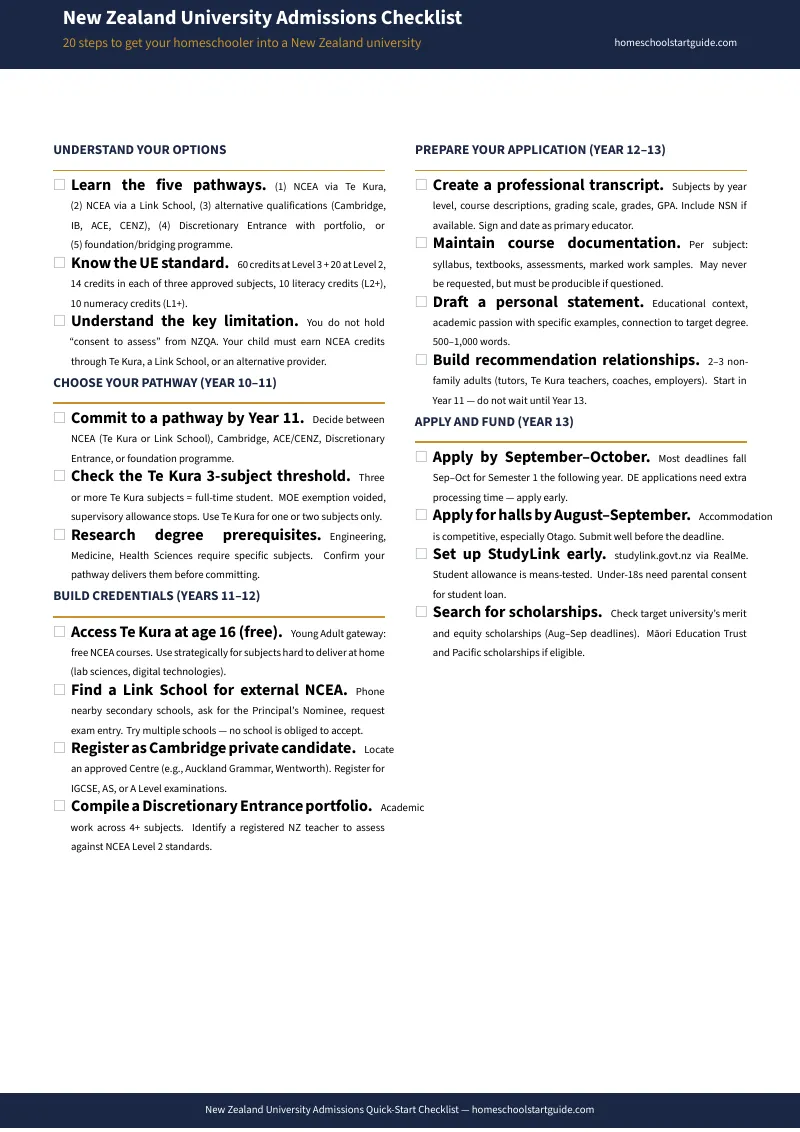
- checklist.pdf — The 20-step Quick-Start Checklist covering pathway selection, credential building, application preparation, and every critical deadline from Year 9 through to university entry
- pathways-matrix.pdf — The Eight-University Admissions Matrix: side-by-side comparison of entry policies, Discretionary Entrance thresholds, alternative qualification acceptance, foundation programmes, and contact details for all eight NZ universities
- timeline.pdf — The Year 9–13 Planning Timeline: a printable, pin-up checklist with year-by-year action items from exploration through to application day
- key-dates.pdf — Key Dates and Deadlines: an annual calendar of UCAT registration, open days, scholarship deadlines, application windows, and exam periods
- admissions-scripts.pdf — Admissions Office Call Scripts: exactly what to say when calling NZ university admissions offices so you get past the "you need NCEA" default and access alternative pathways information
Money-back guarantee, no time limit. If the Framework doesn't clarify the university admissions process for your family, email us and we'll refund you. No questions asked.
Not ready for the full Framework? Download the free University Admissions Quick-Start Checklist — a 20-step action plan covering pathway selection, credential building, application preparation, and every critical deadline from Year 9 through to university entry. It's the "where do I even start?" answer, and it's free.
Your child's home education gave them something most students don't have — genuine intellectual curiosity, self-directed learning, and the ability to think for themselves. The Framework makes sure the university system sees it that way too.
Frequently Asked Questions
What if the rules change after I buy?
We update the guide when the rules change. Email us any time, even years later, and we'll send you the current edition free.