You've Answered "They Do GAA" for the Tenth Time This Month and You're Running Out of Patience
Your mother-in-law asks at every Sunday dinner. The neighbour mentions it over the wall. Your own sister sent you an article about "socialisation deficits." And somewhere in the back of your mind, you know that Tusla is going to ask the same question — except they'll be writing down your answer.
You've joined the Facebook groups. You've scrolled through three years of posts in HEN Ireland looking for meetups near you. You've emailed a county volunteer contact and waited a week for a reply that said "check the local group." You've registered for GAA and felt the school-gate cliques close ranks around you in the car park. You've Googled "home education socialization Ireland" and found forty American blog posts about 4-H clubs and co-ops that don't exist here.
You don't need another defensive argument about why homeschooling is fine. You need a structured system for building a genuinely rich social life using the institutions that actually exist in Ireland — and documented proof that it's working.
The Ireland Socialization & Extracurricular Playbook is an Irish Social Integration System — a 25-chapter guide that maps every major sporting, cultural, youth, STEM, and community organisation in the Republic directly to home-educated families. It shows you how to get in, what it costs, how to navigate the social dynamics as a non-school family, and how to document everything so your Tusla AEARS assessment is a formality rather than a crisis.
What's Inside the Playbook
The GAA Integration Guide
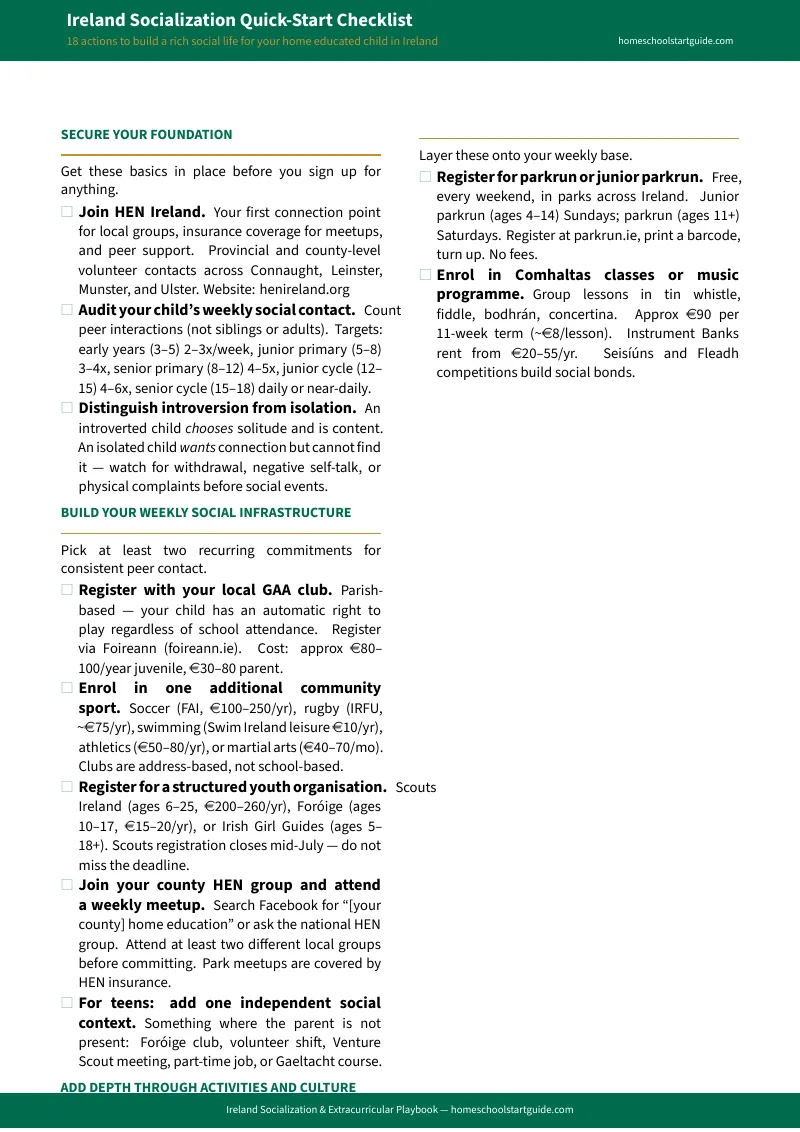
GAA clubs are parish-based — your child has an automatic right to play regardless of school attendance. But registering via Foireann, navigating the parent volunteer expectations, and breaking into a team where every other family met through the school — that's where it gets complicated. The guide covers hurling, football, camogie, and handball, with realistic cost breakdowns (€80–€100/year juvenile, €30–€80 parent, family caps around €220) and specific strategies for integrating when you don't know anyone at the pitch.
Club Sports Beyond GAA
Soccer through FAI local clubs (€100–€250/year), rugby through IRFU youth pathways (~€75/year), swimming via Swim Ireland (leisure membership just €10/year), athletics clubs (€50–€80/year), martial arts (€40–€70/month), equestrian centres, and outdoor adventure. Each sport mapped with registration process, cost, age ranges, and the social dynamics home-educated children actually encounter.
Youth Organisations — Scouts, Foróige, and Irish Girl Guides
Scouts Ireland runs from ages 6 to 25 (€200–€260/year including the €91 national fee — registration closes mid-July). Foróige clubs cost just €15–€20/year and run in almost every town. Irish Girl Guides cover ages 5 to 18+. The guide explains how each organisation works, what the time commitment looks like, and why these are among the strongest social environments for home-educated children — because participation is address-based, not school-based.
Arts, Music, and Irish Cultural Heritage
Comhaltas branches offer group lessons in tin whistle, fiddle, bodhrán, and concertina for approximately €90 per 11-week term. Instrument Banks rent instruments from €20–€55/year. Feis competitions and Fleadh Cheoil provide performance experience and deep community connection. Youth Theatre Ireland, local drama societies, RIAM music programmes, and visual arts options are all mapped with costs and access routes.
STEM and Coding
CoderDojo was founded in Ireland and runs free coding sessions for young people in dojos across the country. BT Young Scientist, SciFest, Science Foundation Ireland programmes, Junior Einsteins workshops, and Raspberry Pi clubs provide hands-on STEM socialization. The guide covers what's available, where, and how to get your child involved without a school to nominate them.
Libraries, Museums, and Heritage Sites
County libraries offer free storytime, craft sessions, book clubs, digital workshops, and meeting rooms your co-op can book. The National Museum of Ireland, National Gallery, and IMMA are all free. An OPW Heritage Card (€40 adult, €10 child, €90 family) gives unlimited access to 780+ heritage sites. The guide shows you how to turn these into recurring social commitments, not one-off field trips.
Gaeltacht Summer Courses
Three weeks in the Gaeltacht is one of the most powerful socialization experiences available to Irish children — language immersion, independence from parents, and friendships that last years. The guide covers how to choose a college (Coláiste Lurgan, Coláiste na bhFiann, and others), when to book (popular colleges fill by February), what it costs, and how home-educated children experience the Gaeltacht differently from school-going peers.
Tusla AEARS Assessment — Building Your Social Portfolio
This is not optional. Tusla assessors evaluate your child's social development as part of the "personality" dimension under the Education (Welfare) Act 2000. The guide gives you a structured Social Portfolio template — a documented, organised record of your child's peer interactions, community involvement, and extracurricular participation that satisfies the AEARS criteria. Walk into your assessment with confidence, not anxiety.
The De-Schooling and Gentle Integration Guide
If your child left school because it was failing them — particularly children with autism, ADHD, or other neurodivergent profiles — the last thing they need is to be pushed straight into another high-stimulation group environment. The guide includes a structured de-schooling timeline and gentle reintegration strategies: when to wait, when to push gently, and how to distinguish between healthy introversion and genuine isolation that needs intervention.
Conversation Scripts for Irish Life
What to say when your mother asks "but what about friends?" What to tell the neighbour who thinks you're depriving your child. How to explain your approach to a Tusla assessor in language they're trained to evaluate. Specific, tested scripts for the conversations that Irish home educators face — not American platitudes about "socialization myths."
Who This Playbook Is For
- Parents who recently withdrew their child from national school and need to build a social life from scratch — fast, because the Tusla assessment clock is ticking
- Families who have been home educating for years but feel stuck in a small bubble of the same three families at the park every Tuesday
- Parents of neurodivergent children (autism, ADHD, sensory processing differences) who need gentle, structured social integration — not a loud pitch or a chaotic classroom
- Rural families in the West, Midlands, or border counties who are geographically isolated from urban meetup groups and need strategies that work outside Dublin and Cork
- Parents approaching a Tusla AEARS assessment who need documented evidence of social development — and a framework for presenting it
- Anyone who is tired of answering "but what about socialization?" with a defensive monologue and wants specific, evidence-backed talking points instead
- Families who want their child in GAA, Scouts, or Comhaltas but feel intimidated by the school-gate social dynamics and don't know how to navigate registration, costs, or cliques
Why Not Just Use the Free Resources?
You can. HEN Ireland's volunteer contacts, Facebook groups, and the annual gathering are genuine community assets. Tusla's guidance documents are publicly available. Individual blogs cover specific field trips and curriculum adaptations. Here's what assembling it yourself actually looks like:
- Weeks of scrolling. HEN Ireland operates entirely on volunteer effort — "County Contacts are all volunteers, we have no paid staff." The quality, frequency, and availability of meetups varies wildly from county to county. You post in a Facebook group, wait for responses, scroll through three years of posts looking for what's been tried before, and piece together a social calendar from scattered replies. The cognitive load sits entirely on you.
- No Tusla assessment guidance. Tusla's published documents explain what they evaluate. They do not explain how to document social development, what format assessors prefer, or how to present non-traditional social environments in language that satisfies the Act. The distance between "we know the law" and "we know how to demonstrate compliance" is where families panic.
- No cost data in one place. Finding out that Scouts Ireland costs €200–€260/year, GAA is €80–€100, Foróige is €15–€20, and Comhaltas terms run €90 requires visiting four different websites, reading registration forms, and in some cases emailing club secretaries. The Playbook maps every major activity with real costs so you can budget your year in one sitting.
- No integration strategy. Free resources tell you that GAA clubs exist. They don't tell you how to walk into a club where every other parent met through the school, how to handle the volunteer expectations, or what to do when your child is the only one who doesn't know anyone on the team. The Playbook covers the social dynamics, not just the logistics.
- No SEN guidance. If your child is autistic or otherwise neurodivergent, generic advice to "just join a club" is not only unhelpful — it can be harmful. The Playbook includes dedicated chapters on de-schooling, gentle integration, and identifying environments that match your child's sensory and social processing needs.
Free resources tell you what exists. The Playbook tells you how to get in, what it costs, how to navigate the social dynamics, how to document it for Tusla, and how to handle the people who question your decision.
— Less Than One Term of Foróige
A year of Scouts Ireland runs €200–€260 per child. GAA registration is €80–€100. Even Foróige — the most affordable structured youth organisation in Ireland — costs €15–€20/year. A three-week Gaeltacht course runs €800–€1,500. The Playbook costs less than a single term of most activities it maps — and it ensures you choose the right activities for your child, integrate smoothly, and document everything properly.
The Playbook includes the full 25-chapter guide (covering GAA, club sports, Scouts, Foróige, arts, music, Comhaltas, STEM, CoderDojo, libraries, museums, heritage sites, Gaeltacht courses, de-schooling, neurodivergent socialization, Tusla assessment preparation, conversation scripts, weekly calendar planning, budgeting, third-level pathways, starting your own group, faith-based and multicultural networks, flexi-schooling, documentation, and annual review), the Quick-Start Checklist (18 actions across 5 steps for families who need to start this week), and standalone printable reference sheets. Instant download, no account required.
Money-back guarantee, no time limit. If the Playbook doesn't help you build a richer social life for your child and prepare for your Tusla assessment, email us and we'll refund you. No questions asked.
Not ready for the full Playbook? Download the free Ireland Socialization Quick-Start Checklist — 18 concrete actions covering your social foundation, weekly infrastructure, cultural activities, documentation, and how to handle the critics. It's enough to get started this week, and it's free.
Your child doesn't need to attend school to have a rich social life. They need a parent who knows exactly how to build one using the institutions Ireland already has — GAA pitches, Scout dens, Comhaltas sessions, library programmes, and heritage sites. The Playbook gives you the map.
Frequently Asked Questions
What if the rules change after I buy?
We update the guide when the rules change. Email us any time, even years later, and we'll send you the current edition free.