Your Child's Academics Are Sorted. Their Social Blueprint Isn't.
You didn't deregister your child on a whim. You researched the legal requirements, found a curriculum that works, and built a routine that fits your family. The academics are handled. But then your mother-in-law asks at Sunday lunch — "But what about socialisation?" — and the best you've got is a defensive blog post you read at midnight about how socialisation is actually a myth.
Except it isn't a myth. It's a real logistical challenge. Your child isn't struggling because home education is wrong — they're struggling because nobody gave you a system for building a social life outside the school system. Schools provide social infrastructure automatically — assembly, sports day, after-school clubs, the lunch table. When you deregister, that infrastructure vanishes. And the advice online is either vague ("just find a co-op!"), American ("sign up for 4-H in your county!" — you live in Yorkshire), or stuck in 2019. Education Otherwise will tell you why the LA's questions are inappropriate. HEAS will post you a physical booklet for £8.75. The council website will remind you that education "may not be deemed suitable if it leads to excessive isolation from the child's peers" — which is the threat that keeps you awake at night, not a solution to it.
You don't need another article defending your choice. You need a Social Blueprint — the directories, scripts, schedules, and frameworks that build real social infrastructure for your child, in your region, at a pace that works for your family.
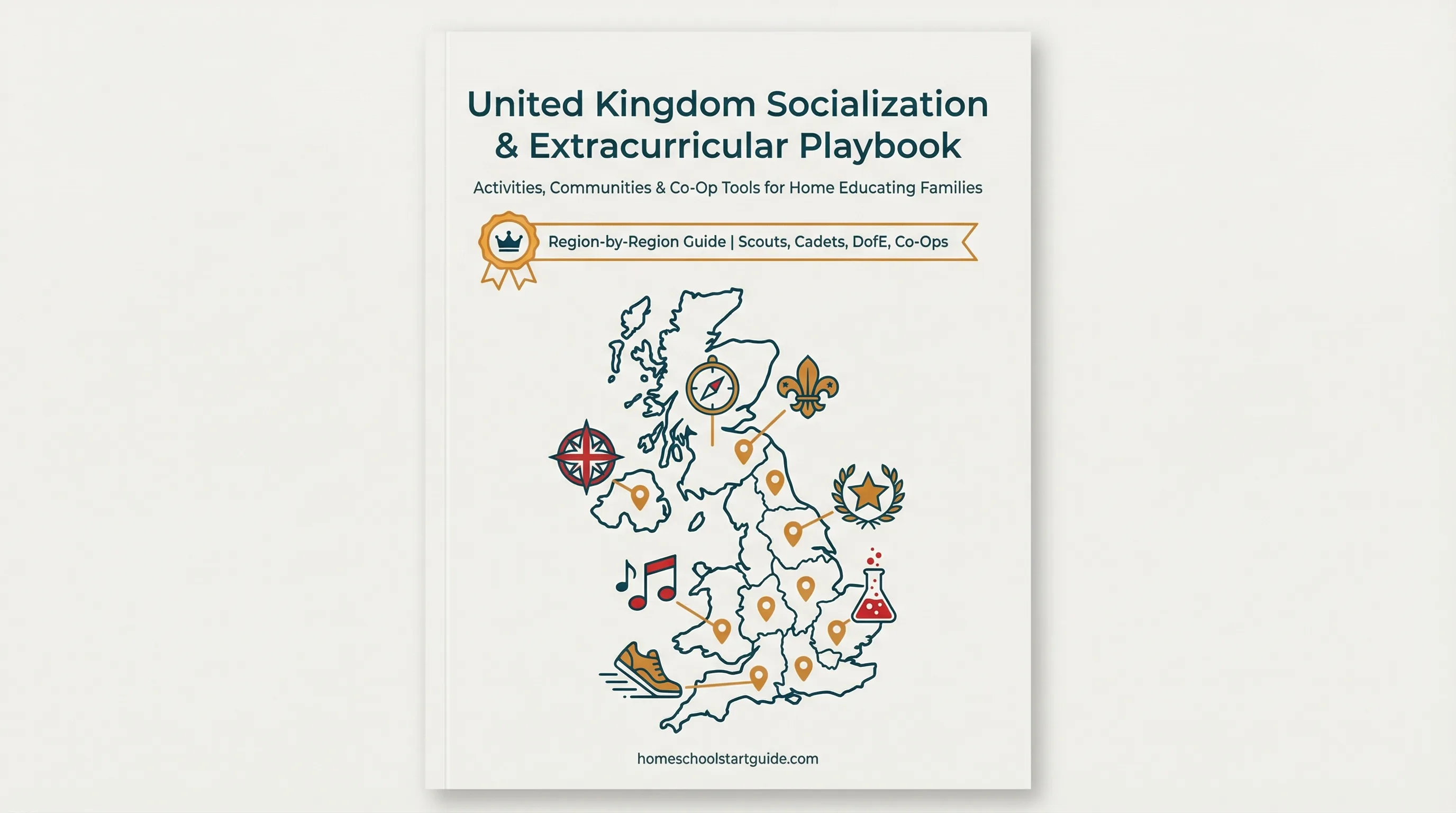
That's what this Playbook is. Not theory. Not reassurance. A Social Blueprint for building a connected, sustainable social life for your home-educated child — specifically engineered for the UK landscape, with the exact tools and scripts to make it happen.
What's Inside the Playbook
The Region-by-Region Activity Directory — because Googling "homeschool extracurriculars UK" returns American 4-H chapters and Civil Air Patrol branches, and the UK home education sites that do exist haven't been updated since 2021.
A curated directory of the major extracurricular pathways open to independent home educators — organised by region. Covers Scouts, Girlguiding (Beavers through Explorers), Cadets (Army, Air, Sea — free, government-funded, open from age 12), Duke of Edinburgh Award, community sports clubs, leisure centres with off-peak programming, youth drama, STEM clubs, and cultural organisations like English Heritage and National Trust education programmes. Each listing includes registration process for home educators, age requirements, typical costs, and best sign-up window.
The Co-Op Founding Toolkit — because UK home education co-ops collapse before Christmas. Parents join with enthusiasm, disagree about structure by half-term, and the group dissolves because nobody set up governance.
The actual infrastructure that prevents this: a customisable organisational charter template, a conflict-resolution protocol, a transparent cost-sharing spreadsheet, safeguarding policy templates aligned to UK requirements, and a scheduling framework. Whether you're joining an existing co-op or founding one from scratch, this is the paperwork that keeps the group alive past Term 1.
The Off-Peak Negotiation Scripts — because asking a martial arts studio for a "home-ed discount" gets you a blank stare, but asking to "fill their empty 11 AM mats on a Tuesday" gets you a business conversation.
Verbatim email templates and phone scripts for approaching local business owners to pitch a daytime "Home Education Class" at a negotiated rate. You're not asking for charity — you're filling their dead hours. The scripts position your proposal as a business opportunity for them, not a favour for you.
The Urban Hub vs. Rural Anchor Framework — because advice built for Greater London is useless when you live in rural Norfolk, and vice versa.
Two distinct strategic frameworks: the Hub Strategy for urban families (leveraging public transport, municipal programmes, large institutions, and co-op networks) and the Anchor Strategy for rural families (building deep community ties through village groups, agricultural shows, parish councils, and regional home education gatherings). Both are UK-specific, not repurposed American advice.
The Social Skills Assessment Framework — because your child is articulate with adults but goes quiet around same-age peers, and you can't tell if that's healthy introversion or a genuine skill gap.
Age-specific benchmarks from primary years through Key Stage 4 for evaluating whether your child is building genuine peer connections or just performing well in adult-supervised settings. Covers the blind spots specific to home-educated children: difficulty reading unspoken group dynamics, social processing that feels draining, and the gap between being articulate with grown-ups and navigating unstructured peer interaction.
The De-Schooling Socialisation Framework — because if your child was withdrawn due to bullying, unmet SEN needs, or school-induced anxiety, telling them to "join Scouts" on day one will set them back, not forward.
A phased, gentle integration approach — starting with low-demand, asynchronous social activities (nature walks, online interest-led groups, parallel play at heritage sites) and gradually escalating social complexity as your child's confidence rebuilds. Specifically designed for children in the de-schooling period and those with neurodivergent profiles.
Conversation Scripts for Family Critics — because "socialisation is actually a myth" is not a useful response at Sunday lunch, and you're tired of sounding defensive about a decision you're confident in.
Five verbatim scripts for the conversations that drain your energy: the mother-in-law interrogation, the "concerned" text from your sister, the school-gate parent who asks "But don't they need real friends?", the partner who wants to send them back, and the hardest one — when your own child says they feel lonely. Calm, specific responses you can rehearse and use tonight.
The Extracurricular Planning Calendar — because discovering Cadets registration closed two months ago, while Scouts has a 170,000-child waiting list, is the kind of preventable failure that makes you want to give up on extracurriculars entirely.
A fillable annual planner aligned to the UK academic year (September start, three terms). Maps Scouts registration windows, Cadets enrolment periods, DofE sign-up deadlines, sports registration dates, drama audition seasons, and leisure centre term programme start dates — so you plan your child's social year intentionally, with deadlines visible.
The LA Documentation Tracker — because "excessive isolation from the child's peers" is what the council letter says, and you need documentation ready before the letter arrives, not after.
A printable tracker for recording extracurricular activities, museum visits, community engagement, and social milestones. If your Local Authority makes an informal enquiry, this gives you a documented record of your child's social and extracurricular life — formatted to clearly satisfy the requirement. Peace of mind in a single printable sheet.
Who This Playbook Is For
- Parents who are confident in their home education academics but privately worry about whether their child is building real peer connections — not just behaving well around adults at co-op meetings
- Families tired of the "socialisation question" from extended family who want more than philosophical reassurance — they want a documented activity calendar and a concrete plan they can point to
- New home educators who left the school system and need to rebuild their child's entire social infrastructure from scratch — using UK-specific resources, not American advice
- Rural families in Norfolk, Cornwall, the Scottish Borders, or mid-Wales who need strategies designed for geographic distance — not advice that assumes you live on the Northern Line
- Working home education parents who need a sustainable social calendar without turning every weekday into an hour-long drive to the next activity
- Parents of children recovering from school trauma — bullying, unmet SEN needs, or anxiety — who need a phased approach to social reintegration, not pressure to "just join a club"
- Parents with teenagers approaching GCSEs who need extracurricular depth that UCAS personal statements require — not just informal playdates and library visits
After Using the Playbook, You'll Be Able To
- Identify every Scouts troop, Cadets unit, DofE centre, sports league, and community organisation in your region that accepts independent home education registrations — without hours of Googling and dead-end Facebook group searches
- Start or join a home education co-op with professional organisational infrastructure — charter, safeguarding policies, cost-sharing agreements, and conflict-resolution protocols that prevent collapse
- Negotiate daytime "home education class" rates at local leisure centres, dojos, dance studios, and climbing walls using scripts that position your proposal as a business opportunity for the facility
- Support a child through the de-schooling period with a phased social integration plan that respects their pace — instead of forcing group activities that trigger anxiety
- Distinguish between a child who is introverted (a personality trait that needs no fixing) and a child who is missing social cues (a skill gap that benefits from intentional practice) — with age-specific benchmarks aligned to UK Key Stages
- Build a sustainable extracurricular calendar that balances social connection with family rest — without the burnout cycle of over-committing and withdrawing
- Document your child's social and extracurricular engagement in a format that confidently satisfies any Local Authority informal enquiry
- Answer the socialisation question at the next family gathering with specifics, not platitudes — because your child's social calendar, enrolments, and development milestones are documented and intentional
Why Not Just Piece This Together for Free?
You can try. The information exists — scattered across a dozen different sources, each with its own problem.
- Education Otherwise covers defence, not logistics. They're excellent at protecting your right to home educate. But their socialisation content focuses on why the criticism is wrong, not how to build the practical infrastructure. They'll tell you the LA's questions are inappropriate. They won't tell you how to negotiate a Tuesday morning martial arts session or set up a co-op that survives past half-term.
- HEAS sells a physical booklet for £8.75 — posted by Royal Mail. Eighty pages of text without a single email template, scheduling framework, or negotiation script. It reads like a legacy academic document from a decade ago. Reassuring, but not operational.
- Facebook advice is anecdotal and contradictory. "My child does Scouts and she's fine" doesn't give you a replicable system. It doesn't tell you which organisations accept home education registrations by region, how to build a co-op that lasts, or how to evaluate whether your child's social skills are genuinely developing or just masking.
- American advice dominates search results. Most socialisation guides reference US organisations, US county systems, and US co-op structures. Scouts vs. Boy Scouts, Cadets vs. Civil Air Patrol, DofE vs. 4-H. You end up adapting American strategies to British realities, or worse, following advice that doesn't apply here at all.
- Council guidance is a threat, not a guide. Your LA's EHE page exists to remind you that insufficient socialisation can trigger a School Attendance Order. It doesn't help you build the social life — it warns you about the consequences of not having one.
- Time is the real cost. Forty hours of scrolling through outdated directories, contradictory threads, and dormant Facebook groups isn't free. For a working home educator whose time is the scarcest resource in the household, one consolidated Social Blueprint saves you several weekends.
A single term of football, gymnastics, or swimming lessons costs £100–300+. Popular home education curricula cost £300–1,500/year and still don't solve the social connection problem. This Playbook is the practical "where to go, what to say, how to negotiate, and how to sustain it" guide — the Social Blueprint that no existing product provides.
— Less Than One Term of Extracurriculars
A single term of recreational gymnastics costs £100–250. Swimming lessons run £60–150 per term. This Playbook is a one-time investment that ensures every pound you spend on extracurriculars goes to the right activities — the ones that build genuine friendships, fit your family's geographic reality, and create a sustainable rhythm instead of a burnout cycle.
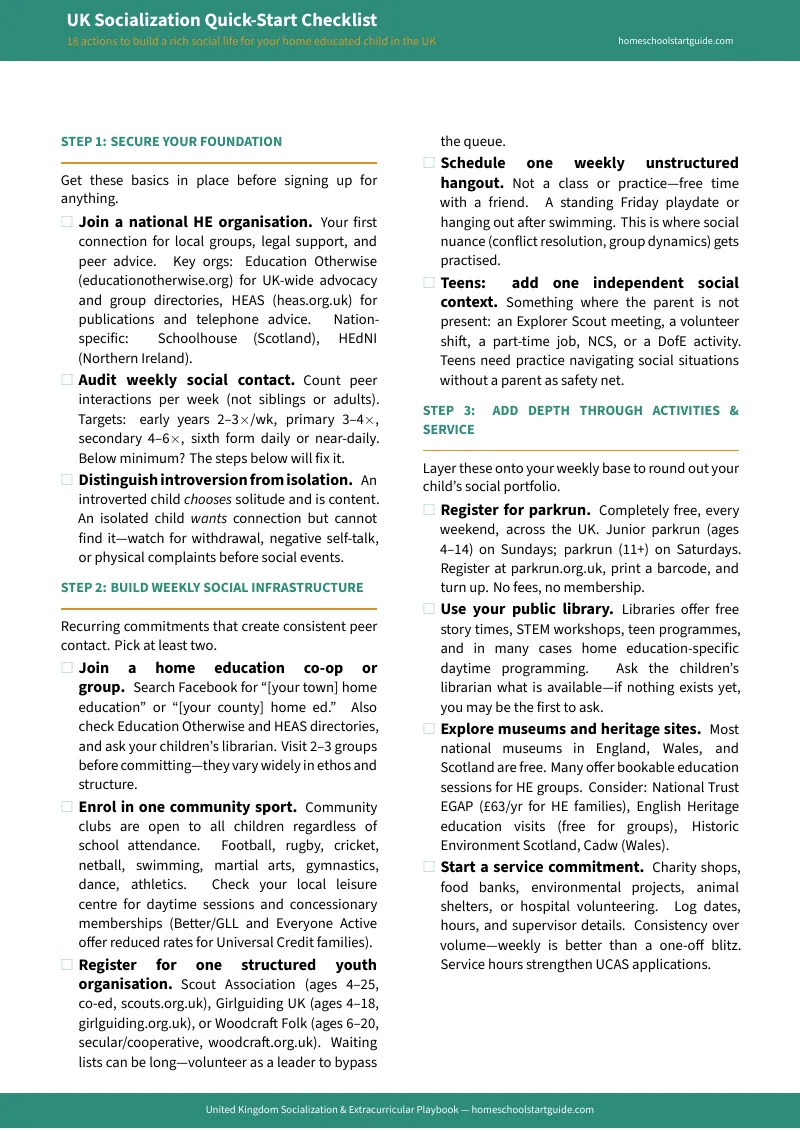
The Playbook includes the full guide plus standalone printable reference cards and templates: the Quick-Start Checklist, the Region-by-Region Activity Directory, the Co-Op Founding Toolkit (charter, safeguarding templates, cost-sharing tools), the Off-Peak Negotiation Scripts, the Social Skills Assessment Framework, the De-Schooling Socialisation Framework, the Conversation Scripts for Family Critics, the UK Academic Year Planning Calendar, the LA Documentation Tracker, the University Extracurricular Portfolio Template, and the Age-by-Age Activity Roadmap. Instant download, no account required.
Money-back guarantee, no time limit. If the Playbook doesn't give your family a clearer path to genuine social connection and a sustainable extracurricular calendar, email us and we'll refund you. No questions asked.
Not ready for the full Playbook? Download the free Socialisation & Extracurricular Quick-Start Checklist — a one-page overview of the key action items: identify your region's top home-education-friendly organisations, assess your child's social development by age, and pick the first three activities to pursue. It's the starting point, and it's free.
Your child's education already proves they can learn anything. The Social Blueprint inside this Playbook makes sure they also have the friendships, the community, and the social confidence to match — built on British soil, on your family's terms.
Frequently Asked Questions
What if the rules change after I buy?
We update the guide when the rules change. Email us any time, even years later, and we'll send you the current edition free.