Your Homeschool Is Legally Happening. Now You Need Proof.
The South Africa Portfolio & Assessment Templates is a complete compliance and documentation system — BELA Act-aligned record-keeping templates, a CAPS translation rubric, phase-end assessor checklists, and subject dividers using correct South African educational nomenclature — that turns your real, living, eclectic home education into the structured, legally recognized evidence that provincial departments and competent assessors demand. Not a curriculum. Not a corporate platform. Not a government form designed for a classroom teacher managing 40 learners. A practical administrative toolkit designed specifically for the independent South African home educator who teaches their way and needs to prove it on paper.
Here is what actually happens when the BELA Act meets your kitchen table: You pull your child from a failing school — or you register from the start — and within days you are confronted by the provincial department's requirements. An Education Plan. A Portfolio of Evidence. A "comparable to the National Curriculum" standard that nobody explains in plain language. You search online and find three things: R30,000-per-year corporate providers who want to own your child's academic records entirely; free GDE templates written by bureaucrats for classroom teachers; and Etsy planners from Johannesburg sellers that track daily nature journals beautifully but contain zero CAPS mapping, zero assessor preparation, and zero reference to the BELA Act at all. You are doing a Charlotte Mason nature study, a Minecraft coding hour, and a home economics afternoon — and you have no idea how to make that look like Home Language, Technology, and Economic Management Sciences on paper. The Pestalozzi Trust will defend you in court if the department oversteps. But what you need right now is not a legal defense — it is a filing system.
Built specifically for South Africa. Uses correct SA educational nomenclature — Home Language, First Additional Language, Life Orientation, Economic Management Sciences — not "Language Arts," "Social Studies," or any other US-centric terminology that marks an international template immediately.
Is This For You?
This is for you — the parent who:
- Is registering with your Provincial Education Department and needs an Education Plan and Portfolio of Evidence framework that actually matches what the law requires — not what outdated 1999 policy templates still circulating online say it requires
- Is approaching the end of Grade 3, Grade 6, or Grade 9 and has a mandatory competent assessor visit coming up, and needs to know exactly what to have in the folder on the table
- Is running an eclectic, Charlotte Mason, project-based, or unschooling approach and has no idea how to map your child's genuine learning into the CAPS-comparable language that officials understand
- Just pulled your child from a school — due to bullying, unplaced placement, or special educational needs — and needs immediate structure to demonstrate that a real education is underway, right now, to your family and to officials
- Refuses to pay R20,000 to R30,000 per year to Impaq or Brainline just to have someone manage your administrative records — but also cannot afford to walk into a departmental assessment with a lever-arch file of disorganized photocopies and handwritten notes
- Knows that quarterly reports are not legally required under the BELA Act guidelines, but is still spending hours every three months producing them anyway because you are not sure what the actual minimum is
You are protecting your educational freedom. These templates protect it on paper.
What's Inside the Portfolio & Assessment Templates
- Master Portfolio Framework — A complete filing structure and index system for your Portfolio of Evidence, built around Section 51 of the South African Schools Act and the BELA Act statutory requirements. Includes a declaration cover page, annual overview sheet, and tab structure using the official South African Phase designations: Foundation Phase (Gr R–3), Intermediate Phase (Gr 4–6), and Senior Phase (Gr 7–9).
- The CAPS Translation Rubric — The centrepiece of the entire system. A mapping matrix that shows you exactly how to categorize non-traditional learning into state-recognized reporting categories. Cooking dinner maps to Economic Management Sciences (fractions, measurement, consumer studies). Building a fort maps to Technology (design, construction, problem-solving). A nature walk maps to Life Skills and Natural Sciences. This rubric is the single tool that allows eclectic and unschooling families to satisfy the "comparable to" standard without abandoning their pedagogy.
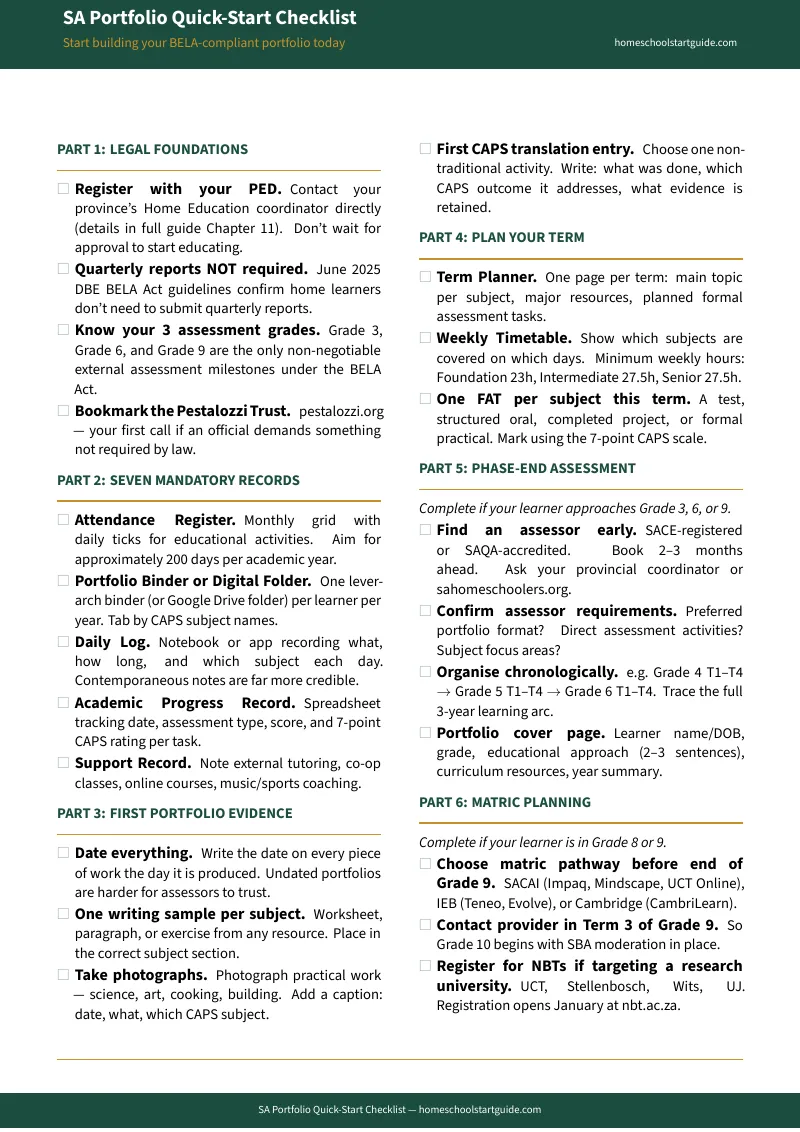
- Phase-End Assessor Preparation Checklist — A dedicated checklist engineered specifically for the mandatory end-of-phase assessments at Grade 3, 6, and 9. Lists exactly what a competent assessor will look for to verify phase outcomes across Home Language, First Additional Language (FAL), Mathematics, and Life Skills. No other affordable SA resource addresses this newly enforced statutory requirement. Walk into the assessment visit with this checklist completed and your portfolio organized around it.
- Continuous Assessment Tracking Sheets — Subject-by-subject record sheets using correct SA nomenclature for all Foundation, Intermediate, and Senior Phase subjects. Track ongoing progress without producing the quarterly reports that the DBE's June 2025 guidelines confirmed are not legally required for home learners. Record what you actually need, nothing more.
- SA Subject Dividers — Professionally formatted tab dividers for every compulsory phase subject: Home Language, First Additional Language, Mathematics, Life Skills (Foundation), Natural Sciences, Social Sciences, Technology, Economic Management Sciences, and Life Orientation. Each divider includes the subject's phase-specific outcome summary so you know what the assessor is measuring — not generic dividers that say "Science" and "English."
- Annual Learner Progress Summary — A structured year-end summary template that consolidates continuous assessment records into a single reviewable document for your own records or for departmental submission requests. Written in the language PED officials recognize, translated from your actual teaching notes.
- Attendance Register — A properly formatted attendance record aligned to the South African school calendar, covering Term 1 through Term 4. Section 51 and the National Policy require parents to maintain this record. This template is already structured; you only need to mark the dates.
- Education Plan Template — A registration-ready Education Plan that satisfies the GDE, WCED, and KZN departmental application requirements. Includes all required sections: learner details, educational philosophy, curriculum approach, assessment methodology, and the statutory comparability statement.
After Using These Templates, You'll Be Able To:
- Submit a registration application to your Provincial Education Department that is structured, legally sound, and professional — reducing the likelihood of unlawful departmental pushback that causes delays and stress
- Walk into a Grade 3, 6, or 9 competent assessor visit with a complete, organized Portfolio of Evidence that demonstrates phase outcomes across every required subject area — without having followed a rigid textbook approach to get there
- Map your existing eclectic, project-based, or unschooling activities to CAPS-comparable outcomes using the translation rubric — and do it retroactively for work already completed, not just going forward
- Maintain continuous assessment records that satisfy the law without producing the quarterly reports that the Department has confirmed are not legally required for home learners, saving you weeks of unnecessary administrative work each year
- Document your child's learning in the language that South African government officials, independent assessors, and educational bureaucrats understand — while teaching in whatever way works for your family
- Feel administrative confidence instead of administrative dread — knowing that your records are in order, your portfolio is current, and no surprise departmental query will catch you unprepared
Why Templates Built for South Africa — Not Adapted From Somewhere Else
The GDE and WCED free templates are technically compliant but written by bureaucrats for public school teachers managing forty learners. They require complex indexing configurations, declaration annexures, and moderation signatures designed for institutional use. Adapting them for a one-child home education takes hours of reformatting and leaves gaps that parents cannot identify because the jargon was never explained.
The Etsy Canva templates from South African creators are beautifully designed for Charlotte Mason journaling and nature study tracking. They have no CAPS mapping, no assessor preparation, no phase-end checklists, and no reference to Section 51 or the BELA Act. They help you document what happened. They cannot help you prove it meets statutory requirements.
The Teachers Pay Teachers templates reference Common Core, "Act 169 Compliant Evaluators," "Semesters," and "State Law." They are built for US educators. A South African departmental official reviewing your portfolio will know immediately that your administrative framework was designed for a different country's legal system.
These templates use the correct SA subject names, the correct phase designations, the correct legal references, and the correct assessment terminology. They were built from the statutory requirements — not adapted from a template designed for someone else.
Less Than One Session With an Independent Assessor
Independent competent assessors in South Africa charge between R500 and R1,500 for a Phase-end assessment visit — and that assumes your portfolio is already organized when they arrive. Walking in without a structured portfolio means the assessor is doing your administrative work on their clock, at their hourly rate, while your child waits. A single consultation with an educational administrator to set up your filing system costs more than this entire toolkit.
For the cost of , you get a complete system, ready to use from the moment you download it. Print the templates. File the subjects. Map the activities. Your portfolio does not have to be an emergency project the night before an assessor visit.
For — Less Than One Term of Anxiety
Compare it to the alternatives:
- Impaq or Brainline annual fees: R20,000–R30,000 — and they own the structure, the timeline, and the reporting
- A single competent assessor visit where you arrive unprepared: R500–R1,500, and they still cannot fix your missing records retroactively
- An educational administrator consultation to set up your filing system: more than this entire toolkit
- The cost of a departmental registration delay because your Education Plan was missing required sections: lost months and compounding anxiety
30-day money-back guarantee. If these templates do not give you a complete, organized, BELA-compliant portfolio system, you pay nothing.
This toolkit is an administrative and organizational resource for home-educating families. It is not legal advice. For legal disputes with provincial departments or questions about constitutional protections, contact the Pestalozzi Trust. For questions about specific departmental requirements in your province, consult your PED directly.
The Department wants evidence. These templates create it — without forcing your family into a R30,000 corporate curriculum or a blank Word document from 2012. Get the South Africa Portfolio & Assessment Templates now and stop treating every assessor visit like a crisis.