
You Qualified for $5,435.62 Per Child — Then the Spending Platform Rejected Your First Purchase
The West Virginia Hope Scholarship promises thousands of dollars for homeschooling or private education. You did the hard part — you tracked down your child's WVEIS number from a county office that took three weeks to respond, you filed the dual-purpose Notice of Intent under the right statute, you uploaded every document in the right format before the June 15 deadline. Then you tried to actually spend the money.
TheoPay rejected your curriculum order because the vendor had not completed Education Service Provider registration. Your tutoring reimbursement was flagged because the tutor was a family member — and the Hope Board's definition of "immediate family" at CSR §112-18-2.15 includes first cousins, aunts, uncles, and in-laws, not just parents and siblings. You tried to buy a laptop for your high schooler and discovered you already used the biennial technology allowance on a tablet eighteen months ago. Meanwhile, your homeschool group is arguing about whether Hope families are even real homeschoolers anymore, CHEWV is publishing warnings about state oversight, and you cannot get a straight answer about what the annual assessment actually requires.
That is the gap this guide fills. Not the rules — the official Parent Handbook covers those. The Hope Scholarship Compliance and Spending System: how to verify eligibility under the new universal expansion, how to get your WVEIS ID without a county runaround, how to navigate TheoPay so every purchase goes through on the first submission, how to stay within the spending rules without a spreadsheet nightmare, how to protect your family's educational autonomy while using state funds, and how to handle audits, renewals, and program exit without losing a dollar.
What the Guide Covers
- Eligibility after universal expansion — The three requirements every applicant must meet, what changed on July 1 2026 when the 45-day public school attendance rule was eliminated, why lifelong homeschoolers and private school students can now apply for the first time, the kindergarten age cutoff (turning 5 before July 1), and the IEP/504 trade-off families must understand before accepting — because taking the Hope Scholarship means voluntarily forfeiting federal IDEA protections in public school.
- The WVEIS ID gauntlet — Step-by-step instructions for requesting the student identification number from your county board of education, a communication workflow with the statutory citation that compels the county to issue it, follow-up timing for rural districts where processing takes weeks, and escalation paths when a county delays past the point where your application window is at risk.
- Application timeline with every deadline mapped — The March 2 to June 15 full-award window, what happens to your funding at each cutoff (100% by June 15, 75% by September 15, 50% by November 30, 25% by February 28), every document you need including the certified birth certificate that rejects hospital-issued versions, why uploading everything in one session matters, and how to avoid the 14-to-30-day review delays that push families past the next funding tier.
- The dual-purpose Notice of Intent explained — Why Hope families file the Version 5 NOI under W. Va. Code §18-8-1(m) instead of the standard Exemption C homeschool notice, what the form satisfies for both compulsory attendance and the Hope Board, how to submit it to your county superintendent, and why CSR §112-18-3.4 allows the Board to withhold your funding if this form is missing.
- TheoPay and the spending platform — from first login to audit-proof purchases — How the approved marketplace works, when direct pay applies versus reimbursement, which vendor categories are registered Education Service Providers, what triggers AI-driven purchase denials, the formal Qualified Expense Request appeal process, and the purchase-framing strategies that turn rejected orders into first-try approvals. Parents report that platform rejections are the single biggest source of out-of-pocket loss — one flagged $300 curriculum order or $150 tutoring fee means you pay full retail while the appeal sits in a queue.
- Approved expenses, prohibited purchases, and the lines between them — Curriculum, tutoring by non-family members, educational therapies (speech, OT, ABA), standardized test fees, and technology within the biennial limit of one primary computing device plus one printer per child every two calendar years. Prohibited: furniture, food, gift cards, live animals, ammunition, witchcraft supplies, payments to immediate family under the CSR §112-18-2.15 definition that is broader than most families expect, and the art supply and shredder caps the Board set in recent expense rulings.
- The homeschool status firewall — The legal distinction between Exemption C (traditional homeschooling under §18-8-1(c)(2) — full autonomy, no funding, no testing mandate) and Exemption M (Hope Individualized Instructional Program under §18-8-1(m) — $5,435.62 per child, annual assessment, spending oversight, audit authority). The guide puts both statuses side by side so you know exactly what changes and what does not — and includes the step-by-step exit procedure for returning to Exemption C if you decide the trade-off is not worth it.
- Annual assessment and the June 30 deadline — Which nationally normed standardized tests are accepted, the 23rd-percentile minimum across five subjects, how portfolio evaluation by a WV-certified teacher works as an alternative, why the WV General Summative Assessment does not qualify, and what happens to your account if you miss the submission window.
- Renewal, multi-child strategy, and program exit — The Continued Participation Confirmation (CPC) that must be submitted through the portal by June 15 each year, what happens if you miss it, mid-year entry procedures, how quarterly disbursements work for late enrollees, and the formal termination sequence for leaving the program and returning to traditional homeschooling — including fund forfeiture rules and the new Notice of Intent you must file.
- Audits, enforcement, and the three-year rule — What the Hope Board can request, how to build an audit-defense file throughout the year with parallel expense tracking outside the platform, receipt retention requirements, the recoupment process for illegal expenditures, and account termination procedures. The guide also covers the relocation rule: if your family moves out of West Virginia, you must notify the Board within 15 calendar days, and any transactions processed after your move date are classified as illegal expenditures subject to recoupment.
Who This Guide Is For
- Parents who just learned the Hope Scholarship expanded to all West Virginia students and need to determine whether their child qualifies, what the application involves, and whether the compliance trade-offs are worth $5,435.62 per child
- Families already in the program who are struggling with TheoPay — purchase rejections, unclear vendor registration requirements, or confusion over the biennial technology limit and the tutoring-by-family prohibition
- Traditional West Virginia homeschoolers who operate under Exemption C and want to understand exactly what changes about their legal status, reporting requirements, and state oversight before accepting scholarship funds
- Lifelong homeschoolers and private school families who were ineligible before universal expansion and are navigating the application from scratch — including the WVEIS ID request most have never dealt with
- Multi-child households managing $10,000 to $16,000 or more in combined annual awards who need a system for tracking spending categories, technology limits, assessment deadlines, and renewal confirmations across all their children
Why the Official Handbook Is Not Enough
The Parent Handbook published by the Hope Scholarship Board and State Treasurer's Office tells you what the rules are. It does not show you how to navigate them. It defines approved expense categories without explaining which vendor types are registered as Education Service Providers and which will get your purchase rejected. It references the Notice of Intent without walking you through the difference between the standard Exemption C form and the Version 5 dual-purpose NOI that Hope families must file. It says nothing about getting a WVEIS ID from an uncooperative county office, building an audit-defense file, or structuring your spending so a mid-year vendor deregistration does not leave you scrambling.
Curriculum vendor guides from companies like Master Books, Time4Learning, and Christianbook explain how to spend your scholarship on their products. They advertise "Hope Approved" status and TheoPay integration — but they omit the annual assessment requirement, the technology biennial limit, the family-member tutoring prohibition, and the spending caps the Board set in recent rulings. They are sales funnels, not compliance systems.
Advocacy organizations like CHEWV provide thorough legal analysis of the Exemption C versus Exemption M distinction — but their core position is that participating in the Hope Scholarship means leaving traditional homeschooling. If you have decided to participate, you need operational guidance they are not designed to provide.
This guide sits in the gap between the rules and the execution. Every chapter is built from W. Va. Code §18-31, the §18-8-1 exemption framework, CSR Title 112 Series 18, Hope Board meeting minutes and expense rulings, TheoPay platform mechanics, and first-year parent experiences — translated into plain-language procedures a family can follow without a policy analyst on retainer.
What You Get
Your download includes 9 PDFs — the complete guide, the quick-start checklist, and 7 standalone planning tools you can print and use immediately:
- The West Virginia Hope Scholarship Parent Guide — 52 pages covering eligibility after universal expansion, the WVEIS ID process, application deadlines and document requirements, the dual-purpose Notice of Intent, award amounts and disbursement schedule, TheoPay navigation, approved and prohibited expenses, the Exemption C vs. Exemption M status distinction, annual assessment, renewal, audits, edge-case scenarios, and federal tax credit stacking
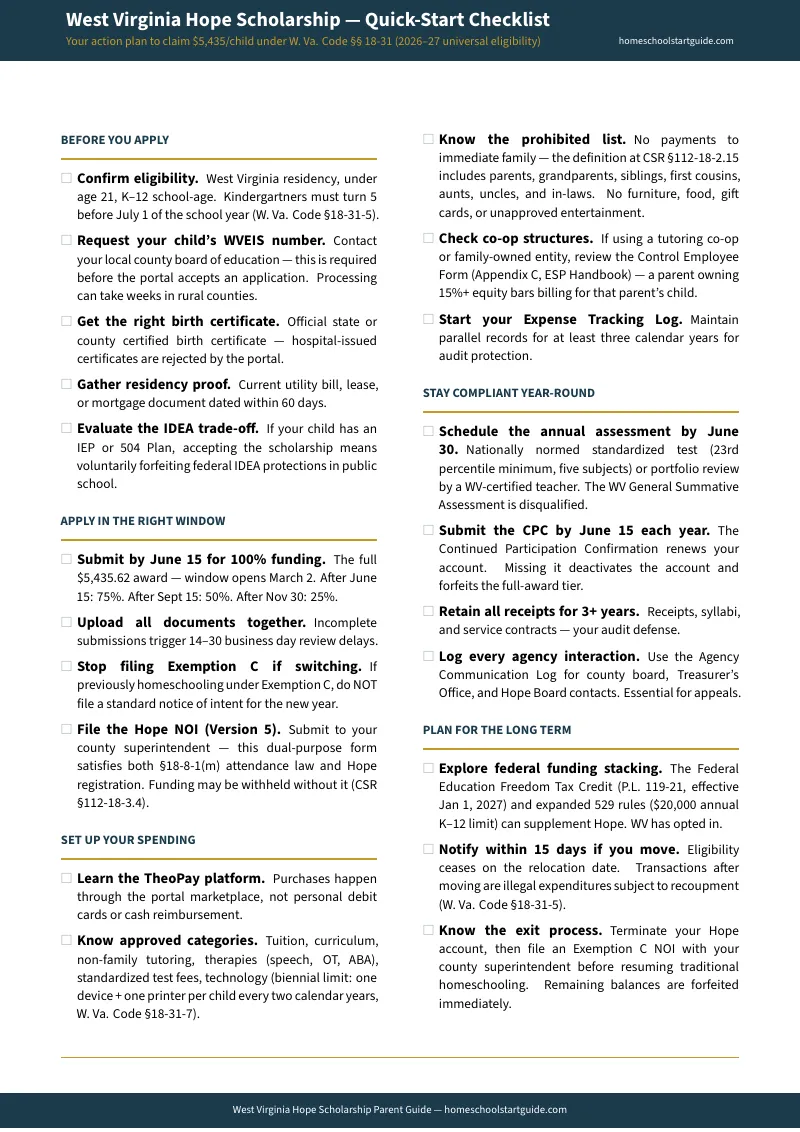
- Quick-Start Checklist — A 21-item action checklist organized across the full scholarship lifecycle: eligibility verification, WVEIS ID request, document preparation, application submission, spending compliance setup, assessment scheduling, and renewal protection
- WVEIS ID Request Tracker — Log every contact with your county board of education from first request through confirmed number, with escalation steps
- Document Preparation Checklist — Pre-application audit of every required document with common rejection causes
- Application Timeline Planner — Work backward from your target funding window to set deadlines for WVEIS requests, document gathering, and portal submission
- Expense Tracking Log — Parallel records for every TheoPay purchase, reimbursement, and technology-cap purchase across the academic year
- Annual Compliance Calendar — 12-month calendar covering application windows, disbursement dates, CPC renewal, and assessment deadlines
- Assessment Planning Organizer — Dual-path planner for standardized testing or portfolio evaluation, working backward from the June 30 deadline
- Agency Communication Log — Record every interaction with county offices, the State Treasurer's Office, the Hope Board, and Education Service Providers
Satisfaction Guarantee
If this guide does not help you navigate the Hope Scholarship process, email [email protected] for a full refund. No time limit, no forms, no hassle.
Start With the Free Checklist
Download the Quick-Start Checklist at no cost — 21 action items covering eligibility verification, WVEIS ID requests, document preparation, application deadlines, and spending compliance essentials. If the checklist helps and you want the full guide with detailed TheoPay navigation, the complete expense breakdown, the dual-status compliance map, audit-defense procedures, and renewal planning tools, the complete West Virginia Hope Scholarship Parent Guide — with all 9 PDFs including 7 standalone planning tools — is available for .