Your child's school had years to teach them to read. They chose the wrong method.
Balanced literacy. Three-cueing. Guessing from pictures. These are the strategies most schools still use to teach reading — and they are the exact opposite of what a dyslexic brain needs. Your child did not fall behind because they are not trying hard enough. They fell behind because their school used a method that actively trains word-guessing instead of phonemic decoding.
You know this now. You have the diagnosis, or you are certain enough to act. The question is not whether to teach structured literacy at home — it is which programme to buy.
Barton costs $550 per level and has ten levels. All About Reading runs $150 to $200 per level with a separate manipulative kit. Logic of English is comprehensive but overwhelming for children with working-memory deficits. UFLI Foundations costs $70 flat but was designed for classroom Tier 2 intervention, not severe dyslexia. And every review you read online is funded by affiliate commissions from the programmes it recommends.
The Structured Literacy Decision System
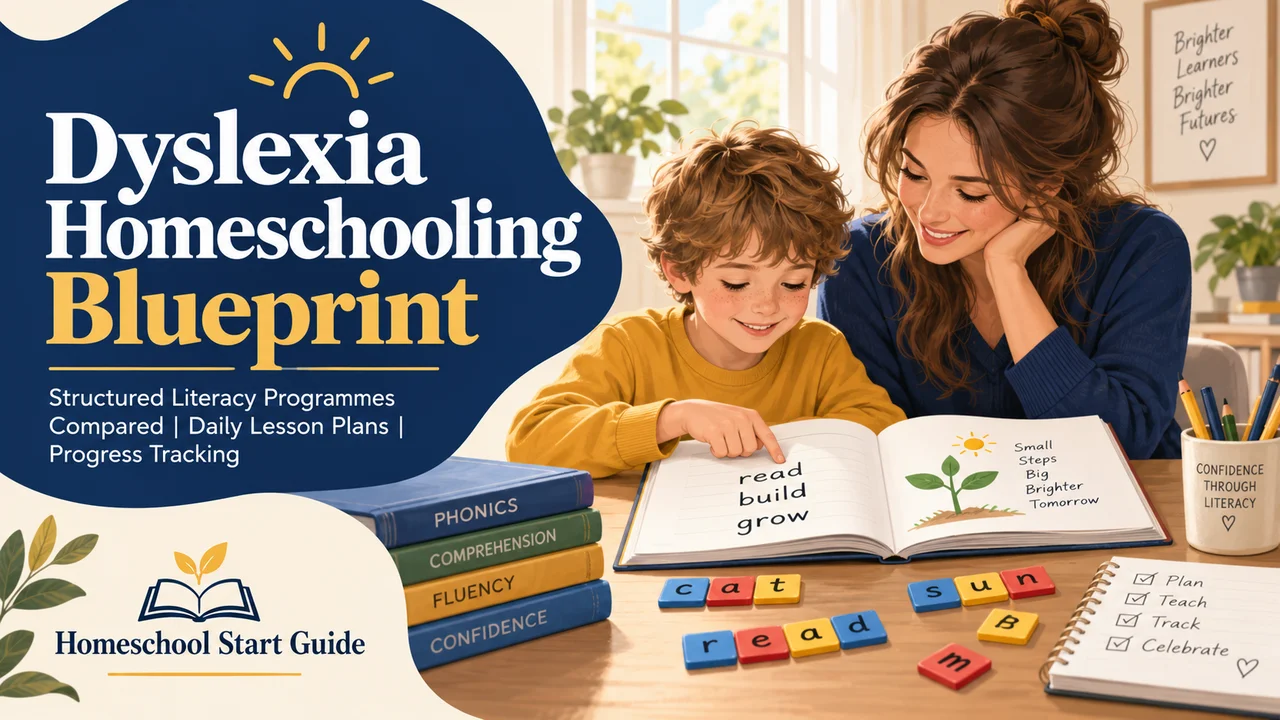
The Dyslexia Homeschooling Blueprint is the guide you read before you spend $200 to $3,000 on a reading programme. It is a 49-page, non-affiliate comparison of every major structured-literacy curriculum — with the daily lesson structure, progress-tracking system, and country-by-country legal withdrawal steps to get your child reading at home.
No affiliate links. No sponsorships. No commissions from programme publishers. The comparison chapter tells you which programmes are tedious, which ones overwhelm children with weak working memory, and which $70 option delivers the same phonemic sequencing as a $550-per-level clinical system — because no affiliate-funded blog will ever tell you that.
What is inside the Blueprint
- The honest programme comparison — Barton, All About Reading, Logic of English, UFLI Foundations, Wilson, Toe by Toe, and the digital options. Cost per level, parent prep time, student engagement, resale value, and a decision matrix that maps your child's cognitive profile directly to the programme most likely to work.
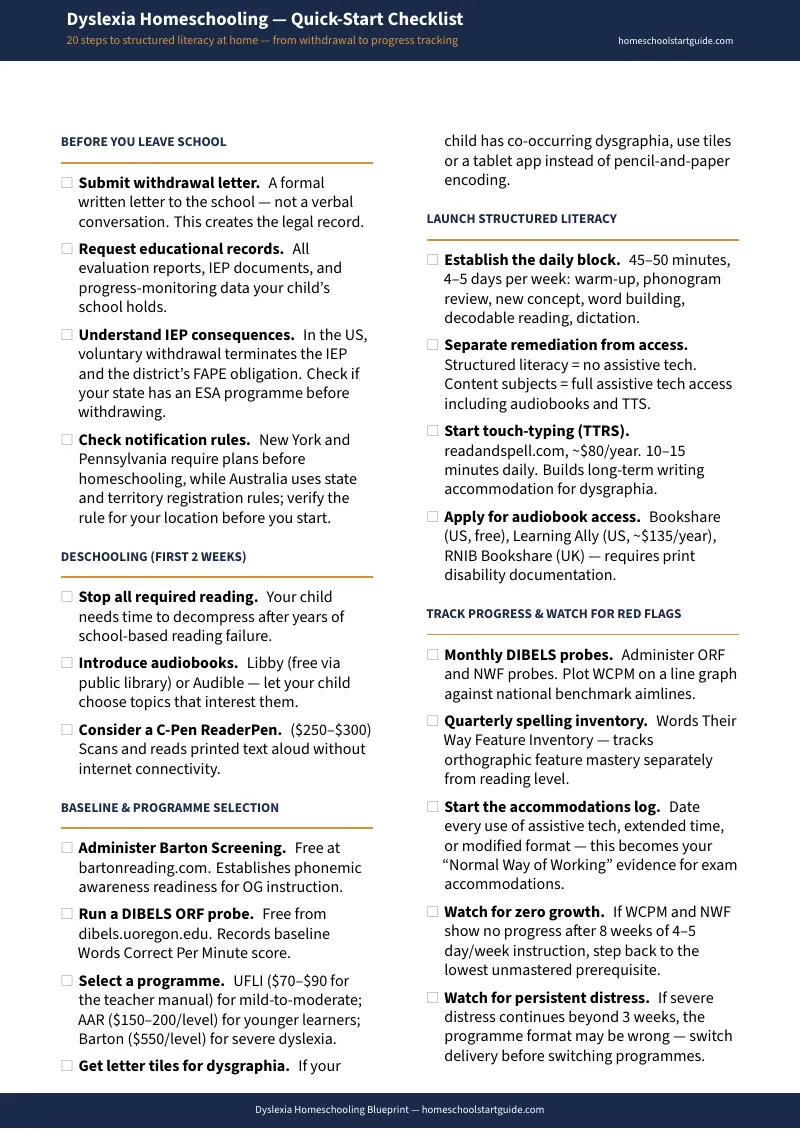
- A 50-minute daily lesson block — six timed segments (warm-up, phonogram review, new concept, word building, decodable reading, dictation) that you run 4 to 5 days per week. Includes an ADHD split variant for children who cannot sustain 50 minutes of seated instruction.
- Parent-administered progress tracking — how to run a DIBELS oral reading fluency probe at your kitchen table, score it in two minutes, plot your child's words correct per minute against national aimlines, and know within eight weeks whether your programme is working.
- Assistive technology setup — audiobook access through Bookshare and Learning Ally (who qualifies, how to apply), the C-Pen ReaderPen for independent scanning, text-to-speech configurations for content subjects, speech-to-text for dysgraphic writers, and AI reading tools that did not exist two years ago.
- Co-occurring condition adaptations — if your child also has dysgraphia, the guide shows you how to replace pencil-and-paper encoding with letter tiles and build touch-typing with TTRS alongside structured literacy. If dyscalculia is in the picture, there are specific math-fact fluency adaptations that keep reading instruction from being derailed.
- Testing accommodations for homeschoolers — how to get extra time and assistive technology on the SAT, ACT, GCSEs, and A-Levels without a school IEP. The "Normal Way of Working" evidence portfolio you need to build now, while your child is in elementary or primary school, so the accommodations are there when exam season arrives.
- Legal withdrawal steps for six countries — United States (with state-by-state notification rules), United Kingdom, Canada, Australia, New Zealand, and Ireland. What to file, who to notify, what records to keep, and what happens to your child's IEP when you leave.
- A 90-day implementation roadmap — the deschooling period (why you stop all required reading for two weeks), baseline testing, programme launch with the six-segment lesson block, and the routine calibration phase that turns daily structured literacy into a sustainable household rhythm.
Who this is for
Parents of a dyslexic child aged 6 to 14 who are ready to teach reading at home. You may have just pulled your child from school, or you may be about to. Your child has been through years of "wait and see," failed reading interventions, or a private tutor bill you cannot keep paying. You do not have a teaching degree — and you do not need one. The programmes in this guide are scripted, explicit, and designed for non-specialists.
Why not just use the free resources?
There are excellent free resources for dyslexia — the IDA fact sheets, UFLI's downloadable slides, Reading Rockets articles, Emily Hanford's Sold a Story podcast that exposed the three-cueing disaster. The problem is not a shortage of information. The problem is that free resources are written for classroom teachers, not for a parent sitting at a kitchen table with one child and no training.
Free resources do not compare programme costs. They do not tell you that Barton's clinical rigour comes with severe student boredom in more than 40% of families. They do not give you a daily lesson structure or a progress-monitoring system. They do not explain how a homeschooled child gets SAT accommodations without a school IEP. And they do not cover the legal withdrawal process for six countries in one place.
The Blueprint fills the gap between "I know my child needs structured literacy" and "I know exactly which programme to buy, how to schedule it, and how to prove it is working."
Your investment is protected
Full refund, no time limit. If the Blueprint does not help you make a clearer decision about your child's reading instruction, email [email protected] and we will refund every penny. No form to fill in, no questions asked.
Consider what this guide replaces: months of reading affiliate-biased blog posts, hundreds of dollars in trial-and-error curriculum purchases, and the sinking feeling that you picked the wrong programme and lost another critical year. The Blueprint costs less than a single hour of private OG tutoring — and it gives you the information that a tutor would not.
Get the Dyslexia Homeschooling Blueprint →
The free Quick-Start Checklist is available at no cost — 20 actions in the right order, from school withdrawal to the first structured literacy lesson. Download it to see whether the approach fits your family before you commit to the full guide.