
One missing form. One wrong course description. One blown deadline. That's all it takes to bench a homeschool athlete — permanently.
Your teenager has put in thousands of hours of training. You've driven to every practice, paid for every tournament, watched them earn their shot at playing in college. And now the NCAA Eligibility Center wants you to prove — on paper — that the education you built from scratch meets their exact standards.
The blank Core-Course Worksheet stares at you. The Eligibility Center portal shows tasks you don't fully understand. A college coach just asked, "Are you registered with the clearinghouse?" and you're not sure what that means for a homeschooler. Meanwhile, your state's athletic director is telling you homeschoolers can't try out for the local team — but you've heard that's not true.
You're one parent doing the work of a guidance counselor, a compliance officer, and an athletic director all at once. And the stakes couldn't be higher.
The Homeschool Eligibility File System
This is the step-by-step compliance guide that bridges the gap between "here are the rules" and "here's exactly how to follow them as a homeschool family."
The NCAA Eligibility Center publishes rules. HSLDA explains your legal rights. Recruiting platforms market your athlete to coaches. But none of them show you how to write a course description that survives an audit, how to document "teach to mastery" grading on an official transcript, or how to handle dual enrollment credits without accidentally disqualifying your athlete.
The Homeschool Eligibility File System fills that gap — a unified compliance manual that treats state sports access, NCAA academic certification, NAIA pathways, and recruiting documentation as one connected process, not four separate bureaucracies you have to navigate alone.
What's Inside
- 50-State Equal-Access Matrix — every state's "Tim Tebow law" status, statutory citations, academic proof requirements, residency mandates, transfer sit-out rules, and fee structures in one reference table. Know your rights before the athletic director tells you what they think the rules are.
- Annotated Core-Course Worksheet Builder — pre-filled examples using popular homeschool curricula (Saxon Math, Apologia Science, Teaching Textbooks, parent-designed humanities) structured specifically to pass NCAA audits. Not blank forms — completed examples you can model.
- Course Description Templates — real-world templates for translating homeschool courses, online programs, co-op classes, and dual enrollment into the precise language the NCAA Eligibility Center accepts. Includes how to phrase "teach to mastery" grading so it doesn't trigger a red flag.
- Administrator and Accordance Statement Walkthrough — line-by-line instructions for the homeschool-specific NCAA form that most parents find confusing. One mistake here puts your entire file on hold.
- NCAA, NAIA, NJCAA Side-by-Side Comparison — academic requirements, test score policies (the NCAA has permanently eliminated SAT/ACT requirements — many resources still haven't updated), transcript rules, and evaluation timelines across all five divisions and two additional associations.
- Post-House v. NCAA Recruiting Manual — the 2025 settlement introduced hard roster caps (baseball capped at 34, football at 105, track at 45) and eliminated walk-on cushions. Your athlete needs a secured roster spot, not a promise to "try out." This chapter covers what changed and what it means for homeschool recruits specifically.
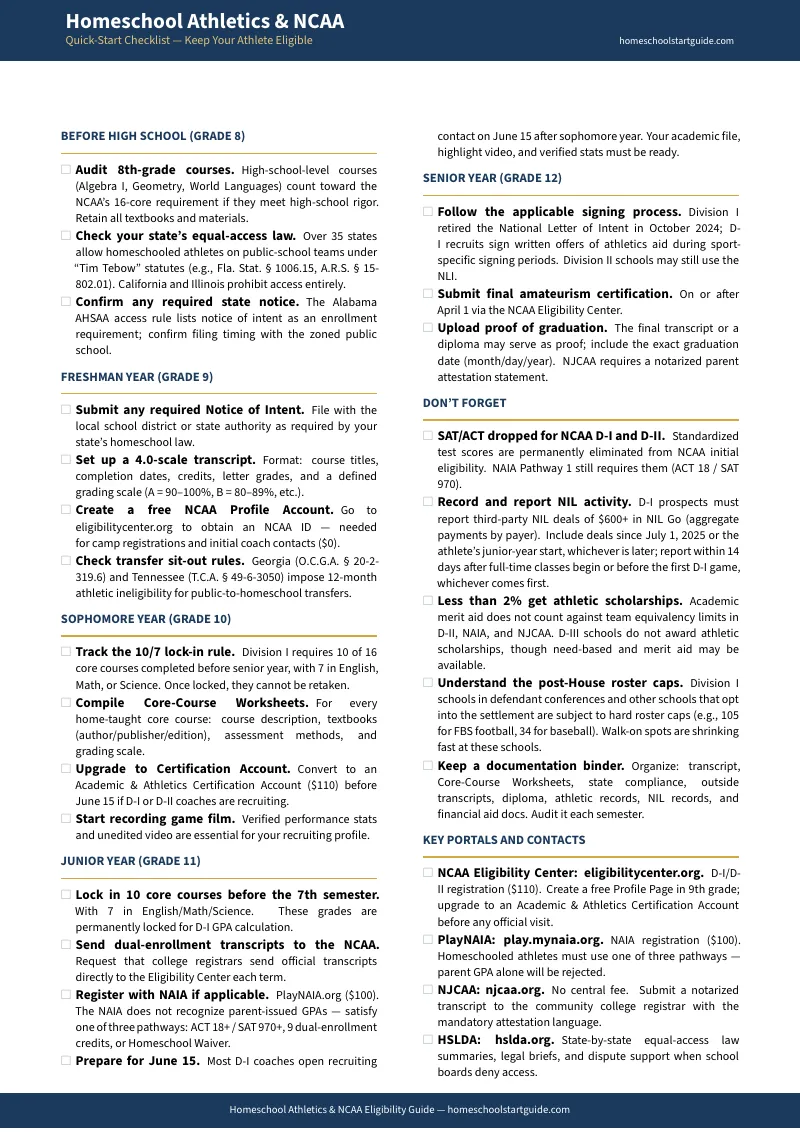
- Grade-by-Grade Compliance Timeline — what to track and file during 8th, 9th, 10th, 11th, and 12th grade. Tells you exactly when to create your NCAA account, when to submit your 6-semester transcript, and when to execute your financial aid agreement.
- NIL Rules for Homeschool Athletes — how Name, Image, and Likeness regulations apply when your athlete competes through a travel team, club, or unattached status rather than a member public high school.
- Alternative Competition Pathways — for states without equal access: independent homeschool leagues (NCSAA, NCHBC), private school co-ops, national tournament circuits, and club/travel options (AAU, ECNL, Perfect Game) that college coaches actively scout.
- Documentation File Checklist — the complete set of records every homeschool athlete should keep: course descriptions, syllabi, grading rubrics, attendance logs, test results, transcripts, administrator statements, and graduation documentation. Build it once, use it for every application.
- Eight printable worksheets — Core-Course Pacing Tracker, Governing Body Comparison Worksheet, Coach Outreach Tracker, NIL Activity Log, Academic Compliance Calendar, Documentation Completeness Checklist, State Equal-Access Filing Checklist, and Financial Aid Comparison Worksheet. Print them, fill them in, and keep them in the binder.
Who This Is For
- Parents of a middle schooler trying out for the local public school team who need to understand their state's equal-access law
- Families with a 10th or 11th grader being recruited to play college sports who need to build an audit-proof NCAA or NAIA file
- Parents of elite travel athletes using online programs or tutors who need to prove their coursework qualifies as parent-directed homeschooling
- Families who didn't plan for college athletics until a late-blooming senior year when a coach makes an offer contingent on clearance
Why the Free NCAA Toolkit Isn't Enough
The NCAA Eligibility Center toolkit outlines what is required. It does not show you how to do it as a homeschool parent.
The toolkit provides blank forms — not filled-in examples. It doesn't explain how to phrase "we used Saxon Algebra 2 at our kitchen table" in terms the Eligibility Center accepts. It doesn't warn you that submitting a transcript without exact start and graduation dates, or without an administrator signature, puts your file on hold. And it doesn't tell you that the NCAA won't even look at your paperwork until a college places your athlete on an Institutional Request List — so if your documentation has errors when that moment comes, the coach moves on.
Recruiting services like NCSA ($2,000–$6,000) handle athletic exposure and coach messaging. They do not write your Core-Course Worksheets or navigate your state's equal-access dispute. Their contracts explicitly state that parents remain solely responsible for academic compliance and clearinghouse filings.
Etsy transcript templates ($5–$25) give you a blank grid. They don't explain which courses count as core, how to handle dual enrollment, or that mandatory SAT/ACT scores were permanently eliminated — many templates still list them as required.
Your Full Refund Guarantee
If the guide doesn't give you clarity on your athlete's eligibility path, email [email protected] for a full refund — no time limit, no questions.
Start Building Your Athlete's Eligibility File
Every week without a compliance system in place is another week where a paperwork gap could cost your athlete a roster spot, a scholarship, or an entire season. Families routinely spend $3,000–$15,000 a year on club dues, showcases, and travel. The guide costs less than a single tournament entry fee — and protects the investment you've already made.
Download the free Quick-Start Checklist to see the grade-by-grade timeline, or get the full Homeschool Athletics & NCAA Eligibility Guide for to build an audit-proof eligibility file before a coach ever asks to see it.
Frequently Asked Questions
What if the rules change after I buy?
We update the guide when the rules change. Email us any time, even years later, and we'll send you the current edition free.