Your child can't go to school. The law says they must. Now what?
The attendance letters are stacking up. The school is marking every absence as unauthorised. Your GP wrote a letter saying your child is too anxious to attend — but the school says that doesn't count. Someone mentioned fines. Someone else mentioned social services. And your child is in their room, unable to leave the house, let alone walk through the school gates.
You've searched for answers and found two worlds that don't talk to each other. Clinical resources tell you to reduce pressure and protect your child's mental health. Attendance enforcement tells you the law requires your child in school and you'll be fined — or worse — if they're not. Nobody explains what to actually do when both of those things are true at the same time.
The School Refusal & Anxiety Withdrawal Blueprint is a Crisis-to-Recovery Legal Process Guide — a step-by-step system that bridges the gap between clinical advice and attendance law. It covers your exact legal exposure right now, what a doctor's letter needs to contain to actually protect you, every option between forced attendance and full withdrawal, and the legal withdrawal steps for your specific country — then walks you through the recovery-first transition that comes after.
Legal exposure — what actually happens when absences pile up
Most parents don't know the specific thresholds that trigger fines, prosecution, or child protection referrals. In England, 10 unauthorised sessions in a rolling 10-week window triggers a penalty notice. In the US, truancy thresholds vary by state but can kick in after as few as 3 unexcused days. The Blueprint maps out the escalation sequence for your jurisdiction so you know exactly where your family stands — and how many days you have before the next consequence hits.
Medical letters — why yours probably isn't protecting you
A letter from your GP or therapist saying your child is "unfit to attend school due to anxiety" feels like a shield. Legally, it isn't. The school — not the doctor — decides whether to authorise the absence. If the letter is too vague, the school marks the days as unauthorised anyway, and you're back in the penalty notice pipeline. The Blueprint explains what a clinical letter must contain — specific diagnosis, explicit statement of harm from attendance, concrete recommendations — to actually shift the attendance code from unauthorised to authorised.
Every option between attendance and withdrawal
Most families don't know there are intermediate pathways. Reduced timetables, flexi-schooling, medical homebound instruction, hospital teaching programmes, part-time attendance agreements — each one has different rules about who controls it, how long it lasts, and when the school can override it. The Blueprint maps every option so you can see which ones are available in your situation before deciding whether full withdrawal is the right step.
Legal withdrawal — country by country, step by step
Withdrawing a child from school to homeschool is a legal process, and the rules are different everywhere. The Blueprint covers six jurisdictions:
- England, Wales, Scotland, and Northern Ireland — elective home education deregistration, local authority duties and limits, the DfE 2024 National Framework for attendance
- Ireland — Tusla Section 14 registration, the R1 application form, and the all-guardians signature requirement
- United States — state-by-state notification requirements, IDEA protections, homebound instruction triggers
- Canada — province-by-province withdrawal procedures
- Australia — state registration authorities and application timelines
- New Zealand — Ministry of Education Certificate of Exemption under Section 38
Safeguarding yourself when social services gets involved
The fear that withdrawing will bring child protection to your door is real — but it's usually backwards. Unmanaged, unauthorised absence is what triggers most referrals. Formal statutory withdrawal replaces "truancy" with a recognised educational pathway. The Blueprint includes documentation protocols, a printable Communication Audit Trail, and a clear explanation of your rights during an investigation — so you're protected whether social services was already involved or might become involved during the transition.
The recovery-first transition
Your child didn't stop going to school because of bad parenting or laziness. Their nervous system shut down under chronic stress. The first weeks after withdrawal are not about curriculum — they're about letting the stress response subside. The Blueprint covers the de-schooling period, low-demand days, how to work with CAMHS teams and therapists, rebuilding learning gently, and keeping the door open for a phased return to school when your child is ready.
Who this is for
- Parents whose child has stopped attending school because of anxiety, panic attacks, depression, burnout, or a mental-health crisis
- Families receiving attendance warnings, truancy letters, penalty notices, or social services referrals
- Parents whose child has been diagnosed with or is being assessed for autism, ADHD, PDA, or another neurodivergent condition and is in school-related distress
- Families who have a medical letter but the school is still marking absences as unauthorised
- Parents considering withdrawal but afraid it will trigger child protection involvement or close the door on mainstream education
Why not piece it together from free resources?
Organisations like Not Fine In School, IPSEA, HSLDA, and School Can't Australia provide valuable information — but it's scattered across dozens of legal guides, forum threads, and policy pages, each covering one jurisdiction and one aspect of the problem. Clinical sites explain anxiety but ignore attendance law. Legal sites explain the law but ignore the clinical reality. Government portals frame everything around compliance and enforcement.
When you're holding a truancy letter and your child can't leave their room, you don't have time to synthesise a crisis plan from 30 browser tabs. The Blueprint condenses the legal mechanics, clinical communication frameworks, and recovery protocols into a single document you can act on today — for less than the cost of a single hour in a therapist's waiting room.
What you get
- The full 45-page guide — 13 chapters covering legal exposure, medical letters, intermediate options, country-specific withdrawal, safeguarding, and the recovery transition
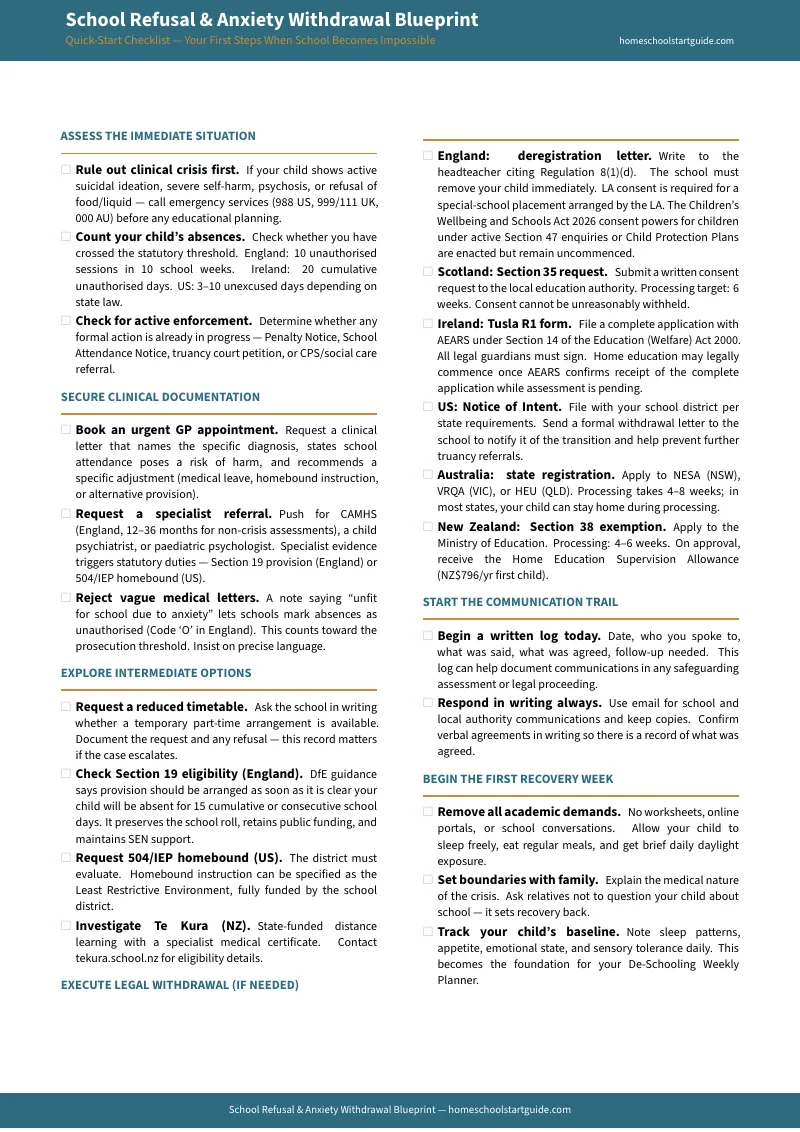
- Quick-start checklist — 21 action items on two printable pages, the immediate first steps when an attendance warning arrives
- Legal Status Assessment Worksheet — map your jurisdiction, unauthorised-day count, and next urgent action
- Clinician Letter Request Template — the three elements a GP or specialist letter needs, with fill-in wording you can hand over
- De-Schooling Weekly Planner — a one-week landscape tracker for sleep, sensory load, emotional state, and one low-demand activity (print six copies)
- Communication Audit Trail — a log for every school, local-authority, social-worker, and clinician contact
- Academic Progress Portfolio Template — the three-log system (academic, activity, clinical) for later re-enrolment or local-authority review
- Re-Entry Readiness Checklist — seven markers for whether a phased return is even on the table
Satisfaction guarantee
If the Blueprint doesn't give you the clarity you need, email [email protected] for a full refund — no time limit, no questions.
This guide provides educational process information, not legal or clinical advice. If your family is facing prosecution, a custody dispute, or a formal child protection investigation, consult a solicitor or attorney. If your child is in immediate danger, contact emergency services.