
Your Homeschooler Can Earn College Credit in High School — If You Navigate the System Right
Dual enrollment. CLEP. AP exams. The options exist, and they work. Families save a semester — sometimes two full years — of college tuition by earning credit before graduation.
But between the options and the savings sits a maze of state funding rules, exam access barriers, and transfer policies that can turn good credit into wasted effort — or worse, a lost scholarship.
What Actually Goes Wrong
A parent calls seven high schools looking for an AP coordinator who will let a homeschooled student sit for the exam. Every one says no. The College Board's search tool lists test centers, but not which ones accept outside students — and the fall ordering deadline passes while the parent is still calling.
A family loads up on dual enrollment courses, proud of the credits their teenager is accumulating. Then the university financial aid office flags the student for exceeding the Satisfactory Academic Progress credit threshold — and aid eligibility disappears during junior year.
A student completes 15 credits on a subscription platform. The family assumes the credits will transfer because the platform says they're "ACE-recommended." The state university disagrees — it doesn't accept ACE credits toward degree requirements, only as general electives. Months of coursework, reduced to filler.
These are not unusual outcomes. They are the outcomes that happen when families plan with incomplete information.
The Credit Transfer Blueprint
The United States Homeschool College Credit Guide is a vendor-neutral reference that covers every credit pathway open to homeschoolers — dual enrollment, CLEP, DSST, and self-studied AP exams — with the state-specific access rules, costs, and downstream risks that free resources leave out.
It is not affiliated with any exam provider, online platform, or university. It does not sell courses. It tells you which credits are worth pursuing, how to secure access, and what to watch out for before your student starts earning.
What's Inside
- 50-State Dual Enrollment Landscape — which states fully fund dual enrollment for homeschoolers, which restrict it to public-school students, and where legal workarounds exist. Age limits, eligibility tests (Accuplacer, SAT cut scores), and the enrollment process for each model
- AP Exam Access Protocol for Non-Enrolled Students — how to find a coordinator who accepts outside students, what to say in your initial contact, the November ordering deadline and late fees, and what to do when every local school says no
- CLEP and DSST Strategy — the full exam list with costs, testing center logistics, remote proctoring options, and how to check whether your target university actually accepts CLEP credit toward degree requirements (not just as electives)
- Scholarship and Financial Aid Protection — how earning credit at the wrong time can reclassify your student from first-time freshman to transfer applicant, costing them merit scholarships worth thousands per year. The SAP credit threshold that triggers financial aid loss. The timing rules that protect eligibility
- Transfer Risk Framework — the difference between regionally accredited credits, ACE-recommended credits, and NCCRS-recommended credits, and why that distinction determines whether a university will count the work. Platform-by-platform analysis of what transfers and what doesn't
- Transcript and Notation Guide — how to document dual enrollment, exam scores, and platform credits on a homeschool transcript so colleges can evaluate them correctly
- Six printable planning tools — College Credit Planning Worksheet, Four-Year Course Planner, AP Exam Logistics Tracker, Dual Enrollment Application Checklist, SAP and Scholarship Risk Audit, and Credit Transfer Verification Log
Who This Is For
This guide is for two kinds of homeschooling families:
Cost-cutters who want to reduce the total cost of a four-year degree by banking credits during high school. You are looking at community college dual enrollment, CLEP exams, and potentially online platforms — and you need to know which options are funded in your state and which credits will actually transfer.
Rigor-seekers who want college-level coursework on the transcript to prove academic quality to selective admissions officers. You are not trying to skip college — you are trying to show that your homeschool curriculum stands up to institutional scrutiny. Graded dual enrollment courses and strong AP scores serve as third-party validation of a parent-issued transcript.
Both groups face the same risk: earning credits that look impressive on paper but fail to serve their purpose at the target institution.
Why Not Just Use Free Resources?
Free resources cover pieces of this puzzle. College Board publishes syllabi and a test-center search tool. State portals publish dual enrollment statutes. Community college websites list their own enrollment steps. Facebook groups and forums share individual family experiences.
None of them pull the pieces together. None of them tell you that the AP coordinator search tool lists centers that don't accept outside students. None of them explain that your state's "free dual enrollment" program excludes homeschoolers unless they register under a specific provision. None of them calculate the SAP credit threshold that will cost your student financial aid two years from now.
The guide fills the gaps between what the official sources say and what actually happens when a homeschooling family tries to follow their instructions.
Satisfaction Guarantee
If the guide doesn't give you a clearer picture of your student's credit options and the risks around them, email [email protected] for a full refund — no time limit.
Start With the Free Checklist or Get the Full Guide
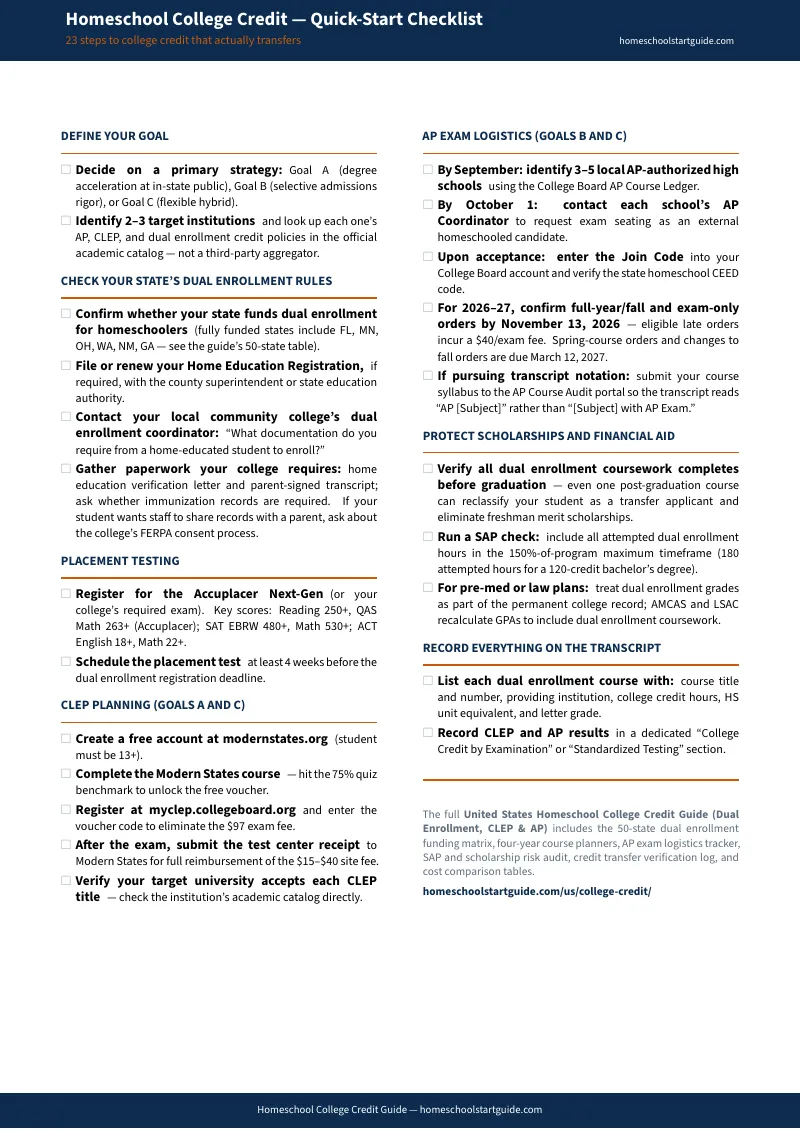
Download the free Homeschool College Credit Quick-Start Checklist — a one-page action plan for getting started with dual enrollment, CLEP, and AP exams.
Ready for the complete reference? The full guide includes the 50-state landscape, the AP access protocol, the transfer risk framework, and the scholarship protection rules — everything the checklist points to but can't cover in one page.
Frequently Asked Questions
What if the rules change after I buy?
We update the guide when the rules change. Email us any time, even years later, and we'll send you the current edition free.