
You Just Found Out You're the School Counselor. The First Deadline Is in Weeks.
Your student opened the Common App, entered your email as their "Counselor," and now you have a portal full of fields designed for someone who runs a guidance office. School Report. Class Rank. CEEB Code. Counselor Recommendation Letter. School Profile. Homeschool Supplement — four text prompts inside the counselor portal; Common App also publishes a separate 2026 PDF supplement for families to send directly to colleges.
Meanwhile, the student at the public high school down the road has a guidance counselor who has done this hundreds of times. You have a stack of Reddit threads, a 2021 blog post that says the SAT is optional (Harvard, Yale, and Dartmouth now require testing, including for homeschool applicants), and a $3 Etsy transcript template that tells you what boxes to fill in but not what to write.
The gap isn't information. You can find every rule, every requirement, every platform help article for free. The gap is execution under deadline pressure — knowing exactly what to write in the School Profile, how to handle "Class Rank" when your graduating class is one, how to draft a counselor letter about your own child that sounds professional instead of parental, and how to answer the Homeschool Supplement's four prompts without repeating yourself across three different documents.
The Counselor Execution System closes that gap. It's the complete operational toolkit for the parent who is also the school counselor — every form, letter, template, and field-by-field walkthrough you need to submit a polished application package before the first deadline hits.
What's Inside the Counselor Execution System
Field-by-Field Common App Counselor Portal Walkthrough — The School Report asks for your CEEB code (use the homeschool code 970000), approximate graduating class size, class-rank reporting, and whether you offer block scheduling. If your homeschool does not calculate class rank, select None. It also asks what percentage of your graduating class attends a four-year college. The guide explains what each field means and how to answer it, so you're not guessing whether "100%" is correct or whether it triggers a flag.
Three Counselor Recommendation Letter Templates — The hardest document in the package, because you have to write about your own child like a professional evaluator. Three complete model letters, each tailored to a different student profile: the STEM and dual-enrollment scholar, the humanities and co-op leader, and the self-directed or entrepreneurial student. Each template uses the third-person professional voice that admissions officers expect, backs every claim with concrete evidence, and runs 1 to 1.5 pages. You fill in your student's specifics; the structure and credibility markers are built in.
School Profile Builder and Template — A fillable builder worksheet for the six sections admissions offices expect (school identity and CEEB code 970000, educational philosophy, curriculum sourcing map, grading scale and credit definitions, testing summary, and state law compliance), plus a 2-page School Profile Template you transfer those answers onto before uploading the PDF in the School Report.
Homeschool Supplement Worksheet — The guide covers four text prompts in the counselor portal. Common App also publishes a separate 2026 PDF Homeschool Supplement for families to send directly to each college. The worksheet is where you draft educational philosophy, curriculum design, grading methodology, and outside evaluation — with the same split the guide uses so you do not duplicate the School Profile or the counselor letter.
Recommender Briefing Template — A one-page briefing sheet you hand a dual-enrollment professor, co-op instructor, or mentor: student name, target major, course highlights, category (Teacher or Other), and submission logistics. The Recommender Coordination Log tracks briefing sent, invite received, and letter submitted.
Multi-Platform Coverage — The Common App isn't the only system. The kit covers Coalition on Scoir's homeschool documentation flow, ApplyTexas (which has its own submission portal and its own essay sets), the University of California application (no counselor portal — different documentation rules entirely), and SUNY. Each platform handles homeschool applicants differently; the kit tells you what each one needs.
College Requirements Tracker — A landscape worksheet with space for 15 schools: platform, round and deadline, extra homeschool documentation, testing policy (required / optional / blind), verification URL, and submission status. The 45-page guide's college matrix is the starting reference; you confirm each row on the institution's current homeschool admissions page.
Application Season Planner — From junior spring through the June Final Report, student tasks and parent-counselor tasks on one printable, with your own due dates. Includes the November 1 / 15 EA/ED crunch checkpoints (October 1 profile and letter; October 15 School Report and Supplement; counselor materials in place before the student clicks Submit).
Course Description Packet and Financial Aid Checklist — Fillable syllabi sheets for colleges that ask homeschoolers for extra course documentation; Amherst recommends course descriptions with texts, syllabi, and time per discipline. Plus a FAFSA / CSS Profile / fee-waiver / award-letter tracker. CSS Profile: $25 initial application, $16 each additional report; free for domestic undergraduates whose family AGI is up to $100,000, with other fee-waiver routes available. First-year application fees are college-specific: Harvard charges $95, Dartmouth $85; Common App's 2025 guide lists 500+ colleges with no fee for domestic students.
Who This Is For
- Parents who just received the Common App counselor email invitation and realized they need to write a School Report, School Profile, and Counselor Recommendation Letter — documents they didn't know existed until that moment
- Families with an Early Action or Early Decision deadline in weeks, not months, who need to produce professional counselor documents fast
- Homeschool parents who have been teaching for years but have never had to translate that work into the institutional language that admissions offices expect
- Families applying through multiple platforms — Common App, Coalition, ApplyTexas, UC — who need to know what each system requires from homeschool applicants specifically
- Parents who can't afford a $3,000–$5,000 private admissions consultant but need more than a blank template with no instructions
Why Not Just Piece This Together for Free?
You can. Every rule and requirement exists somewhere online. Here's what that looks like in practice:
- The Common App help center explains the system mechanics — which buttons to click, what each field label means. It does not tell you what to write in the open-ended text boxes, how to frame your homeschool methodology persuasively, or how to draft a counselor letter that sounds credible. The help center documents the platform; it doesn't teach you how to use it strategically.
- HSLDA offers transcript templates and member-only resources — behind a $150/year membership. Its one-on-one educational consulting program ended in April 2024. Their guidance focuses on legal compliance and basic documentation, not competitive positioning for selective admissions. The free articles provide structural overviews that stop short of execution.
- Reddit threads carry real experience — scattered across hundreds of posts, many contradicting each other, many outdated. A parent posting in 2021 that "the SAT is optional everywhere" was right at the time. Harvard, Yale, and Dartmouth now require testing, including for homeschool applicants.
- Lee Binz's courses are comprehensive — and they cost $197+, contain 60+ hours of video, and mix general high school advice with application mechanics. When the Early Action deadline is weeks away, you don't have time for 60 hours of video. You need a framework you can execute in an afternoon.
- Private consultants offer personalized strategy — at varying rates; IECA says many charge just under $140 per hour. A consultant can advise, but IECA says consultants should not complete application forms for students. Common App asks the home-school supervisor to serve as counselor and complete the School Report.
The Guarantee
Full refund, no time limit. If the kit doesn't make the counselor side of college applications feel manageable, email [email protected] and we'll refund you in full. No forms, no time pressure, no questions.
Start With the Free Checklist or Get the Full Kit
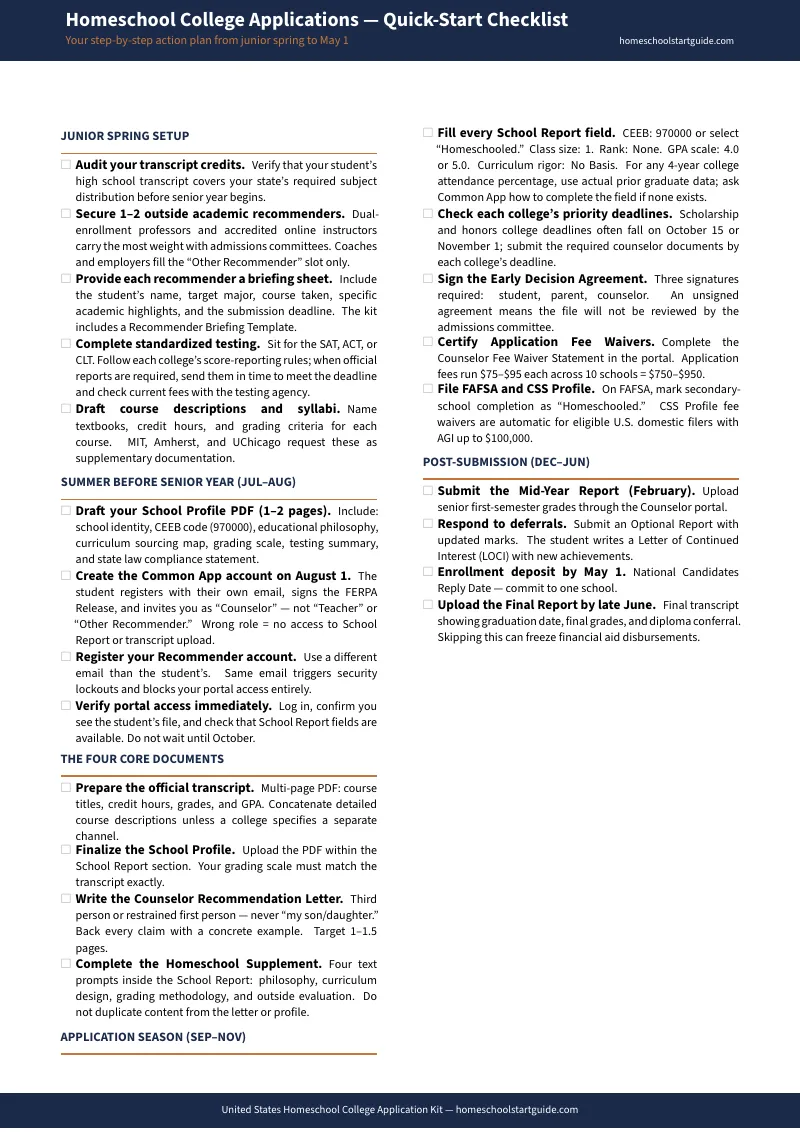
The free Homeschool College Applications — Quick-Start Checklist maps every counselor document and deadline from junior spring through May 1. It tells you what to prepare and when.
The full United States Homeschool College Application Kit gives you the actual templates, letter drafts, field-by-field walkthroughs, and platform-specific guidance to complete each one — for less than the $85 Dartmouth and $95 Harvard first-year application fees.
Frequently Asked Questions
What if the rules change after I buy?
We update the guide when the rules change. Email us any time, even years later, and we'll send you the current edition free.