School was hurting your child — and you knew it before anyone listened
The meltdowns that hit the moment they walked through the door. The mornings that turned into hours of screaming, refusal, and physical shutdown before you could get them in the car. The calls from school about "behaviour" when your child was drowning in sensory pain nobody could see. The EHCP review where nothing changed. The IEP meeting where the same promises were made again. The restraint incident nobody documented. The day they stopped eating, or speaking, or leaving their room.
You pulled your child out — or you're counting the days until you can. And now you're terrified you're about to lose the therapy funding, the speech device, and the legal standing you spent years fighting for.
That is exactly what this Blueprint solves.
The Sensory-First Home Education System
Most homeschool planners assume a child who can sit at a table, follow a schedule, and tolerate direct instruction. For an autistic child — especially one with a PDA profile, a history of burnout, or a communication system that school was the only place modelling — those assumptions fail before lunchtime.
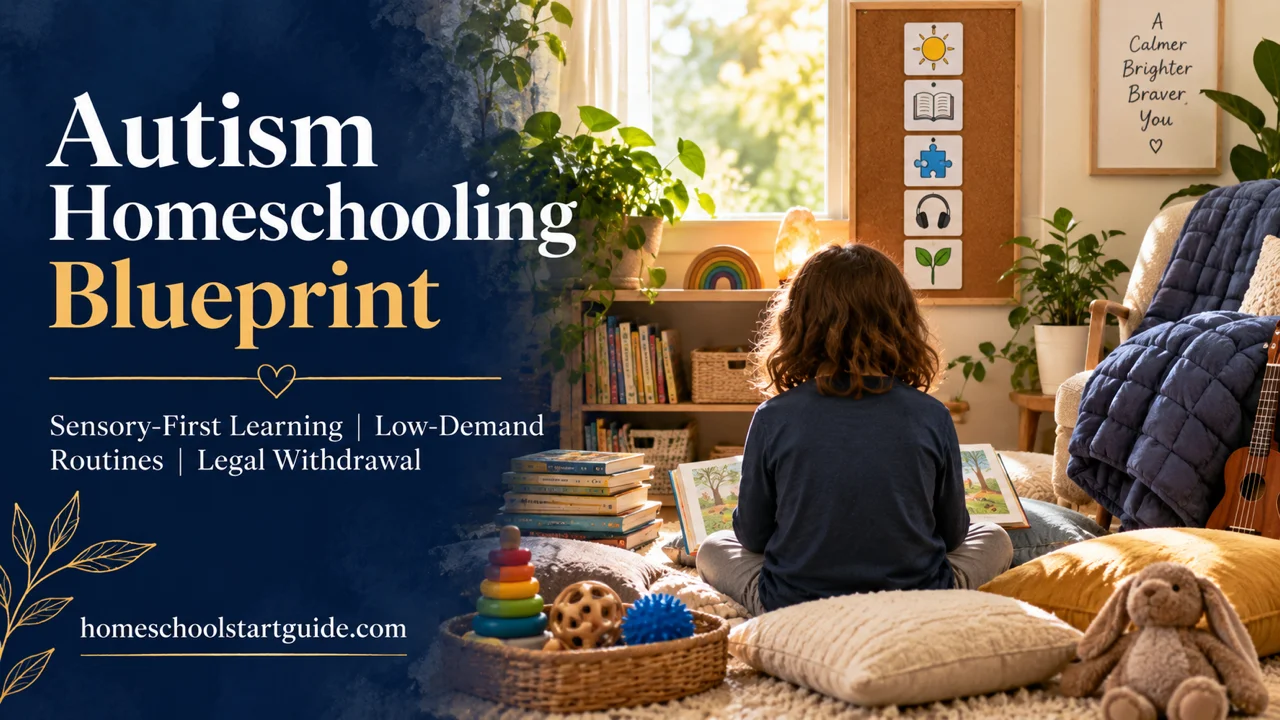
The Autism Homeschooling Blueprint replaces classroom logic with a Sensory-First Home Education System: a framework built around your child's nervous system, not a curriculum calendar. Instead of forcing academics onto a child in shutdown, you start with environmental safety, predictable routines, and sensory regulation — then layer in learning through the interests your child already has.
The result is a home education that satisfies legal requirements in six countries without a single demand your child's nervous system has to fight.
What's inside the Blueprint
- Burnout recovery roadmap — a phased plan from complete nervous system de-escalation through low-demand choice menus to interest-led core academics, with realistic timelines for the child who arrives home unable to do anything but lie in a dark room
- Choice-based daily menus — visual "daily menus" your child picks from instead of schedules they're told to follow, designed for PDA profiles where any direct demand triggers a threat response — with printable templates for speaking, non-speaking, and intermittently speaking children
- Sensory environment design — room-by-room guidance for lighting, sound, texture, and movement spaces, so your home becomes a place your child's nervous system can actually learn in, not just survive
- Special-interest-led curriculum — how to build reading, writing, maths, and science through your child's existing obsessions (trains, Minecraft, marine biology, whatever it is), with worked examples and subject-mapping frameworks that satisfy curriculum requirements
- AAC and communication continuity — what happens to speech devices when you leave school, how to retain them legally, how to continue modelling AAC at home, and how to find a private speech-language pathologist who works with gestalt language processors
- Regulation and recovery toolkit — meltdown and shutdown protocols, interoception supports, co-regulation strategies for parents whose own nervous system is depleted, and explicit guidance on when to step back entirely rather than push through
- Therapy coordination outside school — scheduling OT, speech, and neurodiversity-affirming support around home education instead of around a school timetable, including how to find practitioners who will not use compliance-based approaches
- Retrospective portfolio logging — a documentation system that records interest-led activities after the fact and maps them to your jurisdiction's curriculum standards, so you satisfy legal requirements without putting a single demand on the learning itself
- Six-country legal withdrawal playbook — step-by-step deregistration for the US (all 50 states by regulatory tier), England, Scotland, Wales, Northern Ireland, Ireland, Canada, Australia, and New Zealand, including the specific mechanics for retaining EHCP personal budgets, EOTAS funding, Education Savings Accounts, NDIS plans, and provincial autism grants
- The PDA chapter — why standard special-needs homeschooling advice still fails a PDA child, declarative language scripts, autonomy-preserving structures, and how to handle the days when your child cannot engage with anything at all
- Socialization on your child's terms — interest-based social groups, online communities, one-to-one playdates, and structured-exit strategies for the child whose social battery is real and finite — no forced birthday parties, no "they need to learn to cope"
Who this is for
- Parents who just withdrew (or are about to withdraw) an autistic child from school — after burnout, meltdowns, restraint, seclusion, or a placement that was never right
- Families whose child has a PDA profile and every standard homeschool curriculum has failed because the structure itself is the problem
- Parents managing AAC devices, speech therapy, and OT outside school for the first time and terrified of losing access
- Late-diagnosed autistic or AuDHD parents who need a guide written for their own processing style — direct, visual, low-demand, no jargon
- Families in the UK fighting to retain EHCP or EOTAS funding while home educating, or in the US trying to access Education Savings Accounts for home-based therapies
Why free resources aren't enough
The National Autistic Society has guidance. The PDA Society has strategy sheets. Government portals list the deregistration steps. Reddit threads run thousands of comments deep with parents sharing what worked for their child. The information exists — scattered across charity websites that want your child back in school, forum posts that contradict each other, and legal portals written in language designed for administrators, not exhausted parents in crisis.
For a parent whose nervous system is already fried from years of school battles, synthesising all of that into a coherent daily plan while simultaneously managing a child in burnout is an executive function task that no one in that situation has the capacity for. That is the problem this Blueprint was built to solve: one manual that assembles the legal steps, the sensory environment, the communication continuity, the daily structure, and the documentation system into something you can start using this week — without reading a single academic paper or joining another Facebook group.
Full refund, no time limit
If the Blueprint doesn't work for your family, email [email protected] and you'll get a full refund. No deadline, no forms, no questions.
Get the Autism Homeschooling Blueprint →
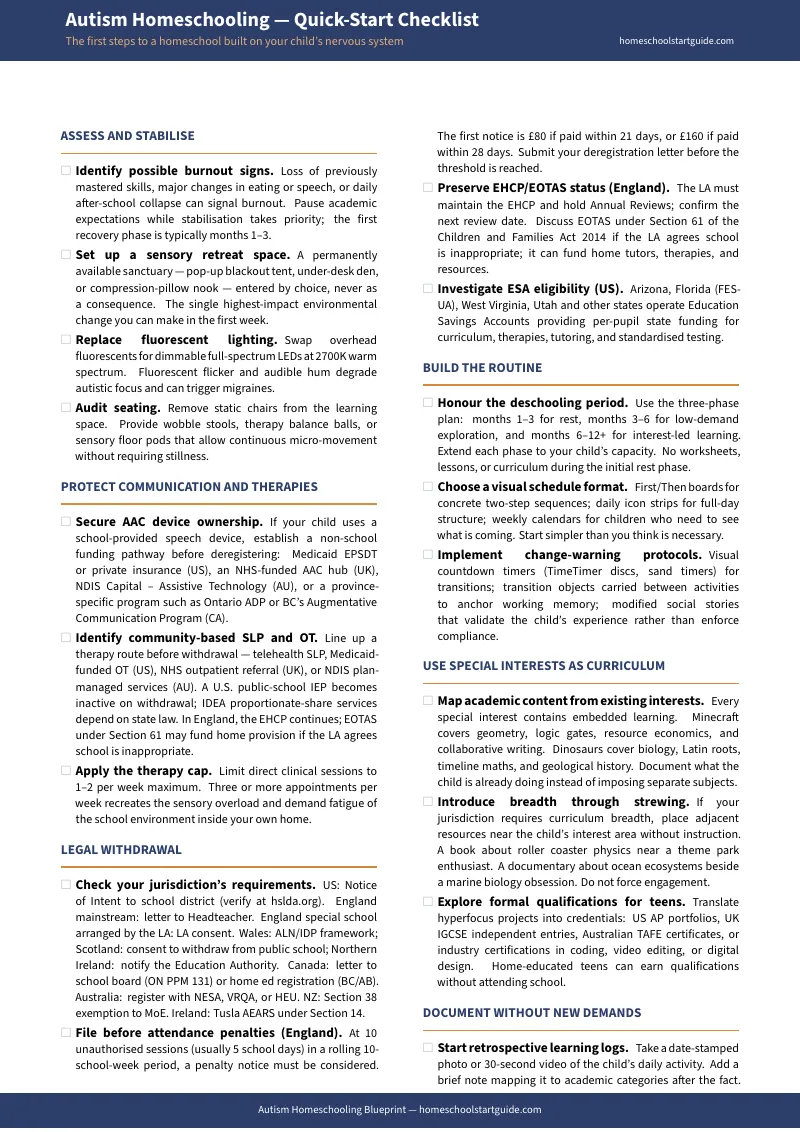
The free Quick-Start Checklist gives you the first sensory and communication supports. The full Blueprint gives you the complete system — the burnout recovery plan, the daily menus, the legal steps, and the documentation framework that makes it sustainable.
Your child isn't failing. The environment they were in was failing them. Now you get to build one that fits.