You fought for every line of that IEP. Now you need to know what happens to it when you leave.
Your child has an IEP from the Committee on Special Education — or a Section 504 plan — and school has stopped working. The accommodations aren't being followed. The CSE keeps scheduling meetings that produce nothing. Your child is in crisis, and you've decided to home-instruct.
But the moment you started researching, you hit two overlapping regulatory systems that nobody explains together. Commissioner's Regulations 8 NYCRR §100.10 governs home instruction: the Letter of Intent, the IHIP, quarterly reports, annual assessments. Education Law §3602-c governs special education services for home-instructed students: the IESP, the June 1 deadline, CSE evaluations, related service delivery. Free resources cover one track or the other. Forum advice mixes them up. The NYSED website gives you the statutory text with no instructions.
The Dual-Track Compliance System in this guide maps both regulatory tracks onto one timeline with one set of steps. You see exactly what to file, who to send it to, and when — for the home-instruction requirements and the special education services process — so nothing falls through the gap between them.
What You Get
The IEP-to-IESP Transition Sequence
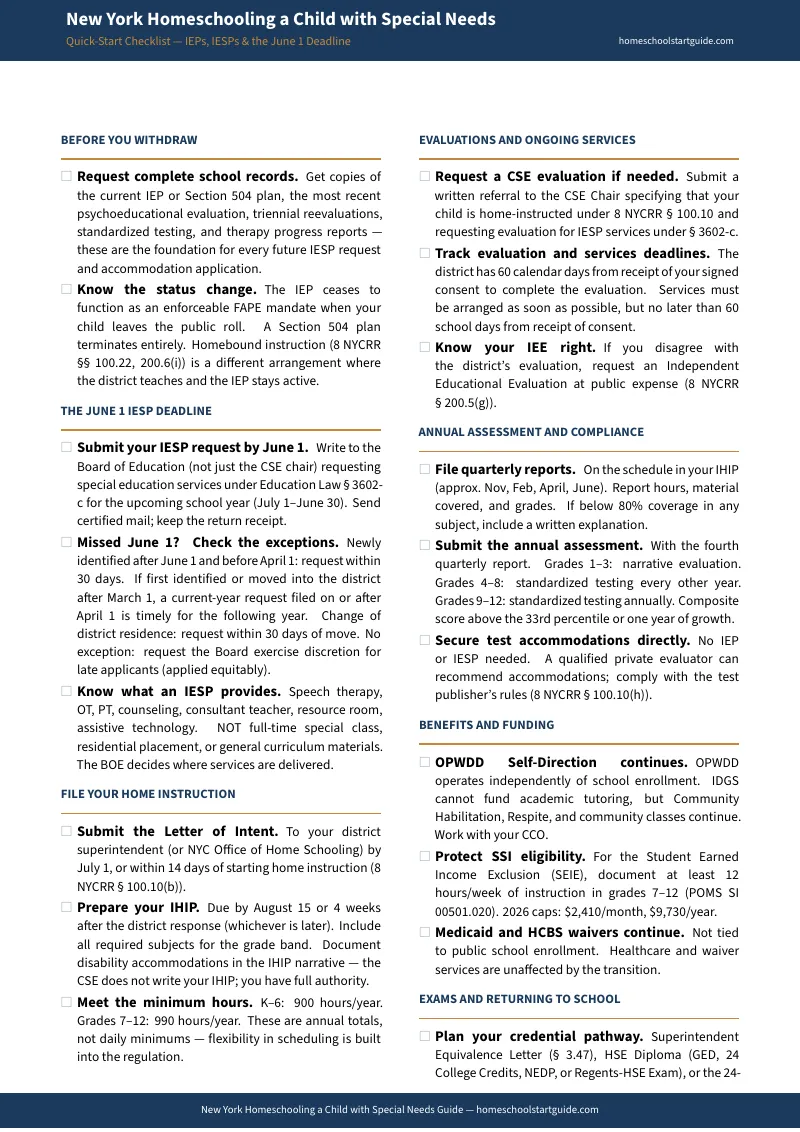
When you withdraw to home-instruct, the school-based IEP no longer applies. If you want the district to provide special education or related services — which may include speech, OT, PT or SETSS — you request them through a separate process under Education Law §3602-c. If the CSE finds your child eligible, it develops an Individualized Education Services Program (IESP). This guide walks through the entire sequence: what to request, who to send it to, the June 1 statutory deadline, what the CSE meeting looks like, and what happens when a child is first identified as having a disability after June 1.
The June 1 Deadline Decoded
Parents generally must submit a written request for special education services by June 1 for the following school year. If you miss it and no statutory timing exception applies, the district is not legally required to provide IESP services that year. If a student is first identified, or establishes residence in the district, after June 1 and before April 1, the request is due within 30 days. If either event occurs after March 1, a request made on or after April 1 is timely for the following school year. The guide covers the standard deadline and these statutory timing exceptions.
IHIP Adaptation for Neurodivergent Learners
The IHIP is already hard to write. Writing one that reflects a child with autism, ADHD, dyslexia, anxiety or multiple diagnoses is harder. The guide explains how to describe subject coverage in terms that acknowledge the child's learning profile, how to frame flexible pacing within the 900/990-hour requirement, and what the district can and cannot legally demand in an IHIP review for a child with a disability.
Disability Funding and Services Mapped
Several funding and service streams operate independently of school enrolment. The guide covers IESP-funded related services from the district, OPWDD eligibility and self-direction (Community Habilitation, respite, Individual Directed Goods and Services), Medicaid-funded therapies, and SSI. Each section explains what continues when you homeschool, what requires a new application, what changes, and what stops.
NYC-Specific Workflows
New York City's centralised Office of Home Schooling operates differently from the rest of the state. The guide includes the NYC submission process, the digital portal for returning families, community school district routing for IESP services, and RSAs for related services and P4 vouchers for SETSS when the district can't provide the service directly.
Annual Assessments with Accommodations
When standardised testing isn't appropriate for your child, the guide explains the narrative evaluation option, how to find an evaluator who understands home-educated students with disabilities, and when Regents scores may be useful for a Superintendent Equivalence Letter or a return to public school.
The Paper Trail That Protects You
Every submission has a date, every request has a deadline, and every communication with the district matters if there's a dispute later. The guide explains what to send by certified mail, what to keep copies of, and how to build a defence-ready record from day one. The Agency Communication Log is the sheet you fill in after every call.
Six Printable Worksheets
The kit includes fillable one- and two-page tools you print and write on: the Departure & Records Checklist, the June 1 IESP Request Planner, the Agency Communication Log, the IHIP Adaptation Worksheet, the Evaluation Timeline Tracker, and the Annual Compliance Calendar.
Re-Enrolment with Support Restored
If your child returns to public school, the district reassesses them and develops a new IEP. The guide explains the re-enrolment process, how the IESP transitions back, what records to bring, and how to prepare for the CSE meeting that follows.
Who This Is For
- Parents withdrawing a child with an active IEP or 504 plan who need to know what happens to the support plan, how to request continued services before June 1, and how to file the LOI and IHIP without forfeiting anything
- Parents who already withdrew and didn't know about the IESP — nobody mentioned Education Law §3602-c, and the guide explains statutory timing exceptions and what to check after June 1
- Parents navigating OPWDD services alongside home instruction — Community Habilitation, self-direction, respite — and need to know how those interact with school-district obligations
- NYC families dealing with the centralised Office of Home Schooling, community school district routing, RSAs, and P4 vouchers
- Parents whose child was just diagnosed after the June 1 deadline passed — the guide covers the separate statutory timeline for newly identified students
Why Not the Free Resources?
NYSED publishes Regulation 100.10 and Education Law §3602-c in full. NYC Public Schools has an Office of Home Schooling page with forms. HSLDA summarises state law for members. TPT has IHIP templates for $10–$15. Reddit and Facebook have thousands of posts from New York homeschool parents.
None of them combine both regulatory tracks into one sequence. The state websites publish raw statutes without operational guidance. The IHIP templates don't address disability accommodations. The advocacy organisations focus on school-side disputes, not home-instruction compliance. The forum advice is fragmented, often outdated, and specific to one district. And hiring a special education advocate runs $100–$350 per hour — appropriate for active legal disputes, but overkill for the administrative self-filing process that home instruction actually is.
This guide sits in the gap between free fragments and expensive professional advice. For , you get a single reference that maps both regulatory systems, every deadline, every step, and the practical detail that the statutes leave out.
Satisfaction Guarantee
Full refund, no time limit. If the guide doesn't help, email [email protected] and we'll refund you.
Get Started
Download the free Quick-Start Checklist for an overview of the deadlines, the order of steps, and links to free advocacy organisations. If you need the full dual-track system — the IESP process, funding maps, IHIP adaptation, NYC workflows, and paper trail strategies — get the full guide.
Frequently Asked Questions
What if the rules change after I buy?
We update the guide when the rules change. Email us any time, even years later, and we'll send you the current edition free.