
Everything You Read About Homeschooling Assumes Your Child Will Cooperate. Yours Won't — and That's Not the Problem.
Your child used to manage school — masking, coping, holding it together until they got home and fell apart. Then it stopped working. The mornings became battles. The school refusals escalated from quiet resistance to full-body shutdowns. The professionals said "firmer boundaries" and the teachers said "consistent expectations" and your child's nervous system said no to all of it, louder every time.
So you withdrew them. Or you're about to. And the relief lasted until you opened a homeschool planning site and realised that every curriculum, every schedule template, every daily planner assumes the child will sit down when asked, follow a sequence of tasks, and accept that someone else has decided what's happening next. For your child — the one whose demand avoidance isn't defiance but a neurological threat response — that assumption breaks everything.
You tried anyway. You bought a gentle curriculum. It sat untouched. You printed a flexible schedule. It triggered a meltdown worse than any school morning. You joined PDA parenting groups where people recommended "offering choices" — and learned that even a choice between two options is a demand when both were chosen by someone else. The Facebook threads spiral between "just unschool" and "they still need to learn something," and neither side explains how to satisfy a local authority that wants evidence of education when your child won't engage with anything you put in front of them.
Here is the gap: there are excellent books on understanding PDA (the clinical picture, the nervous system mechanics, the parenting philosophy), and there are general homeschool guides with schedules and curricula. Nothing bridges the two — nobody explains how to actually run a home education that a PDA child can tolerate and keep records that help explain your provision to a council, registrar, moderator or evaluator if they ask.
The PDA Homeschooling Blueprint is built around what we call the Demand-Free Documentation System — a method for capturing genuine learning as it happens (through photos, narrated portfolios, and learning journals your child never sees you writing) and mapping it back to the standards your authority requires, without imposing the kind of record-keeping that triggers the demand-avoidance cycle all over again. It's a 13-chapter guide that covers everything from burnout recovery and deschooling through low-demand daily life, declarative language, interest-led learning and strewing, all the way to the country-specific legal steps for withdrawing from school and meeting the statutory education standard in the US, England, Scotland, Wales, Northern Ireland, Ireland, Canada, Australia and New Zealand.
What's Inside the 13-Chapter Guide
Understanding the PDA Profile (Chapter 1)
What PDA is, how it presents differently from general autism, and where it sits in clinical practice across each country — NICE, DSM-5-TR, ICD-11 — without taking sides in the diagnostic debate or making clinical claims. Written so you can explain your child's profile clearly to a sceptical family member, an education officer who's never heard of PDA, or a new therapist who thinks demand avoidance is "just anxiety." Covers the current terminology (persistent drive for autonomy, extreme demand avoidance within autism) and why the language matters when you're writing to an authority.
Deschooling and Burnout Recovery (Chapter 2)
The recovery period that most homeschool resources skip entirely — and that PDA families need more than anyone. After months or years of chronic demand saturation at school, your child's nervous system is in a persistent threat state. This chapter covers what demand detox looks like in practice, why "doing nothing" is neurologically productive, how long recovery typically takes (weeks to months, not the two weeks general homeschool sites suggest), and how to tell when your child is genuinely ready to engage again versus performing readiness to stop you worrying.
Low-Demand Parenting — The Operating System (Chapter 3)
Adapts Amanda Diekman's low-demand parenting framework specifically for home education. How to audit your current demand load and identify which demands are genuinely essential (safety, legal minimum) versus which you can drop entirely. The difference between a boundary and a demand. How to lower the demand load on a day that's already going sideways — before the meltdown, not after. Includes Linda Murphy's declarative language in practice: replacing "Do your reading now" and "Sit at the table" with observations such as "I notice the book is still on the table." Worked scripts cover transitions, new topics, redirecting when interest drops, and the days when every answer is "no." Print the Declarative Language Scripts sheet and keep it where you talk.
Learning Without Teaching — Interest-Led and Strewing (Chapter 4)
How to build a genuine education around whatever your child already cares about — even if that's one narrow interest they've had for two years, or a different obsession every week. Covers strewing (placing resources where they'll be found without being assigned), spiralling back to core subjects through interests (the child who loves Minecraft is already doing geometry, economics, and reading comprehension), and the documented evidence that interest-led learning produces outcomes at least as strong as directed instruction. Because the moment you say "Let's use your interest in trains to learn maths," you've turned the interest into a demand and the child stops caring about trains.
Assistive Technology and Accessibility (Chapter 5)
Practical technology that removes demands without removing learning. Voice-to-text for the child who won't write by hand. Text-to-speech for the child who won't read aloud on command. AAC for non-speaking states. Calculators and visual manipulatives as permanent access, not a crutch. Every recommendation accounts for the reality that the technology itself must not feel like a demand — a login screen or a mandatory tutorial can be enough to trigger avoidance.
Leaving School — Legal Steps by Country (Chapter 6)
The exact legal steps for withdrawing your child from school and beginning home education in the US (three representative examples: New York, California and Pennsylvania), England (Education Act 1996 s.7, deregistration from mainstream vs. special school), Scotland (s.35 consent process), Wales, Northern Ireland, Ireland (Tusla AEARS registration), Canada (Ontario, British Columbia and Alberta), Australia (New South Wales and Victoria), and New Zealand (Certificate of Exemption). Covers who to notify, what forms to file, what happens if the school or authority pushes back, what rights you have, and the specific timelines and processes — not generic overviews but the actual steps in order. Print the Legal Withdrawal Checklist by Country and tick only your jurisdiction.
Building a Learning Record the Authorities Will Accept (Chapter 7)
The chapter that solves the central tension of PDA home education: your authority wants evidence; your child's nervous system rejects anything that looks like assessment. The Demand-Free Documentation System uses photo evidence, narrated portfolios you write after the fact, and learning journals your child doesn't see being compiled — then maps interest-led activities back to curriculum areas your authority recognises. Includes the Curriculum Mapping Worksheet, Activity-to-Evidence Translator and Learning Journal Template, plus formats for England's "suitable education" standard, Victoria's eight learning areas, New Zealand's "as regularly and well as" test, and a sample format for explaining your provision if a local authority makes an informal enquiry.
Qualifications and Testing — Pathways Without School (Chapter 8)
When and how to access formal qualifications — GCSEs and IGCSEs (private candidate registration), GED, SAT, ACE, NCEA, and alternatives — for a young person with a PDA profile. Covers exam accommodations for autistic candidates, how to build toward exams without imposing a revision schedule, and the growing number of pathways that don't require sitting in a timed exam hall at all. Because "What about qualifications?" is the question that keeps parents awake at 2am, and there are more answers than most people realise.
Clinical Support Without Coercion (Chapter 9)
How to work with therapists, paediatricians, and educational psychologists who support — rather than undermine — a low-demand home education. What to do when a professional insists your child "needs to learn to cope with demands" or suggests that accommodating demand avoidance is "giving in." How to find clinicians who understand PDA, what to ask in a first appointment, and how to handle professional reports that your authority may request. Log every contact in the Agency Communication Log from the first call.
Family Wellbeing — Siblings, Partners, and Your Own Survival (Chapter 10)
Protecting your own capacity as the parent running a low-demand home education — because the emotional and cognitive load is relentless, and burnout is the biggest threat to your child's education. Managing sibling dynamics when one child has a low-demand rhythm and another needs or wants structure. Co-parent alignment. And the guilt: the persistent feeling that you're not doing enough, that this doesn't look like "real" education, and that everyone else seems to have it figured out.
Social Connection Without Social Pressure (Chapter 11)
How to build genuine social connections for a child whose demand avoidance extends to social expectations. Online communities, interest-based groups, drop-in home education meetups, one-to-one friendships, and how to answer the "What about socialisation?" question from relatives and authorities. Because forced group activities are another demand — and the child who "won't socialise" in a structured group may connect deeply in an unstructured, interest-led setting.
Worksheets and Planning Tools (Chapter 12)
Eight print-and-write PDFs the parent uses without the child seeing them: Demand Audit Worksheet, Declarative Language Scripts, Daily Capacity Tracker, Curriculum Mapping Worksheet, Activity-to-Evidence Translator, Learning Journal Template, Legal Withdrawal Checklist by Country, and Agency Communication Log.
Key Resources and Contacts (Chapter 13)
Support organisations (PDA Society, Autism Awareness Australia, NCHENZ, HEN Ireland, Home Education Victoria), key texts, and the regulatory bodies named in the legal chapters — with what to ask each of them for.
Who This Is For
- Parents withdrawing a PDA child from school who need the legal steps and have no idea where to start
- Families already homeschooling who've discovered that curriculum, schedules, reward charts and "offering choices" all trigger the same meltdowns school did
- Parents in the deschooling phase whose child is recovering from school burnout and can't engage with anything yet — and who need to know how long this lasts and what to tell the authority
- Families facing local authority enquiries who need records to help explain their provision to an inspector or moderator without imposing observable assessment on the child
- Parents whose child has an autism diagnosis with a PDA profile, a suspected PDA profile, or no formal diagnosis — the strategies work based on how your child responds to demands, not what's on a diagnostic report
- Parents in the US, UK, Ireland, Canada, Australia or New Zealand — the legal chapters cover each country's withdrawal process and reporting requirements
This is not a school-side advocacy guide. If you're fighting for an EHCP, IEP, 504 plan, or school placement, that's a different battle — Special Ed Start Guide covers it. This guide starts where school ends.
Why Not Just Use Free Resources?
The PDA Society's introductory materials are good — the PANDA framework, practical low-demand learning ideas, and ways to record progress. Its EHE guide points readers to government guidance for legal requirements rather than compiling withdrawal instructions for every jurisdiction in this guide. Amanda Diekman's Low Demand Parenting is essential reading for the parenting philosophy — but it's a parenting book, not a home education guide, and it doesn't cover statutory reporting, portfolio building, or legal compliance. Linda Murphy's declarative language work is powerful for communication — but it doesn't tell you how to structure a learning day around it. The Facebook groups cycle between the same five pieces of advice, and the Reddit threads end in arguments about whether PDA is even real.
The Blueprint puts all of this in one place: the clinical understanding, the parenting framework, the daily strategies, the legal steps, and the documentation system — written specifically for home education, not adapted from a school or parenting context.
What You Get
- guide.pdf — the 13-chapter PDA Homeschooling Blueprint (47 pages)
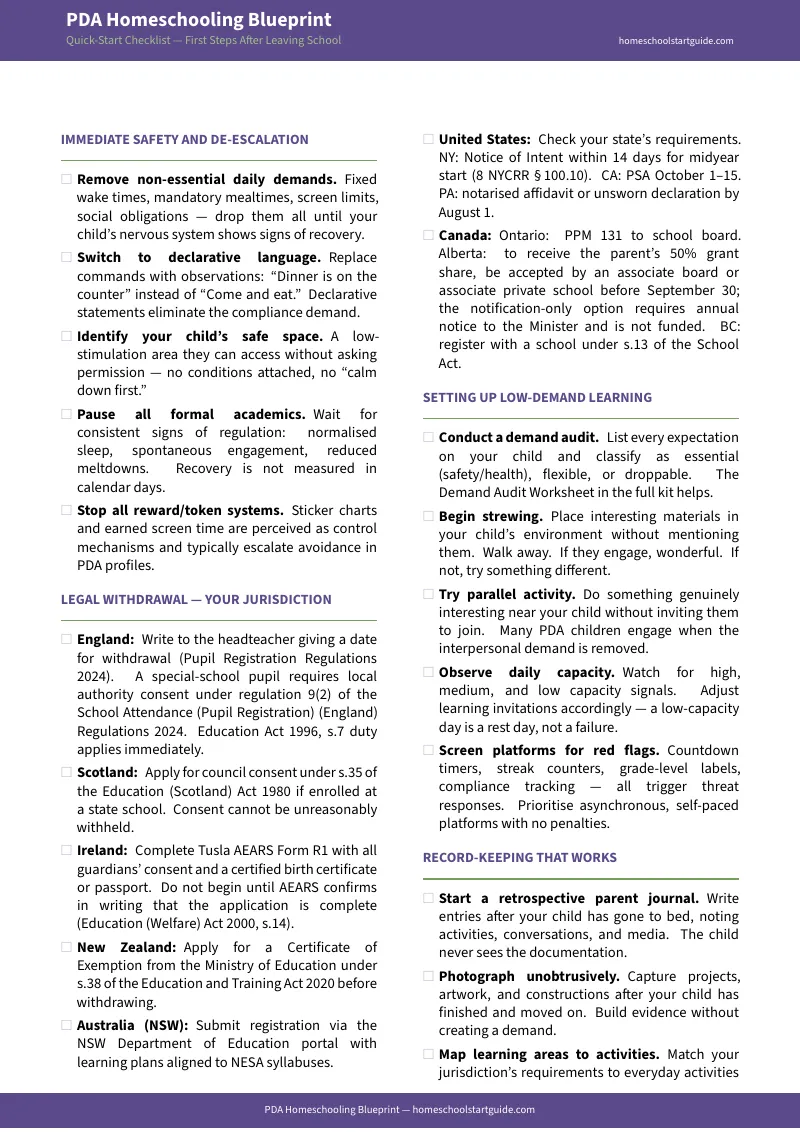
- checklist.pdf — a two-page, 25-item quick-start checklist of the first low-demand changes after leaving school
- Eight fillable worksheets — demand-audit-worksheet.pdf, declarative-language-scripts.pdf, daily-capacity-tracker.pdf, curriculum-mapping-worksheet.pdf, activity-to-evidence-translator.pdf, learning-journal-template.pdf, legal-withdrawal-checklist.pdf, agency-communication-log.pdf
- Full refund, no time limit — if the Blueprint doesn't work for your family, email [email protected] and we'll refund you, no questions asked
Frequently Asked Questions
My child hasn't been formally diagnosed with PDA. Can I still use this?
Yes. PDA is not a standalone diagnosis in most diagnostic systems — it's described within the autism spectrum (NICE, DSM-5-TR, ICD-11). Many families use this guide with a suspected PDA profile, an autism diagnosis that mentions demand avoidance, or no diagnosis at all. The strategies are designed around how your child responds to demands, not around a label on a report.
I already have your Neurodivergent Homeschooling Hack. Do I need this too?
The Neurodivergent Homeschooling Hack covers ADHD, autism, dyslexia, giftedness, and PDA across a broad scope — PDA is one chapter in a 17-chapter guide. The PDA Homeschooling Blueprint goes much deeper into the PDA-specific challenges: full burnout recovery protocols, declarative language scripts for daily home education, the Demand-Free Documentation System for record-keeping that doesn't trigger avoidance, and the demand-reduction strategies that the broader guide only introduces. If PDA is your child's primary profile, this is the one that covers it in full.
What if my child won't do anything at all right now?
Chapter 2 addresses this directly. After months or years of school-related distress, most PDA children need a prolonged recovery period — weeks to months — where the only goal is nervous system regulation, not learning. The chapter explains what's happening neurologically, what recovery looks like in practice, and how to explain to a local authority what education your child is receiving during a period that looks, from outside, like nothing is happening.
Does this replace a curriculum?
It's not a curriculum — it's a framework for learning without one. Chapter 4 covers interest-led learning and strewing, which let your child learn across subjects without being told what to study. Chapter 7 shows you how to document that learning in terms your authority recognises. Some PDA families eventually add gentle structure as their child recovers; others never do. Both paths are covered.
Which countries does the legal section cover?
The US (three representative examples: New York, California and Pennsylvania), England, Scotland, Wales, Northern Ireland, Ireland, Canada (Ontario, British Columbia and Alberta), Australia (New South Wales and Victoria), and New Zealand. Each section covers the withdrawal process, ongoing reporting requirements, and what to do if your authority requests a visit or more evidence.
Is there a free version?
Yes — the PDA Homeschooling Quick-Start Checklist is a free two-page, 25-item download with the first low-demand changes to make after leaving school. Enter your email on this page to get it instantly. The full Blueprint goes much deeper, with 13 chapters and eight fillable worksheets covering the complete journey from school withdrawal to sustainable low-demand home education.
Frequently Asked Questions
What if the rules change after I buy?
We update the guide when the rules change. Email us any time, even years later, and we'll send you the current edition free.