Your State Opted In. The SGO List Is Coming. Now What?
The federal tax-credit scholarship starts in 2027 — the first federal tax credit to support private contributions for K–12 scholarships. But knowing it exists and knowing how to use it are two different things.
The rules are split across IRS notices, Treasury regulations, state executive filings, and independent nonprofit scholarship granting organisations, which Treasury and the IRS project could number 600 to 700 by 2030. Each SGO sets its own application window, its own documentation requirements, and its own award amounts. The IRS portal tells you whether your state opted in. It does not tell you which SGO to apply to, whether your income qualifies in your county, what your homeschool expenses can actually be spent on, or how the scholarship interacts with the state ESA you are already using.
The Federal Tax-Credit Scholarship Verification & Application System puts the entire process in one document — from state opt-in verification to expense tracking after the money arrives — so you can apply with confidence instead of guessing your way through a programme no family has navigated before.
What's Inside the Guide
- State Opt-In Verification Protocol — step-by-step instructions to confirm your state's participation status on the IRS FSTC portal, check whether your state has submitted its certified SGO list, and monitor pending state legislation if your state has not yet opted in
- County-Level Income Eligibility Worksheet — the 300% Area Median Gross Income test is calculated by county, not nationally. The worksheet walks you through comparing household income for the calendar year before your application with HUD data for your specific county and household size
- SGO Discovery and Evaluation Checklist — how to find certified SGOs in your state, the questions to ask before applying (application windows, award amounts, priority rules, payment methods, homeschool-status implications), and what a legitimate SGO looks like versus one that has not met federal requirements
- Application Documentation Guide — the types of income records, residency proof, and student eligibility documents SGOs may ask for under the proposed regulations, plus a timeline so you know when to have everything ready
- Qualified Expense Reference — which spending categories are confirmed under IRC Section 530 (tuition, fees, textbooks, tutoring, educational technology) and where the homeschool and microschool expense rules stand under the current proposed regulations
- Multi-Programme Stacking Framework — how Section 25F scholarships interact with state ESAs, state tax-credit scholarships, and 529 accounts, with an expense separation ledger to help you avoid double-claiming the same cost
- Homeschool Status Protection Questions — three specific questions to ask an SGO administrator before accepting a scholarship, designed to help you check whether the award affects your statutory homeschool status or adds reporting obligations under your state's law
- Donor Credit Guide — a standalone section for grandparents and relatives explaining the nonrefundable federal credit (up to $1,700 per taxpayer), the anti-earmarking rule, the state credit offset, and how to file IRS Form 8525
- Walkthroughs for Common Family Situations — a Texas homeschool family, a Florida PEP family, and a family in a non-participating state, each walked end-to-end through the process
- 7 Printable Worksheets and Planning Tools — income eligibility worksheet, SGO comparison checklist, expense tracking log, expense separation ledger, donor contribution record, application document checklist, and annual renewal timeline — each a standalone PDF you can print and fill in
Who This Is For
- Homeschool parents who want to know whether their curriculum, tutoring, testing, and co-op expenses qualify — and whether taking a scholarship puts new strings on their homeschool
- Microschool families navigating shared instructional costs, SGO disbursement rules, and the federal anti-self-dealing provisions
- Private-school tuition payers trying to align SGO award cycles with school re-enrolment deadlines
- Grandparents and extended family who want to use the donor credit to support a child's education without running into the earmarking prohibition
Why Not Just Read the Free Government Pages?
The IRS FSTC participating-states page tells you which states elected for 2027. The IRS says its approved-SGO list will be available through Tax Exempt Organization Search; neither source explains the income test by county or walks parents through applications. Treasury's proposed regulations (REG-117199-25) run 51 Federal Register pages of legal text written for tax professionals and SGO administrators, not parents.
The 31 states that elected to participate must submit their approved 2027 SGO lists to the IRS by February 15, 2027. All SGOs must prioritize students awarded a scholarship the previous school year, then eligible students with a sibling who received a scholarship from that SGO. SGOs set their own application windows, documentation requirements, and award amounts. There is no single federal parent-application portal.
Meanwhile, online forums and social media groups are already circulating claims that donors can earmark gifts for a specific child (they cannot — IRC § 25F(d)(1)(E) prohibits it), that your state ESA and the federal scholarship can be used on the same expense (the stacking rules vary by state and programme), and that every homeschool expense automatically qualifies (the proposed regulations are more nuanced than that).
This guide translates the statutory text, the temporary regulations, and the proposed rules into a dated, step-by-step process — and tells you exactly where to check when the rules update.
Satisfaction Guarantee
Full refund, no time limit. If the guide does not give you a clear path through the federal scholarship process, email [email protected] and we will refund your purchase — no questions, no deadline.
Get Started
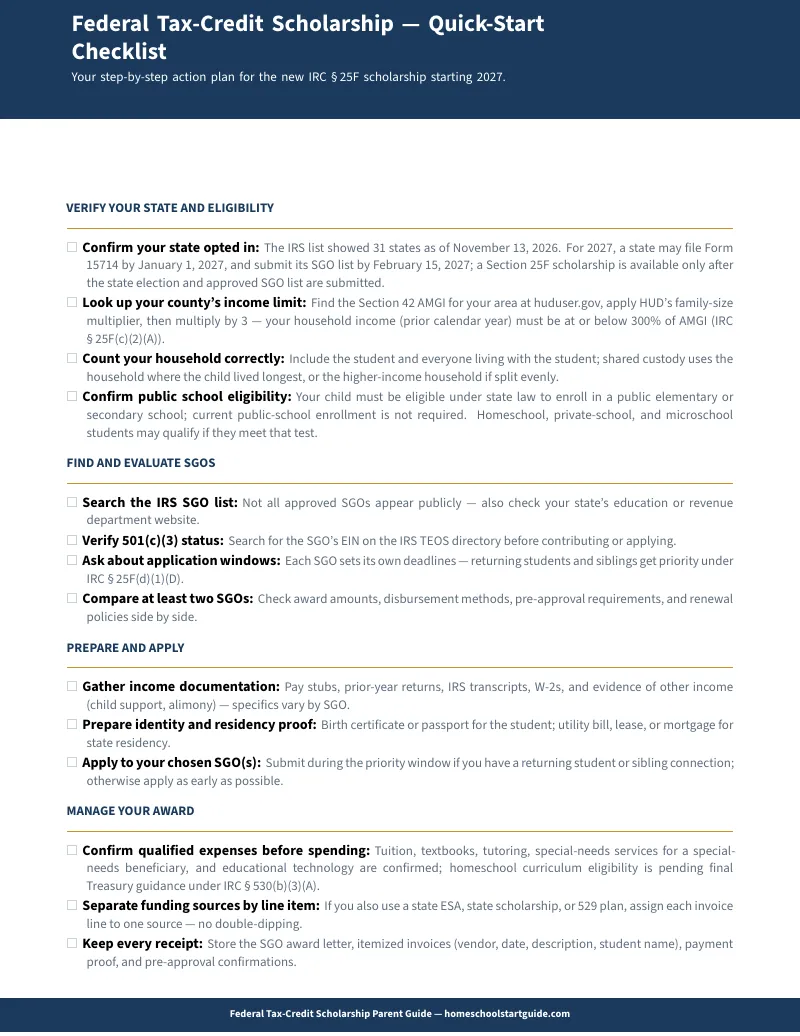
Download the free Quick-Start Checklist to verify your state's opt-in status, run a preliminary income check, and identify certified SGOs — or get the full guide for the complete application system, expense tracking tools, stacking framework, and donor credit section.
The guide is — a one-time purchase with no subscription and no membership. Every rule is dated and cited to the statute, the regulation, or the IRS portal where you can verify it yourself.
Frequently Asked Questions
What if the rules change after I buy?
We update the guide when the rules change. Email us any time, even years later, and we'll send you the current edition free.