
You Applied for $8,000 Per Child — Then the Spending Platform Rejected Your First Purchase
The Utah Fits All Scholarship promises thousands of dollars for homeschooling or private school. You did the hard part — you applied, you waited through the priority tiers, you got the award letter. Then you tried to actually use the money.
The Odyssey platform kicked back your curriculum purchase because the receipt description did not include the right educational-purpose keywords. Your tutoring reimbursement was flagged because the vendor had not completed background check onboarding. You tried to buy PE equipment and discovered there is a 20% spending cap on physical education — but the platform did not warn you until after you exceeded it. Meanwhile, the Utah Home Education Association is telling you that accepting the money changes your legal homeschool status, and the Supreme Court is deciding whether the whole program survives.
That is the gap this guide fills. Not the rules — the Odyssey Parent Handbook covers those. The Scholarship Spending and Compliance System: how to verify eligibility and understand your priority tier before you gamble on an application, how to navigate the Odyssey platform so every purchase is approved on the first submission, how to stay within the spending caps without a spreadsheet nightmare, how to maintain your rights as a Utah parent under either homeschool status, and how to protect your family's education plan regardless of what the Supreme Court decides.
What the Guide Covers
- Eligibility verification and priority tiers decoded — The three requirements every applicant must meet, the four-tier priority system (renewing recipients, siblings, income-based, general lottery), how household processing works when multiple children apply at once, and why accepting a partial household award versus declining it is a genuine strategic decision that affects future renewal priority.
- Application timeline with every document mapped — The March-to-July annual calendar, the difference between the renewal window and the new-applicant window, every document you need to gather, why certain uploads must be converted to JPG, and the pre-July acceptance deadline that forfeits your award if you miss it.
- The Odyssey Spending Platform — from first login to audit-proof receipts — How the direct marketplace works, when to use manual reimbursement instead, vendor onboarding for providers not yet on the platform, and the receipt-description strategies that turn declined purchases into first-try approvals. Parents report that platform rejections are the single biggest source of out-of-pocket loss — one flagged $300 music program or $150 science curriculum means you pay full price while the appeal sits in a queue.
- Spending caps and prohibited expenses, line by line — The 20% cap on extracurricular activities, the 20% cap on physical education, the $1,500 technology hardware limit (once per three years under HB 455), and the items that are expressly banned: ski lift passes, musical instruments, furniture, and parent compensation. The guide maps every category so you know before you spend — not after the platform rejects the transaction.
- The Homeschool Status Firewall — Utah law draws a hard statutory line between a traditional homeschooler operating under § 53G-6-204 (Notice of Intent, zero state oversight, zero funding) and a Home-Based Scholarship Student under § 53F-6-401 (state funds, annual assessment, spending rules, audit authority). Accepting the scholarship does not erase your educational autonomy — but it does layer compliance obligations on top of it. The guide puts both statuses side by side so you know exactly what changes and what does not.
- Audits, record-keeping, and the three-year retention rule — What the state can request, how to build an audit-defense file throughout the year, and why maintaining an independent expense log outside the Odyssey platform is the single most important compliance habit.
- Renewal, multi-child strategy, and long-term planning — How Tier 1 priority locks in returning students, the May 31 portfolio-or-test deadline that determines renewal eligibility, what happens if a sibling ages out of one track into another, and how to manage tiered funding across a household of three or four children without losing track of any cap.
- The Supreme Court challenge — Labresh v. Brown — The district court ruling, the stay that keeps the program operating during appeal, the two legislative backup strategies the Legislature has prepared, and a decision-tree framework so your family can spend confidently now and pivot smoothly if the legal landscape shifts.
Who This Guide Is For
- Parents who just discovered the Utah Fits All Scholarship and need to determine whether their child qualifies — and whether accepting the money is worth the compliance trade-offs
- Families with an active scholarship who are struggling with declined reimbursements, unclear spending categories, or the 20% caps they did not realize existed until after they overspent
- Traditional Utah homeschoolers who value their independence and want to understand exactly what changes about their legal status before committing to the program
- Multi-child households managing $14,000 to $32,000 in combined annual scholarship funds who need a system for tracking spending, caps, deadlines, and renewal requirements across all their children
- Any Utah parent worried about the Supreme Court case who wants a concrete plan — not just hope — for protecting their family's education path regardless of the outcome
Why the Official Handbook Is Not Enough
The Odyssey Parent Handbook tells you what the rules are. It does not show you how to navigate them. It defines spending categories without explaining which receipt descriptions pass the platform's review and which get flagged. It references vendor onboarding without walking you through what a non-marketplace provider needs to complete before you can use scholarship funds with them. It says nothing about coordinating your Notice of Intent with scholarship compliance, building an audit-defense file, or structuring your family's spending so a court ruling does not leave you scrambling.
Vendor-published guides from curriculum companies and tutoring platforms — Teton Music, UPI Study, Christianbook — explain how to spend your scholarship on their products. They are acquisition funnels, not compliance systems. They omit the spending caps that apply across all vendors, the record-keeping requirements that apply year-round, and the legal status implications that affect every homeschool family who participates.
Advocacy organizations like UHEA provide valuable perspective on traditional homeschool freedom — but their core mission is independent homeschooling without state involvement. If you have decided to participate in the scholarship, you need operational guidance they are not designed to provide.
This guide sits in the gap between the rules and the execution. Every chapter is built from the Utah Code, HB 455 amendments, Odyssey platform mechanics, State Board policies, and first-year parent experiences — translated into plain-language procedures a family can follow without a policy analyst on retainer.
What You Get
Your download includes nine PDFs:
- The Utah Fits All Scholarship Parent Guide — 50 pages covering eligibility, application, the Odyssey platform, spending rules and caps, homeschool status implications, audits, renewal, multi-child strategy, and the Supreme Court challenge, with tables, decision trees, and worked examples
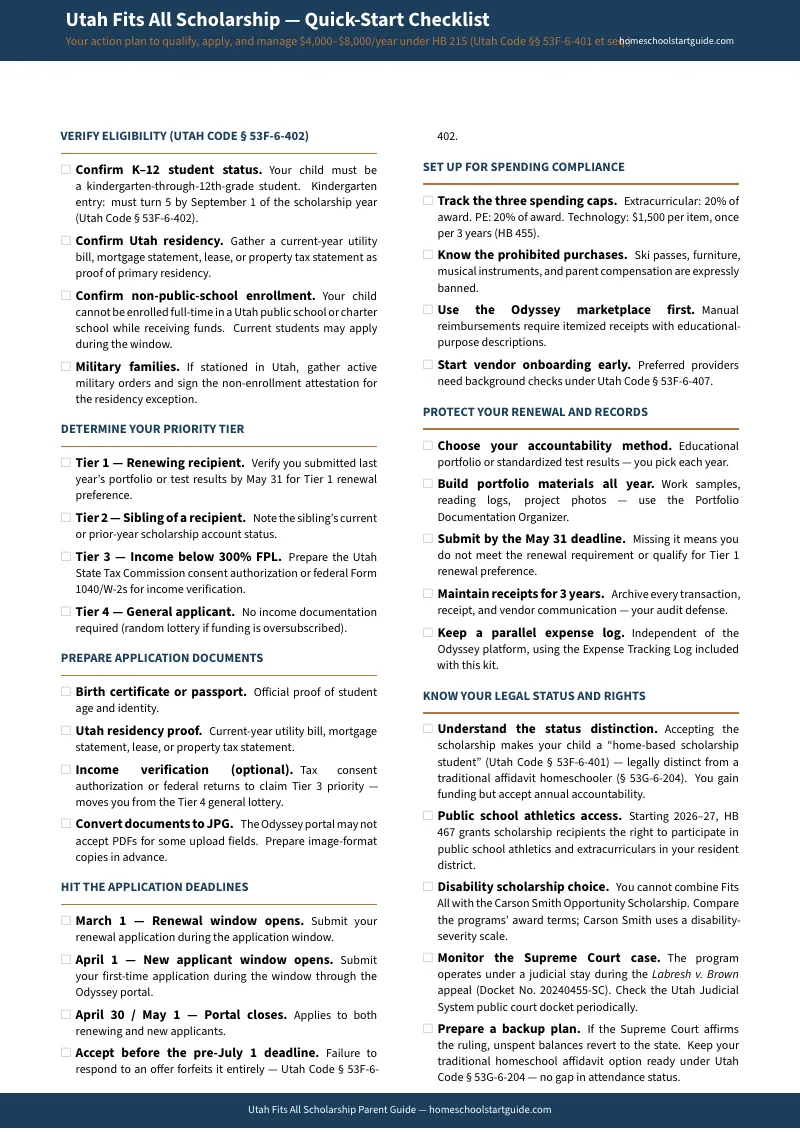
- Quick-Start Checklist — A 25-item action checklist organized across six phases: eligibility verification, priority tier determination, document preparation, application deadlines, spending compliance setup, and renewal protection
- Eligibility Verification Worksheet — Walk through each requirement with space to record your documentation status before starting the portal application
- Document Preparation Checklist — Pre-application audit of every required document with a JPG-conversion tracker
- Application Timeline Planner — Map statutory deadlines alongside your family's target dates from application through acceptance
- Annual Compliance Calendar — A 12-month planning tool covering every deadline, disbursement date, and renewal action item
- Expense Tracking Log — Record every Odyssey transaction and reimbursement claim across the scholarship year for audit-defense documentation
- Spending Cap Tracker — Monitor the three HB 455 caps (extracurricular 20%, PE 20%, technology $1,500) with running totals
- Portfolio Documentation Organizer — Month-by-month guide for collecting work samples and building your May 31 portfolio submission
Satisfaction Guarantee
If this guide does not help you navigate the Utah Fits All Scholarship process, email [email protected] for a full refund. No time limit, no forms, no hassle.
Start With the Free Checklist
Download the Quick-Start Checklist at no cost — 25 action items covering eligibility verification, document preparation, application deadlines, and spending compliance essentials. If the checklist helps and you want the full guide with detailed platform navigation, receipt-framing strategies, the complete expense breakdown, the dual-status compliance map, and the Supreme Court contingency framework, the complete Utah Fits All Scholarship Parent Guide is available for .