The Service Continuity Map — Every Support Your Child Keeps, Loses, or Can Seek Again After Leaving Texas Public School
You fought for that IEP. Months of ARD meetings, paperwork, calls that went to voicemail. You finally got your child's needs documented — speech therapy minutes, behavioral support, occupational therapy, accommodations for sensory processing. And the district delivered maybe half of it.
Now the school is failing your child so badly that leaving is the only option. But the moment you started researching homeschool withdrawal, you hit a wall of questions that no single website answers:
- Does the IEP disappear when you withdraw?
- Can the district still evaluate your child — and are they required to?
- What happens to Medicaid waiver services — STAR Kids, CLASS, MDCP — when school enrollment ends?
- Can a homeschooled child with a disability qualify for TEFA priority without a current IEP?
- If homeschooling is temporary, can your child return and be evaluated for special-education support again?
The answers exist. They're scattered across TEA technical guidance documents, HHSC waiver manuals, Comptroller TEFA rules, federal IDEA regulations, and district-specific Proportionate Share policies that read like compliance manuals for bureaucrats. Synthesizing them takes 20+ hours of reading legal language that wasn't written for you.
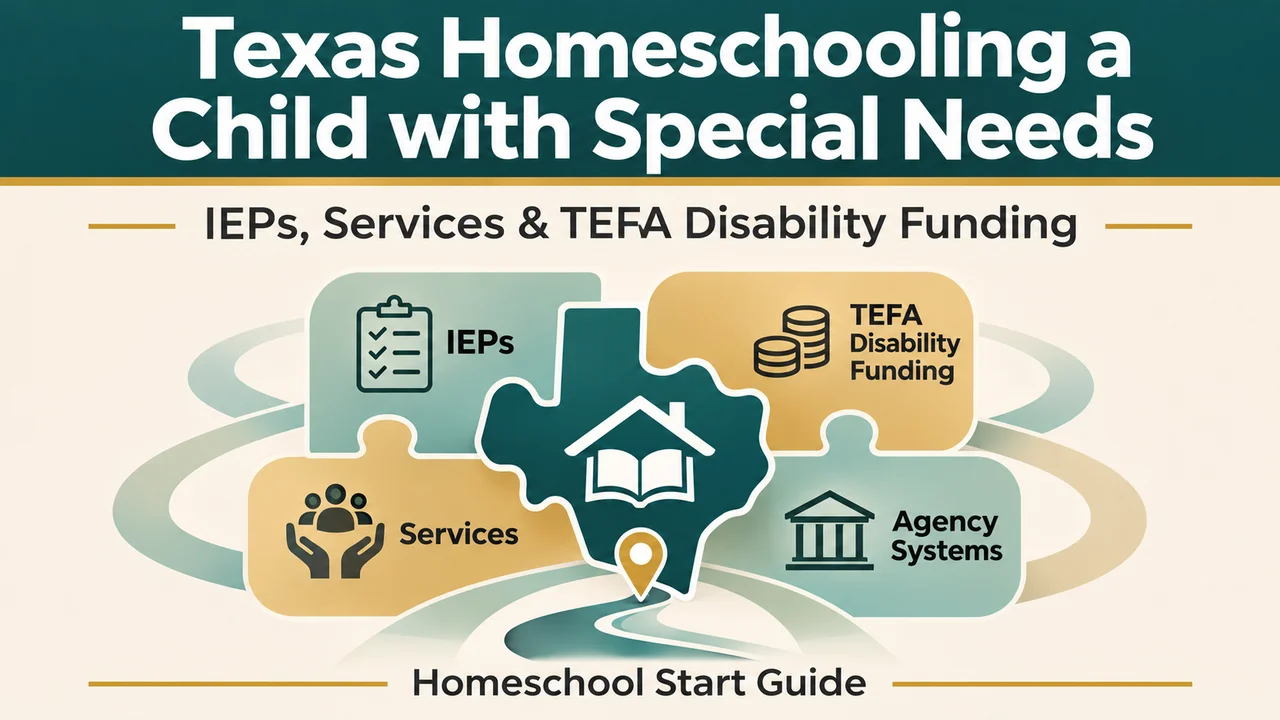
The Texas Homeschooling a Child with Special Needs Guide is the Service Continuity Map — one document that traces every support your child currently receives, shows what happens to each one when you withdraw, and gives you the steps, timelines, and printable logs to preserve, replace, or reclaim every service that matters.
The Departure Sequence — Leave Without Losing Documentation
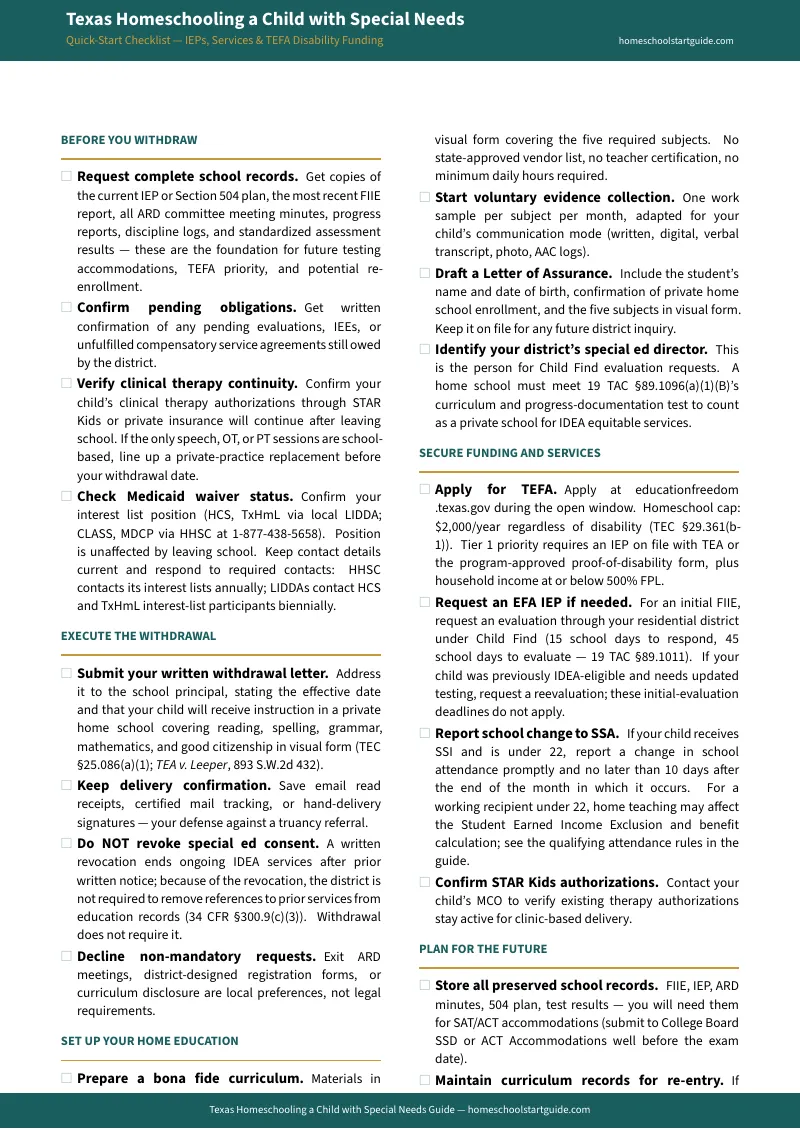
An ARD meeting is not required to withdraw. But there are things worth doing before you send that letter — and an order that protects your child's evaluation history. The guide walks you through requesting complete FIIE records, securing ARD minutes, confirming the status of any pending evaluations, and submitting your withdrawal notice with clear language and a delivery record if truancy questions arise. It also explains why withdrawal does not require a separate written revocation of special education consent.
Child Find Evaluations — The District's Duty Doesn't End When You Leave
Withdrawing ends your child's individual right to a Free Appropriate Public Education. It does not end the district's Child Find duty under IDEA. The district where your homeschool is located must still identify, locate, and evaluate children with suspected disabilities — including yours. The guide explains the Full Individual and Initial Evaluation (FIIE) process: the district must give notice of its proposal or refusal within 15 school days after receiving a written request; it generally has 45 school days after written consent to complete the evaluation; and the ARD committee generally determines eligibility within 30 calendar days after the report, subject to timing exceptions.
Proportionate Share Services — What the District May Still Provide
Under IDEA, the district sets aside federal funds for equitable services to parentally placed private-school students — including homeschoolers that meet Texas's private-school criteria. This is Proportionate Share: there is no individual right to the services a child would receive in public school, and the district selects services and students through the required consultation process. The guide explains how to participate, what "equitable" means in practice (it's not "equal"), and what to do when a district claims it doesn't serve qualifying homeschoolers.
TEFA Funding — Disability Priority and the Homeschool Award
For 2026–27, the maximum TEFA award for homeschool/other students is $2,000. Disability documentation can affect application priority for families with household income at or below 500% of the federal poverty level, but it does not increase the homeschool award. Increased awards of up to $30,000 are for students with a disability who have an IEP on file with TEA by the end of the application period and attend a participating private school or pre-K or kindergarten program. The guide explains this distinction and how to check application dates for each program year.
Medicaid Waivers, STAR Kids & SSI — The Services That Don't Depend on School
Healthcare funding operates on a separate track from educational services. School withdrawal alone does not determine eligibility for STAR Kids, CLASS, MDCP, TxHmL, or SSI, but each program's eligibility and service-authorization rules still apply. School-based IEP services end at withdrawal; qualifying homeschoolers may separately be selected for limited Proportionate Share services. The guide maps the boundary and explains how to confirm existing medical-therapy authorizations and plan for any service gap.
SAT/ACT Accommodations — Preserving the Evidence Trail
College entrance exams require documentation of a disability and a history of accommodations. For homeschooled students, that documentation often comes from the FIIE reports and ARD records created while they were in public school. The guide shows you exactly what to preserve, how testing boards evaluate accommodation requests from homeschool candidates, and what additional documentation you may need.
Re-Entry — Going Back with Support Reassessed
Homeschooling may be a bridge, not a destination. The guide covers what happens when a child returns to public school: how districts evaluate returning students for grade placement, how to request a special-education evaluation, and how to maintain records that support the re-enrollment process.
Worksheets, Timelines & Resource Directory
The kit includes eight printable worksheets — Departure Checklist, Agency Communication Log, Evaluation Timeline Tracker, Evidence Collection Log, TEFA Budget Planner, Re-Entry Documentation Organizer, Accommodation History Organizer, and Transition Timeline — plus a directory of free Texas resources — SPEDTex, Partners Resource Network, Disability Rights Texas, Texas Project FIRST, and Texas Parent to Parent — with direct phone numbers and web addresses.
Who This Guide Is For
- Parents leaving because the IEP isn't being followed — the ARD committee promised services that never materialized, and your child is in crisis
- Parents who just received a diagnosis — the school is slow to evaluate or accommodate, and you're pulling your child out before the system catches up
- Parents confused by TEFA disability funding — the eligibility rules are dense and the timelines are unforgiving
- Parents navigating both school services and Medicaid waivers — you need to know which therapies stop and which continue, and you can't afford a gap
- Parents who may put their child back in school later — you need a bridge that keeps the re-enrollment path clean
What This Guide Is Not
This is not legal advice. It is not affiliated with TEA, HHSC, the Comptroller, any school district, or any government agency. It does not promise that services will continue, that TEFA funding will be awarded, or that any district will provide Proportionate Share services. It explains the administrative rules, timelines, and documentation requirements in plain language so you can make informed decisions and avoid procedural disqualifications.
Families facing active truancy prosecution, disciplinary hearings, Manifestation Determination Reviews, or due process complaints should consult a special education attorney or contact Disability Rights Texas before making any withdrawal decisions.
The Free Checklist vs. the Full Guide
The free Quick-Start Checklist covers the withdrawal steps, three questions to ask the district about Child Find, and a directory of free state resources. It's enough to understand your rights tonight.
The full kit goes deeper — a 12-chapter guide covering the departure sequence, Child Find evaluations, Proportionate Share, TEFA disability funding, Medicaid waivers and STAR Kids, clinical assessments, record-keeping adapted to your child, SAT/ACT accommodations, re-entry, dispute resolution, and a complete resource directory, plus eight printable worksheets. Every agency. Every timeline. Every step.
Some Texas special education advocates charge by the hour; one DFW practice lists consultation packages from $175. Standard HSLDA membership is $150 a year. The full guide costs — once, with no subscription and no membership.
Get the Texas Special Needs Homeschooling Guide →
Your child's support didn't fail because of a diagnosis. It failed because of a system. This guide helps you leave that system without losing what your child needs.
Frequently Asked Questions
What if the rules change after I buy?
We update the guide when the rules change. Email us any time, even years later, and we'll send you the current edition free.