The Comptroller Published the Rules. Nobody Published the Playbook.
Texas just launched the largest single-year school choice programme in the country — $1 billion in Education Freedom Accounts for the 2026–27 school year. Over 274,000 families applied. Roughly 100,000 got funded. The rest are on a waitlist or were disqualified entirely.
Many of those disqualifications were preventable. Parents submitted the wrong income document. They misunderstood the priority tiers. They assumed homeschooled students with disabilities could access the $30,000 award (they cannot — the cap is $2,000 regardless). They tried to get reimbursed for out-of-pocket purchases, not realising the final rules prohibit direct reimbursements entirely.
The state portal defines the rules. Odyssey runs the spending platform. THSC lobbies for the programme. HSLDA warns against it. None of them provide an independent, step-by-step execution strategy built to protect your family's finances and legal autonomy.
That is what this guide does.
The TEFA Application Readiness System
The Texas Education Freedom Accounts (TEFA) Parent Guide is a complete execution manual for every stage of the TEFA process — from preparing your documents before the application window opens, through the priority lottery, into the Odyssey spending platform, and all the way to annual renewal.
It is not a summary of the Comptroller's FAQ. It is not a vendor guide designed to steer you toward a particular curriculum. It is a neutral, independent walkthrough built on the final adopted administrative rules filed with the Texas Secretary of State — not the draft proposals that most blogs and YouTube videos still reference.
What's Inside
- The Eligibility Gate — every criterion spelled out with the exact documents to upload, including the Pre-K qualifying criteria most families do not know exist and the AGI verification standard that disqualified 25,500 applications in the first cycle
- The Four-Tier Priority Lottery, Decoded — concrete household scenarios showing how your AGI, disability documentation, and prior public school enrolment determine your tier placement and lottery odds, including the 20% statutory cap on higher-income families
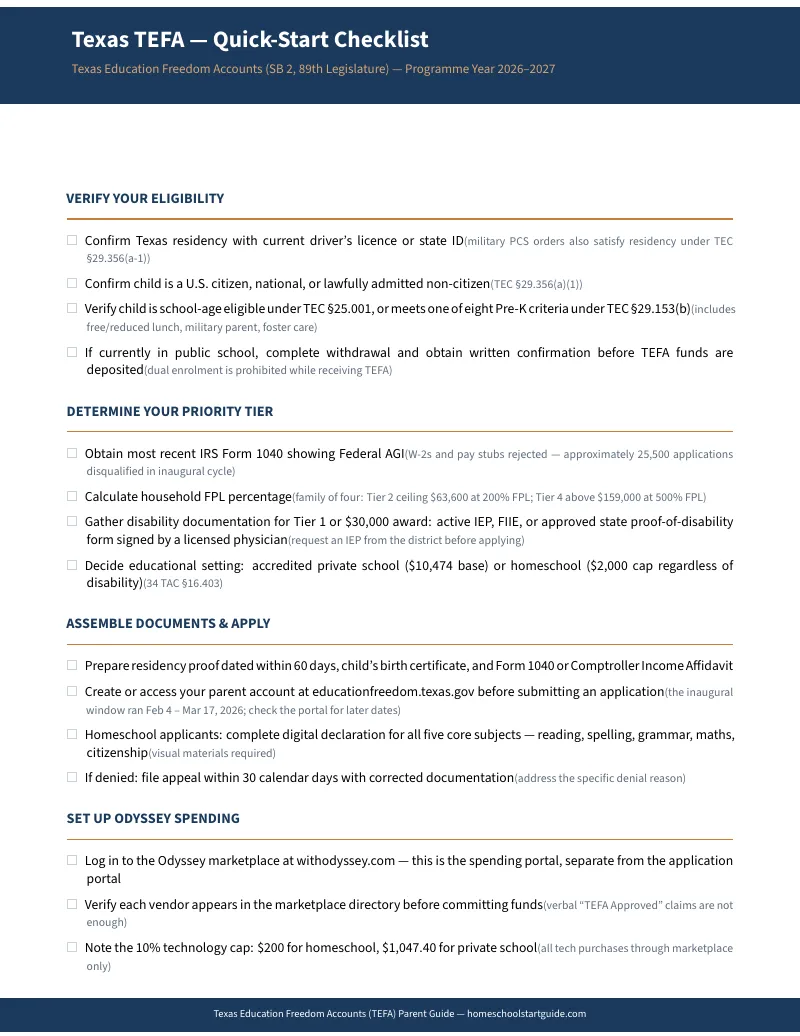
- The Application Readiness Checklist — a step-by-step document preparation sequence covering Texas ID, residency proof, IRS Form 1040 for AGI, IEP or disability documentation, and the Comptroller Income Affidavit for non-filers
- The Odyssey Spending Playbook — approved and prohibited expenses broken down by category, the 10% technology hardware cap ($200 for homeschoolers), the prohibition on paying family members, and how the direct-pay digital wallet actually works
- The Homeschool Legal Matrix — how TEFA interacts with your Leeper status, why HB 2674 prevents state regulation of homeschools through TEFA, and exactly which testing obligations apply to TEFA participants by grade level (grades K–2 are exempt; grades 3–12 take one annual norm-referenced test)
- The Renewal and Exit Roadmap — how continuation works for funded families, how waitlisted applicants update their files, and how to exit the programme mid-year without triggering a truancy inquiry from your former school district
- The $30,000 Special Education Pathway — how private school families navigate public school district IEP evaluations to access the maximum award, including the FIIE process and ARD committee documentation
Who This Guide Is For
- Homeschool families considering whether to apply for the $2,000 allocation — particularly those who want the money but are anxious about state oversight or losing Leeper protections
- Parents withdrawing from public school for the 2026–27 year who need to understand how to complete the withdrawal, obtain their child's Student Unique ID, and navigate the Odyssey portal in the correct order
- Private school families seeking the $10,474 base award or up to $30,000 for students with disabilities, who need to understand the tuition gap, disbursement timing, and how the lottery affects their chance of funding
- Waitlisted families from the inaugural cycle who need to know how to strengthen their application for the next round
Why Not Just Use Free Resources?
The Comptroller's portal provides legal definitions — not execution strategies. It does not tell you how to optimise your tier placement, which filing errors trigger disqualification, or how the proposed rules differ from the final rules you are actually bound by.
Vendor guides from curriculum companies and microschool operators are designed to sell their services. They routinely conceal the technology spending cap, the prohibition on direct reimbursements, and the audit rules that apply if you overspend.
THSC and HSLDA offer opposing advocacy positions on whether families should participate at all. Neither provides an unbiased, step-by-step walkthrough for parents who have already decided to apply.
This guide accepts zero vendor sponsorship, receives no state funding, and sells no curriculum. Its only purpose is to help your family capture every dollar you are entitled to — without filing errors, without audit surprises, and without compromising your legal autonomy.
Your Satisfaction, Guaranteed
If the guide does not deliver what you expected, email [email protected] for a full refund — no time limit, no questions.
Get Started
Download the free Texas TEFA Quick-Start Checklist to see the eligibility criteria, key deadlines, and spending categories at a glance. When you are ready for the complete execution system — the 44-page guide plus 7 printable planning tools including the Priority Tier Worksheet, the Spending Category Card, the Audit Preparation Log, and the Compliance Calendar — get the full kit for .