
The district says you have to choose between homeschooling and your child's IEP funding. Ohio law built a bridge they're not telling you about.
Your child has an IEP. The school isn't following it. Every morning is a battle — the sensory overload, the meltdowns in the car park, the calls from the front office asking you to pick them up early. You've sat through meeting after meeting where the team agreed to accommodations and nothing changed. You're done.
But the special education coordinator told you that pulling your child out means signing away the IEP. The principal said homeschooling and scholarships don't mix. Someone in a Facebook group told you the Jon Peterson money only works for private schools. And the form the school handed you is titled "Revocation of Consent for Services" — which sounds like you're forfeiting everything you spent two years fighting for.
None of this is true. Under Ohio law, an eligible home-educated child can access up to $34,000 per year in state scholarship funding for therapy, specialised instruction, and educational services — delivered by an approved provider while you teach at home. The withdrawal notification requires three elements. The IEP document survives. And the district is still required to evaluate your child under federal Child Find rules after you leave.
The problem isn't the law. The problem is that the law lives across five different state portals, three statutory codes, and a provider directory nobody tells parents about — and the school has no incentive to connect the dots for you.
The Special Needs Home Education System
The Ohio Special Needs Homeschool Guide connects the pieces that the state scatters and the district won't explain. It's the full execution system for Ohio families home educating a child with an IEP, a 504 plan, an autism diagnosis, or any disability — from the day you decide to withdraw through the day you submit your first scholarship reimbursement.
What You Get
The HB 33 Legal Foundation for Special Needs Families
House Bill 33 replaced Ohio's old superintendent-approval system with a notification under O.R.C. §3321.042: your name and address, your child's name, an assurance of instruction in six subjects. No approval, no testing, no credentials. The guide explains what this means specifically for a child with disabilities — including the forms you should refuse to sign, the records to request before sending your notification, and what the superintendent can and cannot legally demand from a family withdrawing a child with an IEP.
Jon Peterson Special Needs Scholarship — The Complete Execution Path
JPSN provides $10,045 to $34,000 per year (FY 2027, scaled by disability category) for speech therapy, occupational therapy, specialised instruction, ABA, assistive technology, and other approved services — delivered by a registered business provider while you homeschool. The guide walks through every step: maintaining district disability identification and a current IEP, selecting a provider from the DEW directory, the application timeline, what services qualify, reimbursement mechanics, and annual renewal, including required state assessments unless an exception applies.
The Autism Scholarship Track
If your child has an autism diagnosis, the Autism Scholarship provides up to $34,000 through an approved provider — and it can be accessed through either a district IEP or an Autism Education Plan, which opens a path that JPSN doesn't. The guide explains when each scholarship applies, how to choose between them when your child qualifies for both, and the specific documentation the Autism Scholarship requires that differs from JPSN.
The 504-to-IEP Evaluation Bridge
If your child has a Section 504 plan instead of an IEP, scholarship funding is off the table — a 504 plan alone does not establish eligibility under either program. But the guide maps the evaluation pathway that can change this: how to request an evaluation from your resident district before you withdraw, the 30-day district response and 60-day evaluation timelines, what the district must identify for scholarship eligibility, and when to time the withdrawal so the evaluation completes first.
IEP Preservation — What Survives Withdrawal and What Doesn't
The district's duty to implement the IEP ends when your child leaves school. The IEP document and ETR remain in your child's education records. The guide explains the difference between withdrawing from school and revoking consent for services, why a written revocation ends district-provided special education services after prior written notice, and how to meet the current IEP, district disability-identification, and state assessment requirements for JPSN renewal, unless an exception applies.
District Obligations That Continue After You Leave
Federal Child Find requirements mean your resident district must still evaluate your child for suspected disabilities after withdrawal. The guide covers how to request and manage ETR evaluations as a homeschool family, what equitable services home-educated children may access, and the distinction between FAPE obligations (which end) and Child Find duties (which continue regardless of enrollment status).
County DD, OhioRISE, and Medicaid Continuity
Pulling your child from school does not affect Medicaid eligibility, County Board of Developmental Disabilities services, or OhioRISE behavioural health wraparound. These are healthcare programs independent of school enrollment. The guide explains how each one works alongside home education, what to tell your case manager, and the specific forms that document the transition without triggering a service review.
Therapies, Accommodations, and Testing Outside School
How to structure speech, OT, ABA, and counselling through scholarship providers or private pay. How to document accommodations for a home-educated child. And how to secure ACT and SAT testing accommodations when there's no school coordinator to file the paperwork — including the independent submission process, the institutional codes for homeschoolers, and the documentation requirements that replace a school-based SSD filing.
The Return-to-School Chapter
If your family decides to return to public school, the guide covers the re-enrollment timeline, how to request a new ETR evaluation, the process for restoring an IEP, and what happens to scholarship funding during the transition — so you never lose ground if circumstances change.
Who This Guide Is Built For
- Parents whose child has an IEP and school has stopped working — your child is in crisis, the accommodations aren't being followed, and you need to withdraw without losing access to therapy funding
- Parents confused about scholarship eligibility for homeschoolers — you've heard of Jon Peterson and the Autism Scholarship but can't figure out how they work when your child isn't in a school building
- Parents with a 504 plan and no clear path to funding — the school says withdrawal ends everything; the guide shows the evaluation pathway that can change that
- Parents navigating County DD, OhioRISE, or Medicaid waivers — you've been told homeschooling could disqualify your family (it doesn't) and need to know how to manage the transition
- Families who already withdrew and need the scholarship steps — the crisis is over, your child is home, and now you need to execute the funding application before the next school year starts
- Parents pulling a child out mid-year — you can't wait until June, and you need to protect the IEP documentation and start the scholarship process immediately
Why Not Just Piece It Together for Free?
The information is public. Here's what finding it actually costs you:
The Ohio DEW website posts scholarship guidelines, provider directories, and home education forms across separate portals that don't link to each other. The home education page notes that home-educated children may qualify for scholarships, but does not explain the application steps for special needs families. The scholarship pages do not explain how the systems connect for a homeschool family.
Disability Rights Ohio and OCECD offer free advocacy guides — for enforcing IEP rights inside public schools. If you've already decided to leave, their guidance on structuring independent home education with scholarship funding is thin.
Facebook and Reddit groups host parents sharing scholarship experiences — alongside outdated testing requirements eliminated by HB 33, incorrect claims that Jon Peterson doesn't work for homeschoolers, and advice to sign forms that could cost you a year of funding. The peer advice is free, contradictory, and when it's wrong about scholarship eligibility, the cost is real money.
HSLDA membership costs $150 per year. Its one-on-one educational consultant program ended in April 2024; its general resources are not built around Ohio's provider directory, scholarship requirements, or the HB 33 notification mechanics.
The guide costs — once, no membership, no subscription. It connects every piece: withdrawal, IEP preservation, scholarship execution, provider selection, Medicaid continuity, and the return-to-school pathway. One download. Every step in the right order.
Full Refund, No Time Limit
If the guide doesn't help your family, email [email protected] for a full refund. No time limit. No questions. No form to fill out.
Less Than One Hour of an Advocate's Time
A special education advocate charges $50 to $150 per hour. Most of them specialise in fighting within the public school system — not in structuring home education with state scholarship funding. HSLDA membership runs $150 per year, but its one-on-one educational consultant program ended in April 2024. A private educational consultant costs hundreds per session.
The guide costs . It covers the complete HB 33 notification process, IEP and ETR preservation, Jon Peterson and Autism Scholarship execution with provider selection, the 504 evaluation pathway, Medicaid and County DD continuity, testing accommodations, and the return-to-school process. One purchase. Every funding pathway mapped. Every district pushback answered.
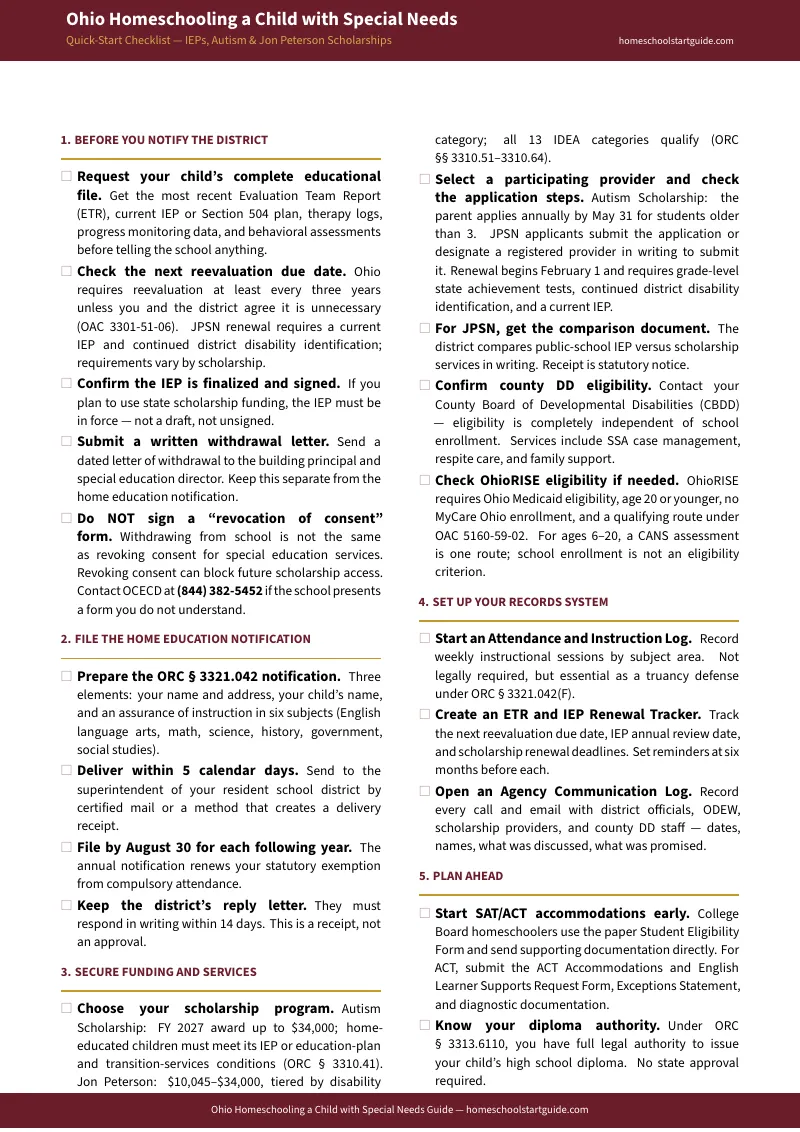
Not ready for the full guide? Download the free Ohio Homeschooling a Child with Special Needs — Quick-Start Checklist — a two-page overview of the withdrawal process, what happens to your child's support plan, and the records to secure before you leave.
Ohio law says your child can homeschool and keep the scholarship. The district just hasn't told you that yet. This guide does.
Frequently Asked Questions
What if the rules change after I buy?
We update the guide when the rules change. Email us any time, even years later, and we'll send you the current edition free.