
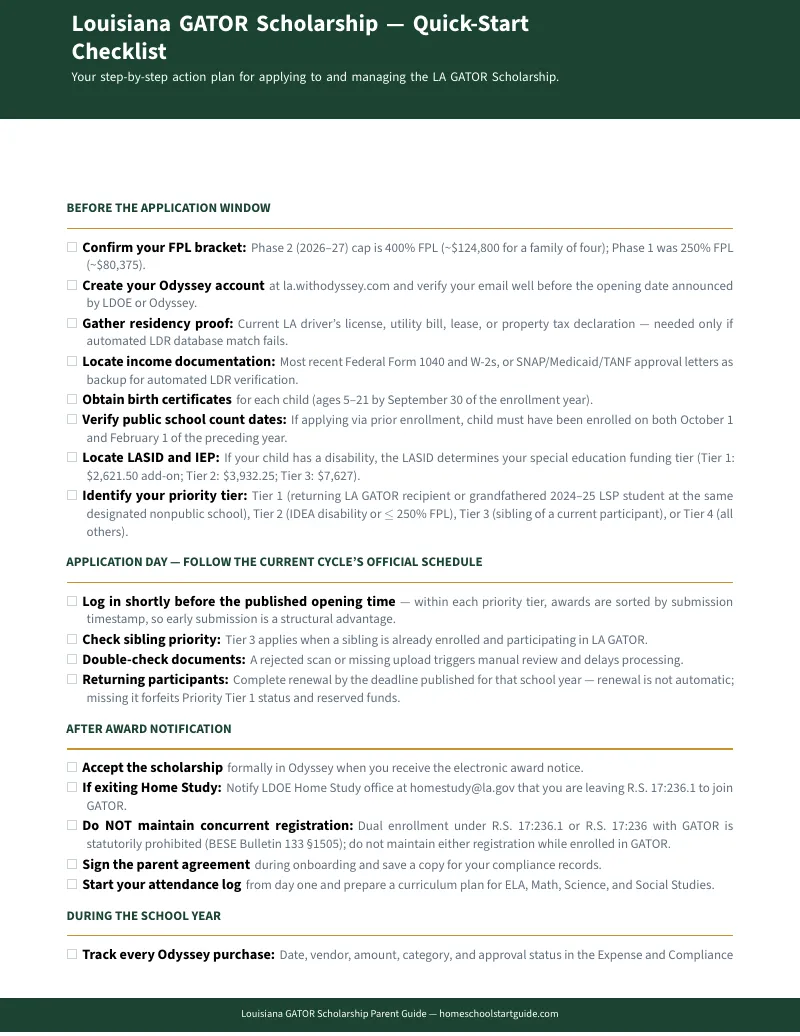
You're Applying for $5,243 to $15,253 Per Child — With a Two-Week Window and No Do-Overs
Louisiana's LA GATOR Scholarship funds between $5,243 and $15,253 per child every year. That money doesn't arrive in a check. It sits inside the Odyssey platform — behind spending categories, quarterly disbursements, core-subject-first rules, and vendor approvals that reject purchases made in the wrong order or the wrong category.
The state received over 39,000 eligible applications in Year 1 and funded roughly 6,000. Within each priority tier, awards are distributed strictly by submission timestamp — first in, first funded. A family that submits at 9:01 a.m. on opening day has a structural advantage over one that submits at 3 p.m. Parents who don't understand the priority system, the document requirements, or the legal status tradeoff end up on a waitlist that expires at the end of the year.
The LDOE handbook explains the rules. It doesn't explain how to execute them without expensive mistakes.
The GATOR Navigation System
The Louisiana GATOR Scholarship Parent Guide is a complete operational roadmap — not a binder printable, not a spending tracker, not a pep talk about school choice. It is a step-by-step system for determining your eligibility, optimizing your application, navigating the Odyssey marketplace, and staying compliant through renewal — without rejected orders, waitlist surprises, or legal status problems you didn't expect.
Where the state handbook states that applications are "prioritized by tier and timestamp," this guide shows you exactly how to identify your tier, pre-stage every document, and submit within the first minutes of the portal opening. Where Facebook groups give you anecdotal advice that mixes last year's rules with other states' ESA programs, this guide gives you categorized, program-year-specific rules current to the 2026–27 cycle.
What's Inside
- Phase-Finder Decision Matrix — determine your eligibility phase, priority tier (1 through 4), and estimated award in under two minutes, using the guide's walk-through of FPL thresholds, disability verification, and sibling priority rules
- Application Timestamp Playbook — the exact document-prepping framework needed to submit within the first minutes of the portal opening, because within each tier, funding is allocated strictly by submission time — not by application quality or completeness after the fact
- Document Readiness Checklist — every form and credential the Odyssey portal requires: Louisiana residency proofs, Form 1040 and W-2 income verification, government-issued birth certificates, LASID lookups for disability verification, and the backup documents for manual review
- Legal Status Transition Matrix — a side-by-side statutory comparison of BESE-Approved Home Study (R.S. 17:236.1), Registered Nonpublic School (R.S. 17:232), and GATOR Home-Based Education, covering testing mandates, transcript requirements, curriculum oversight, and TOPS college scholarship eligibility — because accepting GATOR money means leaving your current legal category, and most families don't discover this until after they've applied
- Award Calculations With Worked Examples — base general education ($5,243), low-income general education ($7,626), and the three disability add-on tiers (supplemental funding from $2,621.50 to $7,627), with step-by-step calculations for families with multiple children at different tiers
- Odyssey Marketplace Spending Blueprint — approved, prohibited, and capped spending categories, the core-subject-first funding mandate, quarterly disbursement timing, technology limits, the conflict-of-interest rule that disqualifies relative-provided tutoring, and the specific vendor selection strategies that prevent order rejections
- Compliance and Audit Defense — attendance logging requirements, mandatory ELA and Math assessments under Bulletin 133 §1525, and what to do if an order is flagged or your account is placed under review
- Renewal and Waitlist Strategy — how renewal secures Priority Tier 1 status for the following year, the filing deadlines, the waitlist rules (it expires — it does not roll over), and re-application strategies for families who were waitlisted
- 6 Printable Planning Tools — a document readiness checklist, an application day action plan, an award calculator worksheet, a legal status transition planner, an expense and compliance tracker, and an annual renewal calendar — all designed to print and use alongside the guide
Who This Guide Is For
- Home educators considering GATOR who want to understand the legal trade-offs before exiting their BESE-Approved Home Study or Nonpublic School registration — because that exit is a one-way legal reclassification until you formally re-register
- Parents of children with disabilities who need clarity on how IEP documentation and LASID verification unlock supplemental disability funding of up to $7,627 above the base award
- Families withdrawing from public school who are navigating the application timeline, the priority tiers, and the legal registration steps simultaneously — and who cannot afford a truancy investigation from filing documents in the wrong order
- Enrolled families dealing with rejected Odyssey orders, spending category confusion, quarterly disbursement timing, or renewal anxiety
Why Not the Free Resources?
The LDOE website and Odyssey help center are authoritative — and they are also fragmented across dozens of PDF downloads, policy manuals, and support articles written in dense administrative language designed to protect the department, not guide the parent. They state that you need "proof of residency" without specifying the exact combination of documents that passes the automated Louisiana Department of Revenue database match versus the manual verification fallback. They list priority tiers without explaining that the waitlist expires and you lose your place.
Facebook groups fill some of those gaps — but with crowd-sourced advice that mixes other states' ESA programs (Arizona, Florida, West Virginia), references the old LSP rules, and sometimes recommends actions that trigger compliance violations. A parent who tells you to "just keep your Home Study registration while using GATOR" is handing you a statutory violation — R.S. 17:236.1 and R.S. 17:232 are explicitly incompatible with GATOR enrollment under BESE Bulletin 133 §1505. The consequences include account termination and repayment of spent funds.
A single procedural mistake — submitting an unapproved residency document, selecting the wrong priority code, or maintaining a concurrent registration — results in placement on a waitlist or account termination, forfeiting between $5,243 and $15,253 in education funding for the year. The guide costs a fraction of any one of those mistakes.
Satisfaction Guarantee
Full refund, no time limit. If the guide doesn't help you navigate your GATOR application and spending with less stress and fewer mistakes, email [email protected] and we'll refund every penny.
The Application Window Won't Wait
Download the free Quick-Start Checklist to see the eligibility tiers and key deadlines right now. When you're ready for the complete system — the timestamp playbook, the legal status matrix, the spending blueprint, and the full compliance framework — the full guide is here.