The school's attendance office sent a letter. Now you need to know what it actually means — and what happens if you get it wrong.
Your child missed school. Maybe it was a string of sick days. Maybe therapy appointments that the attendance clerk never coded correctly. Maybe a family trip the district refused to excuse. Whatever the reason, the letter arrived — official letterhead, statutory citations, a tone that makes it sound like the next step is a courtroom.
And the letter is confusing on purpose. It references thresholds — three or more unexcused days or parts within four weeks, ten or more unexcused days or parts within six months of the same school year, ninety percent for class credit — without explaining which ones apply to your situation. It mentions "truancy prevention measures" and "referral" without telling you that the school must apply those measures before referring your child to truancy court. It never mentions that you can audit the attendance ledger, challenge miscoded absences, or request that statutory medical excusals be applied retroactively.
Free information exists — scattered across the Texas Education Code, district handbooks written from the enforcement side, law firm blogs that quote retainer fees before they explain the process, and Reddit threads where parents give each other advice from the wrong state. What doesn't exist, until now, is a single document that walks a Texas parent through every stage of attendance enforcement in order, with the deadlines that actually matter and the rights the school never mentions.
The Attendance Enforcement Navigator
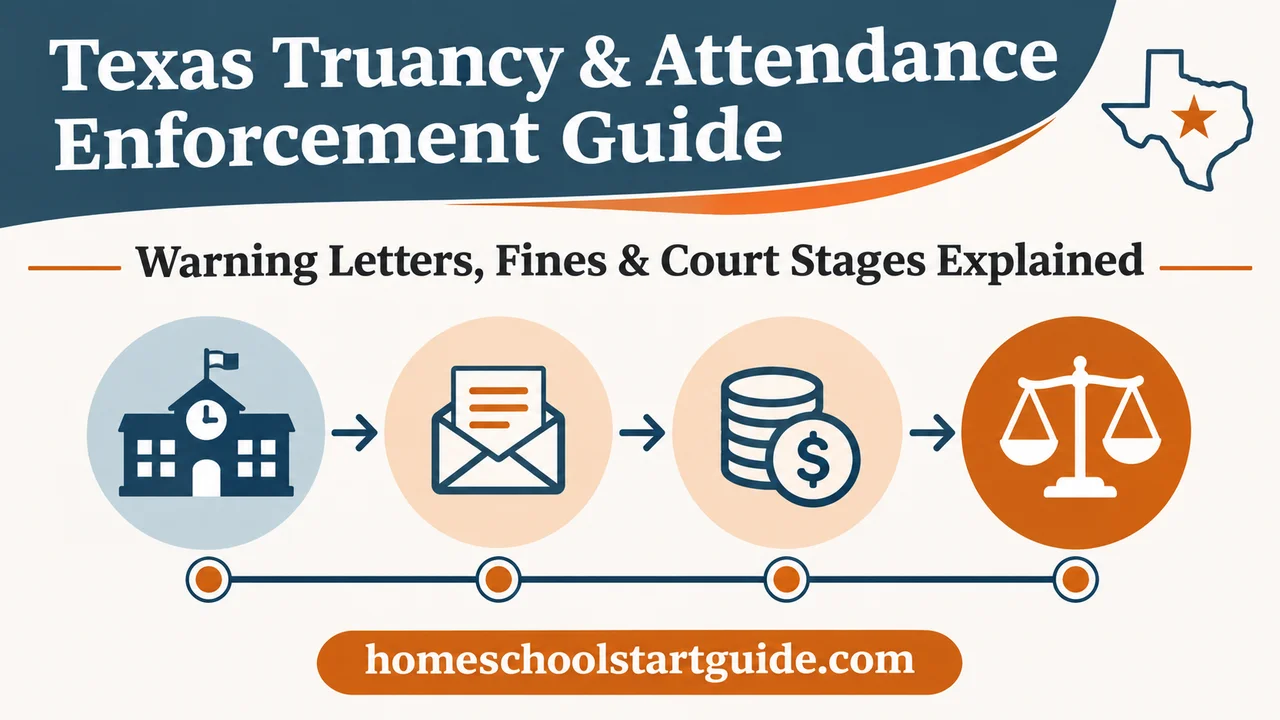
The Texas Truancy & Attendance Enforcement Guide is a structured process navigation system — not legal advice, not a template, not a single letter you send and hope for the best. It maps the entire enforcement timeline from the first warning through the final court order, tells you what's happening at each stage, what your options are, and where the system gives you room to act before things escalate.
What makes this different from the free resources you've already found: the guide doesn't just quote the law. It translates it into a decision framework. When you get a three-absence warning, the guide tells you what to check on the attendance ledger, how to submit documentation and keep proof of what you sent, and what the school must do before referring your child to court. When you're preparing for a truancy prevention meeting, the guide gives you a preparation framework and an evidence organisation system. When you're facing a Parent Contributing citation, the guide maps the criminal track separately from the civil track so you know exactly which proceeding you're in and what it means.
What's Inside the Guide
The Enforcement Timeline — Every Stage, In Order
Compulsory attendance ages, how absences are counted (including partial days that most parents don't realise count), the notice threshold of three or more unexcused days or parts within four weeks under TEC § 25.095(b), the truancy prevention measures the school must apply under § 25.0915, and the referral threshold of ten or more unexcused days or parts within six months of the same school year under § 25.0951(a). You'll know exactly where your family sits and what triggers each next step.
Statutory vs. District Excused Absences
Texas law mandates excusal for specific absences under defined conditions — healthcare and mental health appointments for the student or the student's child if the student begins or returns to school the same day; an absence for a serious or life-threatening illness or related treatment that makes the student's attendance infeasible, certified by a Texas-licensed physician on the district's adopted form; religious observance; required court appearances; and the military visits listed in TEC § 25.087(b-4), subject to its deployment and timing limits. But districts also set their own local rules, and the boundary between what the law requires and what the district chooses is where most coding errors happen. The guide maps both layers so you can spot when an absence was wrongly coded.
The Attendance Ledger Audit Worksheet
A structured tool for comparing the school's attendance record against your own documentation — appointment confirmations, doctor's notes, therapy receipts, written communications with the attendance office. Schools refer cases built on their ledger. If the ledger is wrong, the referral is built on wrong data. The worksheet helps you find discrepancies and document them before they become court evidence.
Meeting and Conference Preparation Framework
When the school schedules a truancy prevention conference or attendance committee hearing, the guide tells you what to bring, what questions to expect, how attendance improvement plans are structured, and how to document the outcome in writing. For children with an IEP, Section 504 plan, or disability-related absences, there's a dedicated section on how attendance accommodations intersect with truancy enforcement.
The Two Court Tracks — Mapped Separately
Most online resources blur the civil and criminal tracks together. The guide separates them completely. The civil track: a truancy court petition for the child under Family Code Chapter 65 — what the petition looks like, what the hearing involves, what remedial orders the court can make, and, if the child is found to have engaged in truant conduct, the $50 court cost (ordered only after a reasonable opportunity to be heard and only if the person is financially able). The criminal track: a Parent Contributing to Nonattendance citation under TEC § 25.093 — the offence elements, the fine structure ($100 first offence rising to $500 for a fifth or subsequent), plea options, deferred disposition, and the record implications of paying a fine without understanding what it means.
The 90% Credit Rule and Recovery
Even excused absences count toward the 90% attendance threshold for academic credit — except absences for a serious or life-threatening illness or related treatment that makes the student's attendance infeasible and is certified by a Texas-licensed physician on the district's adopted form. The guide explains the attendance committee process, what a principal-approved instructional plan looks like for students with 75% to less than 90% attendance, and how to request the medical exclusion so your child's illness doesn't cost them credit.
Home Education — the Choice and Its Boundaries
Withdrawing to homeschool is lawful in Texas and simpler than most schools will tell you. But it is prospective: prior absences stay on the record, and an active court referral or citation does not disappear because your child is no longer enrolled. The guide explains what withdrawal does and does not change. For the full withdrawal mechanics, it cross-links to the Texas Legal Withdrawal Blueprint.
Evidence Toolkit and Printable Worksheets
Five standalone printable PDFs alongside the main guide: an attendance ledger audit worksheet, a communication log, an evidence checklist, a conference preparation sheet, and a 90% credit tracker — plus a contacts directory for TexasLawHelp, Disability Rights Texas, the State Bar Lawyer Referral Service, and local legal aid. Print the worksheets, fill them in, and bring them to your next school meeting or court appearance.
Who This Guide Is For
- Parents who just received an attendance warning letter and need to understand whether it's serious, what comes next, and what to do before the district's deadline passes.
- Parents whose child has medical or mental health absences that the school keeps coding as unexcused — chronic illness, anxiety, therapy, hospital stays — and who need to know which absences the law requires the school to excuse.
- Parents cited for Parent Contributing to Nonattendance who want to understand the criminal misdemeanour process, their plea options, and the consequences of paying a fine without legal advice.
- Parents whose child has been referred to truancy court and who need to understand the civil proceeding — the petition, the hearing, the possible court orders, and their child's rights.
- Parents considering withdrawing to homeschool who want to know what it stops, what it doesn't stop, and how to do it without creating new problems.
Why Free Information Isn't Enough
The Texas Education Code is public. District attendance handbooks are posted online. TexasLawHelp has articles on truancy defence. So why do parents keep getting caught off guard?
Because the information is fragmented across three different codes (Education Code, Family Code, Code of Criminal Procedure), written for different audiences (school administrators, judges, attorneys), and presented from the enforcement side. District handbooks explain when they will refer you, not what rights you have when they do. Law firm pages explain what a lawyer can do, not what you can do yourself at the administrative stage where most cases can still be resolved. Reddit threads mix Texas advice with advice from states where truancy is still a criminal offence for children.
The guide synthesises all of it into one walkthrough — in order, in plain language, with the deadlines and options at every stage. It's the document you wish the school had given you alongside the letter.
The Free Quick-Start Checklist
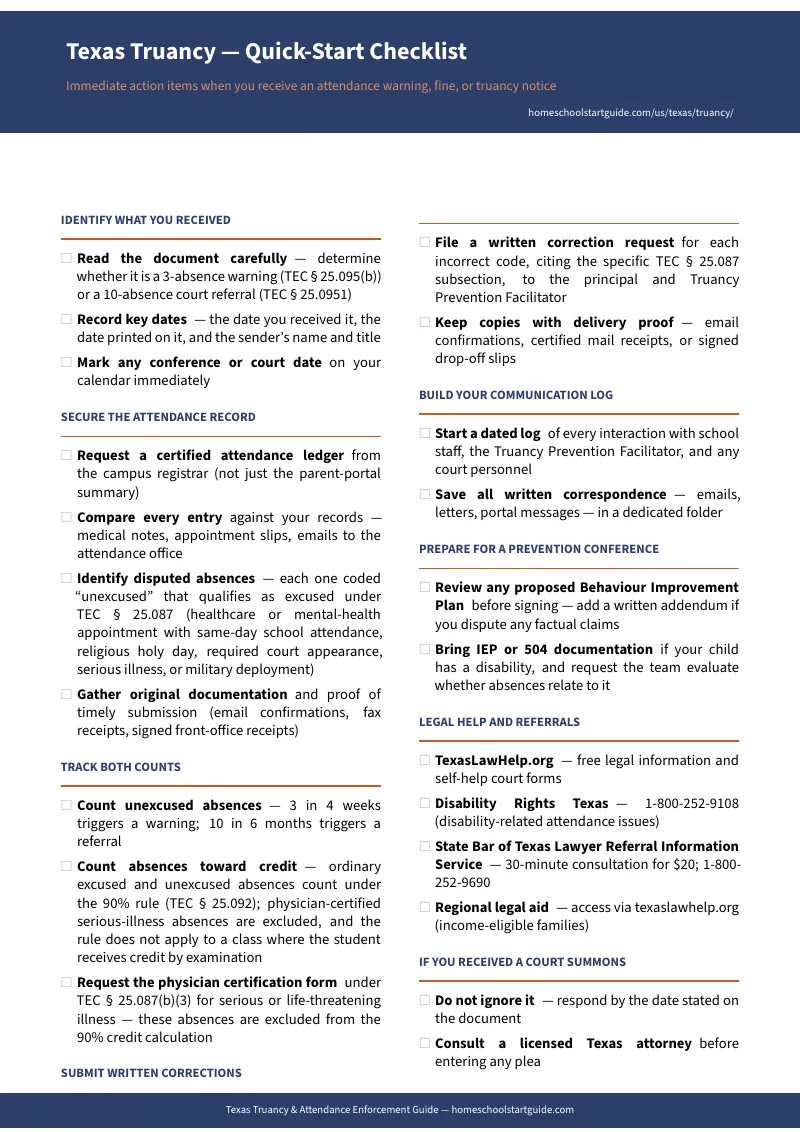
Not sure whether you need the full guide? Start with the free Texas Truancy Quick-Start Checklist — a two-page download covering the first 72 hours after receiving an attendance notice: identify what type of notice you received, inventory your documentation, start a communication log, and find free legal help contacts. The checklist gives you immediate action items, with follow-up emails to help you use them.
Satisfaction Guarantee
Full refund, no time limit. If the guide doesn't help you understand and respond to your attendance situation, email [email protected] and we'll refund your purchase. No form, no questionnaire, no waiting period.
Get the Guide
The Texas Truancy & Attendance Enforcement Guide costs less than a single hour of attorney consultation — and covers every stage of the enforcement process that most parents navigate before they ever need a lawyer. Download it now and read it tonight.
Or start with the free Quick-Start Checklist — the first steps you need right now, at no cost.
Frequently Asked Questions
What if the rules change after I buy?
We update the guide when the rules change. Email us any time, even years later, and we'll send you the current edition free.