The letter says "habitual truant." You kept your kid home with the flu.
Your child was sick for a week. The doctor's office faxed the note. You called the absence line every morning. And now there is a letter from the school district referencing Ohio Revised Code sections, instructional hour thresholds, and an Absence Intervention Team meeting — or worse, a juvenile court complaint.
The letter does not explain what happens next. It does not tell you which absences actually count against you. It does not explain the difference between a district attendance notice, which is an administrative notification under local policy, and habitual truancy, which is based on hours missed without legitimate excuse and can lead to a juvenile-court complaint.
Ohio's attendance framework — restructured under House Bill 410 and updated by House Bill 96 — tracks instructional hours, not days. Ohio public schools report each student's total hours absent for excused and unexcused reasons. Each district sets its attendance-notification threshold, capped at 5% of the minimum annual instructional hours. This notice threshold can include excused absences; habitual truancy is separate and counts only hours missed without legitimate excuse. Partial-day absences add the missed instructional time to attendance totals.
The Attendance Enforcement Navigator
The Ohio Truancy & Attendance Enforcement Guide is a structured process navigation system that explains district attendance notices, support options under local policy, and the juvenile-court complaint process when habitual-truancy thresholds are met without satisfactory progress. It maps the decision points, documentation steps, and local or court timelines to check.
This is not a legal defense strategy. It is not a template to fight the school. It is a plain-language reference that explains what each document means, what state law requires, what to check in local policy, and when the situation calls for a lawyer instead of a self-help guide.
What free resources get wrong
Ohio Legal Help and the Department of Education and Workforce publish accurate legal definitions — but they are written for administrators and attorneys, not for a parent who just opened an envelope from the attendance office. County court websites provide clerk instructions for filing responses, but they cannot advise you on whether to respond or how to prepare for an Absence Intervention Team meeting. Generic attendance log templates from online marketplaces track daily presence and absence, but they do not reconcile partial-day instructional minutes against Ohio's hour-based thresholds.
The gap is not information. The gap is organization. Parents need to know which attendance measure or notice applies, what it triggers, what documentation supports an excusal, and when to get help — in one place, in order, in language that does not require a law degree.
What's inside
- Three Attendance Measures Decoded — Ohio law sets a district attendance-notification threshold no higher than 5% of minimum annual instructional hours, defines habitual truancy by 30 consecutive hours, 42 in one school month, or 72 in a school year without legitimate excuse, and defines chronic absenteeism at 10% or more of minimum annual instructional hours. Each measure serves a different purpose, and the guide explains how they relate.
- The Attendance and Court Process — The guide explains district attendance notices, support options under local policy, and when a juvenile-court complaint is required after habitual-truancy hours are reached if the student and family are not making satisfactory progress.
- Excused vs. Unexcused — The Hours That Matter — Ohio reports excused and unexcused absence hours separately, and only hours without legitimate excuse count toward habitual truancy. The guide breaks down the excuse framework, how district policies handle documentation, and how partial-day absences affect hour totals. Includes a worked example showing how hours add up across a semester.
- AIT and Attendance-Meeting Preparation — Ohio requires districts to provide Absence Intervention Teams for students at risk of chronic absenteeism; local policy defines the team's work. The guide explains how to clarify the meeting type, prepare your records and narrative, and document follow-up. It includes a preparation worksheet.
- Court Procedure and Penalties — Both Parent and Child — When enforcement moves to juvenile court, the guide explains the complaint, the hearing, and the possible outcomes. For the child: unruly adjudication, probation, community service, driver's license conditions. For the parent: under ORC §3321.99, a violation of §3321.38(A) may be punished by a fine up to $500 or up to 70 hours of community service; ORC §2919.24 is a first-degree misdemeanor. The guide explains the exposure and when to call a lawyer.
- Disability and Special Education Intersection — If your child has an IEP or 504 plan, attendance enforcement interacts with FAPE protections. The guide explains when disability-related absences are protected, when they are not, and where to get help from Disability Rights Ohio and the Ohio Coalition for the Education of Children with Disabilities.
- Home Education Under ORC §3321.042 — Withdrawing to homeschool ends the compulsory attendance obligation going forward, but it does not erase hours already recorded or stop enforcement already underway. The guide walks through the notification to the superintendent, when the exemption takes effect, and what withdrawing changes and does not change.
- Record-Keeping Templates — Printable Attendance Hours Reconciliation Worksheet, Parent Action Log, Evidence Documentation Checklist, AIT meeting preparation worksheet, and home education notice template.
Who it's for
This guide is for Ohio parents and guardians who are navigating school attendance enforcement — whether the first letter just arrived or a juvenile court date is already set.
It is built for the parent whose child has been sick, anxious, attending therapy, or dealing with circumstances the school does not fully understand — and who needs to know what the letter means, what comes next, and what to do about it, without paying a $1,500 retainer to find out.
It is not legal representation. If your child has a juvenile court summons and you need a defense attorney, the guide tells you where to find one — including Ohio Legal Help, regional legal aid societies, and public defender offices. The guide is the organized reference you use before, alongside, and after legal counsel — not instead of it.
Satisfaction guarantee
If the guide is not what you need, email [email protected] for a full refund — no time limit, no questions.
Frequently Asked Questions
My child's absences were all excused. Why did we get this letter?
Ohio public schools report total hours absent for excused and unexcused reasons. District policy sets the attendance-notification threshold and process; the threshold cannot exceed 5% of minimum annual instructional hours. A notice alone is not a truancy finding. Habitual truancy is separate and counts only hours missed without legitimate excuse. The guide explains how these measures differ.
Can I withdraw my child to homeschool and stop the attendance case?
Withdrawing to home education under ORC §3321.042 ends the compulsory attendance obligation going forward. It does not retroactively excuse hours already on the record, and it does not dismiss a juvenile court complaint already filed. The guide explains the withdrawal steps and their limits.
What is the worst that can happen to me as a parent?
Parents face separate possible liability. Under ORC §3321.99, a violation of §3321.38(A) (failure to cause attendance) may be punished by a fine up to $500 or up to 70 hours of community service. ORC §2919.24 (contributing to the unruliness of a child) is a first-degree misdemeanor carrying up to $1,000 in fines and 180 days in jail. The guide explains what triggers each charge and when to get a lawyer.
Does my child get a criminal record?
An unruly adjudication is not a criminal conviction; Ohio law says the child is not a criminal by reason of the juvenile judgment. Access to juvenile court records depends on record type and court rules; eligible records can be sealed and expunged. The court can impose conditions including probation, community service, and driver's license restrictions. The guide explains the range of outcomes.
How is this different from the free checklist?
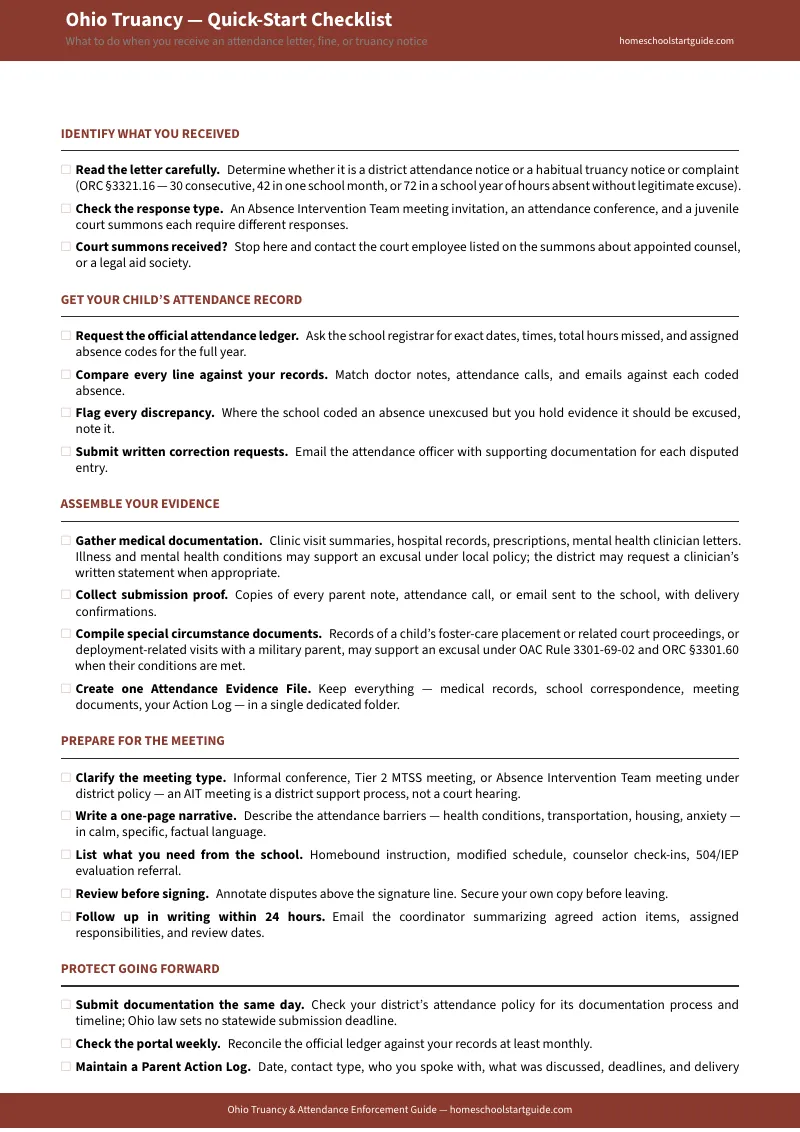
The two-page free checklist helps you identify the attendance notice or court document you received, gather records, prepare for a meeting, and find legal-help resources. The full guide covers the legal framework in detail, includes worked examples of how hours accumulate, provides AIT meeting preparation materials, explains court procedure and penalties for both the child and the parent, and walks through the home education option with its limits.
Is this legal advice?
No. This is an educational process navigation guide. It explains what the law says and how the enforcement process works in plain language. It does not tell you what to do in your specific situation and it does not replace a licensed attorney. The guide tells you clearly when you need legal counsel and where to find it.
Frequently Asked Questions
What if the rules change after I buy?
We update the guide when the rules change. Email us any time, even years later, and we'll send you the current edition free.