Claim Every Eligible Dollar of Minnesota K–12 Tax Relief — Without Guessing Which Receipts Survive a DOR Review
You already paid out of pocket for your child's secular textbooks, math workbooks, lab kits, tutoring, or microschool courses. Minnesota gives homeschooling and nonpublic families two real ways to recover part of that cost — a refundable K–12 Education Credit (Schedule M1ED) worth up to $1,500 per child, and a K–12 Education Subtraction (Schedule M1M) with no income cap worth up to $1,625 per child in grades K–6 and $2,500 per child in grades 7–12.
So why do so many Minnesota families either skip the claim for years or get hit with a Department of Revenue disallowance letter? Because the actual rules are buried across separate tax schedules, Fact Sheets 8 and 8a, and local school district pages. One fading store receipt without line-item detail, one hybrid curriculum box with a religious teacher's manual still bundled in, one mistaken attempt to shift the uncredited 25% of a credit expense onto Schedule M1M, or one non-conforming K–12 withdrawal from a 529 plan can cost you hundreds of dollars in lost relief or state tax adjustments.
Meet the Dual-Schedule Audit-Ready System
The Minnesota K–12 Education Credit & Subtraction Guide for Homeschoolers (Tax Year 2025 & Tax Year 2026 Edition) replaces scattered state PDFs and shoebox receipts with one plain-language process: the Dual-Schedule Audit-Ready System. Instead of guessing at tax time, you sort secular expenses as you buy them, verify tutor credentials before you pay, fill Schedule M1ED first up to your exact Federal AGI limit, route only separate unused dollars to Schedule M1M, and keep your tax return strictly separated from your October 1 school district report.
What's Inside the 58-Page Guide & Printable Toolkit
- Tax Year 2025 & 2026 Eligibility & Federal AGI Map — because the credit ceiling shifts every year ($81,820 for 1–2 children in TY2025; $83,550 in TY2026), Married Filing Separately bars the credit completely, and part-year residents must prorate on Schedule M1NR.
- Fact Sheet 8a Line-by-Line Secular Expense Matrix — because claiming a religious workbook, a home classroom desk, a monthly internet bill, or parent teaching time is the fastest way to trigger a DOR disallowance, while knowing how to unbundle hybrid curriculum packages and microschool invoices legally protects every eligible dollar.
- Qualified Instructor Verification Rules & Family Exclusion — because paying a grandparent, sibling, or unverified tutor disqualifies the expense, whereas documenting one of Minnesota's five statutory credentials (including a Bachelor's degree or MMTA membership) upfront makes tutoring and music lessons audit-ready.
- Dual-Schedule Allocation Math & Three Worked Family Scenarios — because the uncredited 25% of an M1ED expense can never move to Schedule M1M, the $200-per-schedule computer cap requires separate dollars to reach $400 combined, and a 6th-to-7th grade transition unlocks the $2,500 cap for the entire calendar year.
- 2026 Legislative Traps Explained Plainly — covering the repeal of refund assignment advances (Minn. Stat. § 290.0679 after December 31, 2025), Minnesota's non-conformity with federal $20,000 K–12 529 withdrawals (which triggers a Minnesota earnings addition and potential ratio-based recapture tax), and Minnesota's current status on the 2027 federal tax-credit scholarship framework.
- Homeschool Status Protection & District Aid Separation — showing why claiming DOR tax relief changes nothing about your nonpublic homeschool status under Minn. Stat. § 120A.22–.24, and how to coordinate with local district Aids to Nonpublic Students (Form ED-01650-38, $132.98 in SY 2025–26 and $138.43 in SY 2026–27) without illegal double-claiming.
- DOR Review & 60-Day Appeal Playbook — exact receipt standards, how long to keep records (3.5 years standard; 6 years for amended returns), how to assemble a clean response packet if a DOR letter arrives, and how to preserve your 60-day administrative appeal or Minnesota Tax Court deadline.
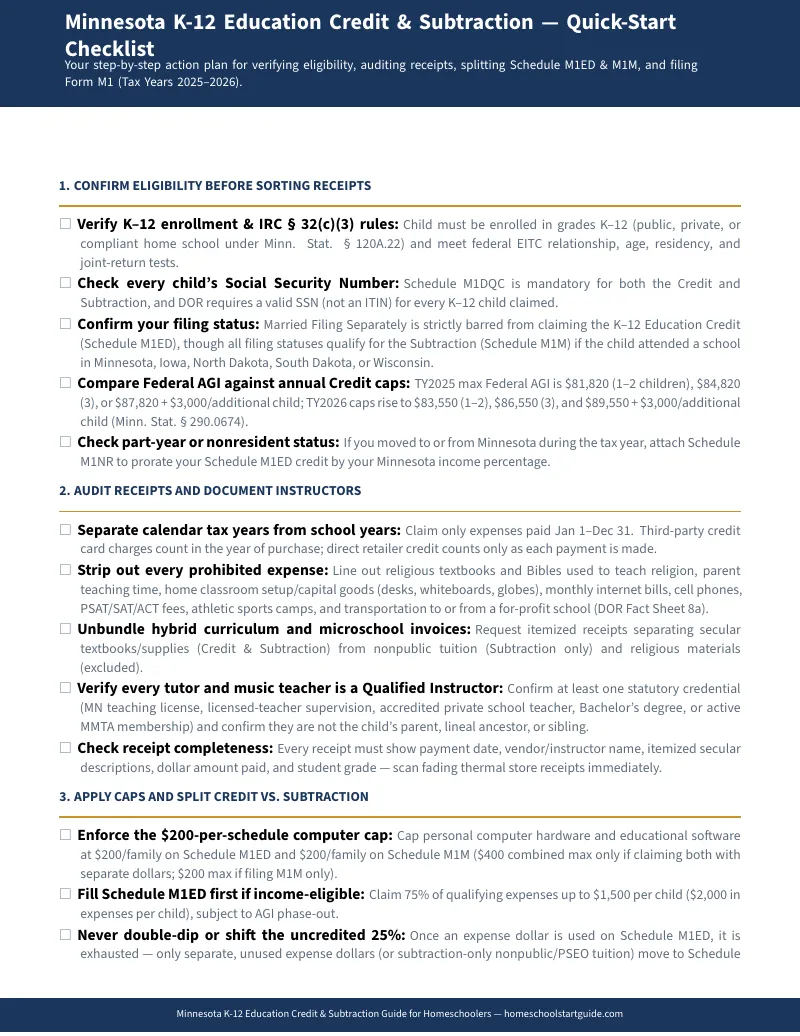
- Quick-Start Checklist & Eight Standalone Printable Worksheets — ready-to-use tools for eligibility checks, year-round receipt logging, secular invoice audits, instructor verification, dual-schedule math, multi-child grade and computer caps, district aid coordination, and DOR notice responses.
Who This Guide Is Built For
- New Minnesota homeschooling families (Years 1–2) who want clear, step-by-step filing guidance without worrying that claiming tax relief will alter their legal homeschool status.
- Established homeschoolers who are tired of envelopes taped inside planners and want an audit-proof system for secular receipts, computer caps, and Form M1X amended returns for missed prior years.
- Tutoring, enrichment, and music-lesson families who need to verify instructor qualifications and separate eligible instruction from non-qualifying fees.
- Microschool and private-education families whose household income exceeds the credit ceiling and who want to maximize Schedule M1M subtraction caps while unbundling tuition from secular materials.
Why Free Fact Sheets, Generic Trackers, and Forums Fall Short
- Official DOR Fact Sheets (8 & 8a) state the raw definitions across separate pages, but give you no receipt-logging workflow, no hybrid-curriculum audit checklist, and no step-by-step allocation sheet for splitting Schedule M1ED and Schedule M1M.
- Generic Etsy and Gumroad homeschool trackers are built for states with ESAs or flat deductions. They miss Minnesota's dual-schedule structure, the uncredited 25% rule, the $200-per-schedule computer split, and the repeal of refund assignment loans.
- Curriculum-vendor blog posts (from workbook publishers or class marketplaces) exist to promote their own products and leave out co-op unbundling, district aid coordination, and DOR audit responses.
- National homeschool legal memberships cost $130+ every year and explicitly disclaim tax filing and schedule navigation. Free VITA tax clinics can help prepare your return, but you will need itemized receipts and expense details to support a credit claim.
- Social media groups routinely circulate outdated or flat-wrong advice — like claiming religious curricula, paying family members to tutor, or taking K–12 529 withdrawals assuming federal rules apply in Minnesota.
Independent, Plain-Language, and Backed by a No-Time-Limit Guarantee
Homeschool Start Guide is an independent publisher of state-specific process guides. This guide is not affiliated with or endorsed by the Minnesota Department of Revenue, the Minnesota Department of Education, HSLDA, or MACHE, and it provides educational process navigation rather than legal, tax, or financial advice. Every rule, threshold, and line reference is dated to Tax Years 2025–2026 and School Years 2025–26 and 2026–27.
Full refund, no time limit. If this guide does not save you hours of confusion and give you a clear, organized workflow for your Minnesota K–12 tax claim, email [email protected] anytime for a full refund — no questions, no deadline.
Choose How You Want to Start
Want to test your eligibility first? Grab the free 2-page Quick-Start Checklist using the form on this page. Ready for the complete 58-page guide, worked dollar scenarios, Fact Sheet 8a matrix, and printable worksheets? Get instant digital access for a single one-time payment — a fraction of what a single CPA consultation ($150–$400+) or one disallowed receipt costs.
Frequently Asked Questions
What if the rules change after I buy?
We update the guide when the rules change. Email us any time, even years later, and we'll send you the current edition free.