
You're Managing $8,000+ Per Child — With Rules That Change Every July
Florida's FES-UA and PEP scholarships fund between $7,200 and $39,100 per child every year. That money doesn't arrive in a check. It sits inside a portal — behind spending categories, receipt requirements, approval queues, and a 30-day "On Hold" window that silently converts into an automatic denial if you miss it.
Parents hear "homeschool scholarship" and assume the money works like a flexible grant. It doesn't. PEP participants are legally reclassified as private education choice students under Section 1002.395, F.S. — not homeschoolers under Section 1002.41. That reclassification changes your testing obligations, your annual paperwork, and whether HSLDA will represent you in a dispute. Families who skip this distinction end up with dual-enrollment flags, rejected reimbursements, and compliance letters they were not expecting.
The SFO handbooks explain the rules. They don't explain how to execute them without expensive mistakes.
The Scholarship Navigation System
The Florida FES-UA & PEP Scholarship Parent Guide is a complete operational roadmap for both programs — not a binder printable, not a budget tracker, not a cheerleader for state funding. It is a step-by-step system for applying, spending, documenting, and renewing without rejected claims, unexpected cash-flow gaps, or legal status surprises.
Where the SFO handbook states that you need an "itemized receipt," this guide shows you the exact fields that processors check — student legal name, line-item descriptions, proof-of-payment format — and explains what triggers an "On Hold" flag versus an outright rejection. Where Facebook groups give you anecdotal advice from someone who used FES-UA last year, this guide gives you categorized rules current to the 2026–27 program year.
What's Inside
- Tri-Option Legal Comparison — a side-by-side matrix of registered home education (§1002.41), PEP (§1002.395), and FES-UA (§1002.394), covering legal classification, funding amounts, testing requirements, spending oversight, technology rules, and HSLDA representation status
- Eligibility and Priority Tier Breakdown — who qualifies for each program, the four-tier priority system for PEP, the FES-UA diagnostic requirements, and the annual student caps that determine whether your application is funded this year
- Application Step-by-Step — from the February 1 portal opening through the April 30 priority deadline, including the required documents, the Odyssey eligibility cross-check, and what to do if your SFO reaches capacity and directs you to the other organization
- Categorized Expense Database — a cross-referenced breakdown of approved, prohibited, and capped spending categories for both programs, including the technology rules (both programs allow one digital device purchase every two calendar years per student), the 25% PE/extracurricular cap, and the $299 annual-pass ceiling
- Receipt Formatting and Rejection Fixes — the exact invoice fields that cause first-time rejections, visual contrasts of approved versus denied receipt layouts, the "On Hold" resolution workflow, and how to respond within the mandatory window before your claim converts to an automatic denial
- Student Learning Plan Framework — how to draft an SLP that links your learning objectives directly to EMA marketplace purchase categories, so your plan clears SFO verification without rewrites or portal flags
- Cash-Flow and Disbursement Calendar — quarterly payout timing, the gap between renewal and new-student release dates, and strategies for families who cannot float expenses on personal credit cards for 30–60 days
- FES-UA Therapy and Technology Maximizer — how to set up direct-pay providers, which clinical therapies (ABA, speech, OT) qualify, matrix level documentation, and the technology device procurement rules
- Renewal and Rollover Guide — annual renewal deadlines, what happens to unused funds, rollover rules by program, and multi-child coordination for families managing more than one scholarship
- Legal Status Decision Map — exactly what changes when you accept PEP or FES-UA, how to exit back to registered home education under §1002.41 if you decide the trade-off isn't worth it, and the specific steps to terminate without creating a legal status gap
Who This Guide Is For
- Home educators considering PEP who want to understand what the money costs in legal status, testing obligations, and curriculum oversight before they terminate their §1002.41 notice
- Parents of children with disabilities evaluating FES-UA for therapy, technology, and specialized instruction funding — and who need clarity on the matrix level system, diagnostic requirements, and direct-pay provider setup
- Families withdrawing from public school who are navigating the application timeline, the SFO portals, and the legal registration steps simultaneously
- Enrolled families dealing with rejected reimbursements, "On Hold" statuses, spending category confusion, or renewal anxiety
Why Not the Free Handbook?
Step Up For Students and AAA Scholarship Foundation publish official parent handbooks every year. Those handbooks are compliance documents — written to explain the rules the organization enforces. They describe what an "itemized receipt" must include without showing you what one looks like. They list approved spending categories without explaining the edge cases that cause rejections. They don't cover what happens when your valid purchase gets flagged "On Hold," how to write an SLP that passes verification without rewrites, or how to plan your cash flow around quarterly disbursement delays.
Facebook groups fill some of those gaps — but with anecdotal advice that mixes PEP and FES-UA rules, references outdated portal layouts, and sometimes recommends purchases that are approved under one program but strictly prohibited under the other. A parent who claimed a clinical therapy under FES-UA will tell a PEP parent to do the same — resulting in an immediate denial, because PEP prohibits clinical therapies like ABA and speech entirely.
A single rejected reimbursement for a $200 curriculum set or a $299 theme park pass ties up your money for 30–60 days. Two or three of those in a quarter, and you're floating hundreds of dollars on a credit card while waiting for resolutions that a correctly formatted receipt would have prevented. The guide costs a fraction of one rejected claim.
Satisfaction Guarantee
Full refund, no time limit. If the guide doesn't help you navigate your scholarship with less stress and fewer rejections, email [email protected] and we'll refund every penny.
Your Scholarship Application Window Won't Wait
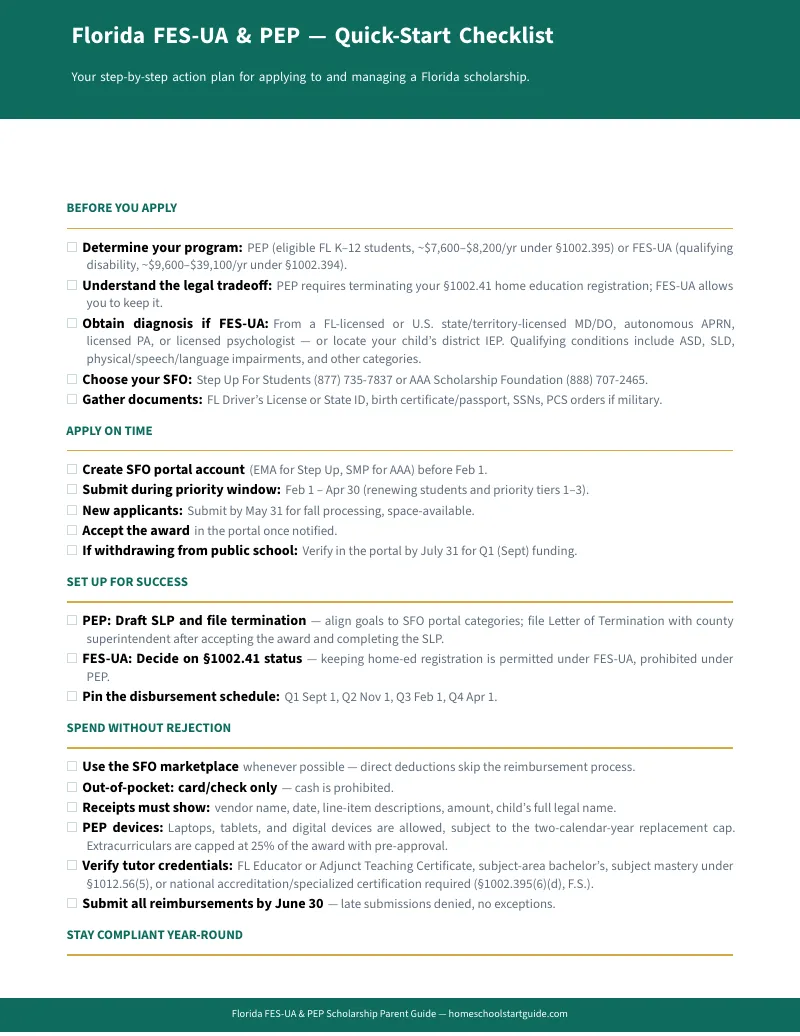
Download the free Quick-Start Checklist to see the eligibility comparison and key deadlines right now. When you're ready for the complete system — receipt formatting, SLP templates, spending category rules, and the full rejection-resolution workflow — the full guide is here.