
Your Child's Allotment Is Worth Up to $4,500 a Year. One Denied Claim or Missed Deadline Can Wipe Half of It Out — The Allotment Navigation System Keeps Every Dollar on Track.
You heard about Alaska's correspondence school allotments from another homeschool family — maybe $2,700 from IDEA, maybe $3,000 from BEST, maybe $4,500 from Family Partnership. Real money for curriculum, tutoring, lab supplies, and technology. You started researching, and within an hour you had seven browser tabs open: a 40-page IDEA handbook, an AKTEACH reimbursement page demanding W-9 forms, a Connections handbook listing an April 30, 2027 final paper-reimbursement deadline, and a Facebook thread where three parents gave three different answers about whether you can buy a laptop with allotment funds.
Here's what none of those sources told you: when you enroll your child in a correspondence study program, their legal status changes. They are no longer an exempt homeschooler under AS 14.30.010(b)(12). They become a public school student enrolled in a school district under AS 14.03.300. That classification triggers mandatory standardized testing, certified teacher oversight, an Individual Learning Plan aligned with state content standards, and spending rules that can reject your reimbursement claim for a single missing receipt. And if you withdraw mid-year before the wrong date, some programs require you to reimburse every dollar the district already spent on your child's allotment.
The Allotment Navigation System inside this guide exists because district handbooks are written for district compliance officers, not for parents trying to get their child's education funded without losing money to paperwork mistakes. It maps every step of the allotment process — from choosing a program to filing your last claim of the year — into a parent-side workflow with built-in checkpoints that catch problems before they cost you.
What's Inside
The Two-Track Legal Map — because the biggest mistake families make is thinking correspondence study is "funded homeschooling." It is not. It is a public school enrollment option that happens to take place at your kitchen table. The Legal Map lays out what changes — testing, teacher contact, curriculum restrictions, religious-material bans — and what stays the same, so you choose the right track before you sign anything.
The Program Comparison Matrix — IDEA, Raven, Family Partnership, Mat-Su Central, Connections, BEST, AK-TRAILS, and AKTEACH, with published allotment figures where listed and key features for each. The guide separately explains enrollment dates, pre-approval, vendor approval, and equipment returns.
The ILP Planning Worksheet — your Individual Learning Plan is the document that unlocks your spending authority. The worksheet helps you structure core and elective courses to meet the 50% core-course requirement before your first advisor meeting, so you can bring a clear draft to discuss. Purchases still follow the approved ILP and your program's approval rules.
The Pre-Purchase Audit Checklist — a five-question check before you spend: Is the item written into an approved ILP course? Is the material secular? Does the student's coursework meet the 50% core requirement, or does a district waiver under 4 AAC 33.426(b) apply? Is the expenditure approved under the district's written standards? Do you have written pre-authorization when required? A "no" means pause and fix the gap before spending. The checklist helps catch issues before they cost you.
The Line-Item Expense Log — track purchase dates, vendors, item descriptions, amounts, receipts, and the ILP course each purchase supports. District written standards govern allowable expenditures and approvals; confirm your program's documentation requirements before submitting a reimbursement claim.
The Equipment Inventory Tracker — non-consumable items purchased with allotment dollars (laptops, instruments, robotics kits, MiFi hotspots) remain district property and must be returned when you leave. The guide notes that some districts may allow a depreciated purchase. The inventory tracks each item and its return status; confirm your program's specific withdrawal cutoff before you transfer or exit.
The Annual Renewal Timeline — a one-page planner for enrollment, ILP, testing, claim, and exit dates. Programs set their own cutoffs, so you write this year's dates in and check them off as you go.
The Agency Communication Log — date, person, topic, outcome, and follow-up for every contact with the assigned teacher, program office, district accounting, and DEED. Informal phone calls do not extend a written-appeal deadline.
The Assessment and Reporting Guide — correspondence students take mandatory statewide assessments (AK STAR and Alaska Science Assessment). The guide lists which grades take each test and explains quarterly progress reviews and semester grade reports.
529 and Tax Credit Scholarship Coordination — since Public Law 119-21 expanded qualified 529 expenses beyond tuition to include curriculum, tutoring, standardized test fees, and licensed therapies (with the annual K–12 cap doubling to $20,000 for tax year 2026 onward), families can layer 529 withdrawals on top of correspondence allotments for separate expenses. The guide explains the 529 rules, distinct receipt trails, and federal scholarship tax-credit basics. The federal scholarship program begins January 1, 2027; DEED says homeschool and correspondence eligibility remains subject to additional federal clarification. Check current guidance with a participating SGO before relying on an award.
Who This Guide Is For
- Parents withdrawing their child from brick-and-mortar public school who want allotment funding from day one — and need the enrollment timeline, ILP meeting prep, and spending rules organized before the first deadline hits
- Independent homeschoolers who've been paying for everything out of pocket and are evaluating whether $2,600–$4,500 in annual funding is worth the oversight trade-off — and need the legal status differences laid out without sales pressure from a correspondence program's enrollment office
- Experienced correspondence families managing allotments for two, three, or four children across different grade levels — who lose hundreds each year to missed pre-approvals, mismatched receipts, or forgotten return deadlines
- Parents considering private classes, co-ops, or microschool pods alongside their correspondence program — who need clarity on which expenses are currently reimbursable and which are legally uncertain after the Alexander litigation
- Families transferring between programs or districts mid-year — who need to understand dual-enrollment prohibitions, transcript transfers, and what happens to equipment purchased through the old program
Why Not Just Use the Program Handbook?
You should read the handbook. It is free, it is official, and your contact teacher expects you to know what's in it. Here is what it does not do:
- Handbooks are written for district liability, not parent clarity. Key spending rules, deadline exceptions, and pre-approval thresholds are scattered across 20–80 pages of policy language. The guide extracts the operational rules into decision-ready checklists and worksheets — the parts you need when you are standing in the checkout line wondering if this $350 curriculum set needs pre-approval.
- No handbook compares programs. IDEA's handbook tells you about IDEA. Connections' handbook tells you about Connections. Family Partnership publishes 2026–27 allotments of $4,000–$4,500 by grade. BEST requires enrollment and an approved ILP by October 1 for 2026–27; Connections enrolls year-round and provides half allotments for October 16–January 8 enrollments. The Program Comparison Matrix brings program information together.
- Free online advice is anecdotal and often wrong. Facebook groups and Reddit threads mix up independent homeschooling with correspondence enrollment, quote last year's allotment amounts, and confidently tell you that "you can buy anything educational." You cannot. Allotment funds are public money with line-item restrictions. One parent's successful reimbursement does not mean the same purchase passes audit in a different program.
- Vendor marketing is not compliance guidance. Curriculum companies publish "Alaska Allotment Spending Guides" to help you buy their products. They do not mention the secular-content restriction, program-specific pre-approval thresholds, tutor screening requirements, or the non-consumable return mandate — because those rules could stop you from buying.
Satisfaction Guarantee
If the guide does not help you navigate the allotment process more confidently, email [email protected] for a full refund, no time limit. The guide is an independent reference publication — it has no affiliation with DEED, any school district, or any curriculum vendor.
Get Started
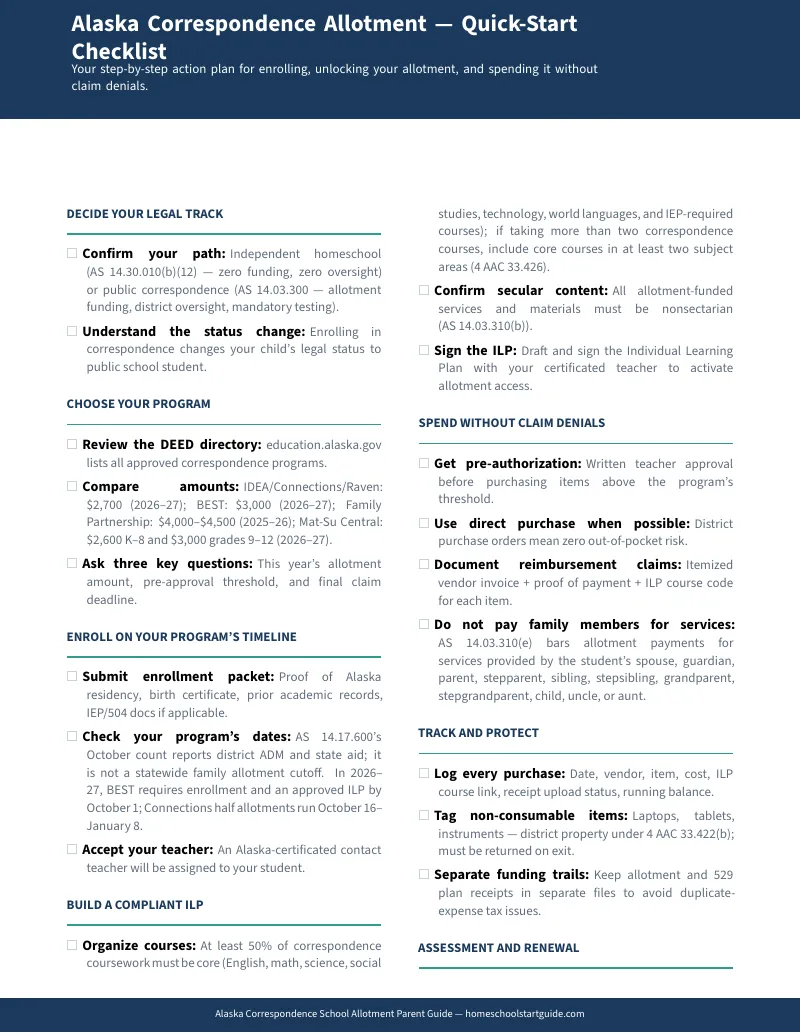
Download the free Alaska Correspondence Allotment Quick-Start Checklist — a two-page eligibility self-audit, core-course alignment checkpoint, and reimbursement red-flag list. If you want the complete system — program comparisons, ILP Planning Worksheet, Pre-Purchase Audit Checklist, Line-Item Expense Log, Equipment Inventory Tracker, Annual Renewal Timeline, Agency Communication Log, assessment guide, and 529 coordination — get the full Alaska Correspondence School Allotment Parent Guide and have every step organized before your next deadline.
Frequently Asked Questions
What if the rules change after I buy?
We update the guide when the rules change. Email us any time, even years later, and we'll send you the current edition free.