Tennessee's biggest education funding program launched — and nobody told you the rules that actually matter.
The Education Freedom Scholarship puts $7,530 per child on the table. The state website says it's "universal." The headlines say 35,000 families are already funded. Your friend at church says her kids qualified. It sounds straightforward.
Then you try to apply, and discover it's anything but. You find out there are three separate state programs — EFS, the ESA Pilot, and the IEA — each with different eligibility rules, different geographic restrictions, and different award amounts. You learn that EFS uses a 5-tier priority system, not a simple lottery, and that over 17,000 families ended up on the waitlist last year because they didn't understand how tier placement actually works. And if you're one of the 95% of Tennessee homeschool families enrolled in a Category IV church-related umbrella school, you discover that your child is explicitly excluded from EFS by state law — a fact buried deep in the regulatory language that most free resources barely mention.
The state's 60-page Family Handbook tells you the rules. It does not tell you how to navigate them. It doesn't show you which of the three programs fits your family's specific situation. It doesn't explain how to document your income to maximize your priority tier. It doesn't walk you through the spending platform or the renewal process. And it certainly doesn't offer homeschool families a practical alternative when they discover their current enrollment category disqualifies them.
The Tennessee School Choice Navigation System
The Tennessee Education Freedom Scholarship (EFS) Parent Guide translates the state's regulatory framework into a single, structured decision system. Instead of piecing together fragments from the TDOE website, advocacy blogs, umbrella school newsletters, and parent Facebook groups, you get one document that covers every eligibility rule, every application step, every spending restriction, and every strategic decision — organized around the questions Tennessee parents actually ask.
This works where free resources don't because free resources serve different purposes. The TDOE handbook is a compliance document — it states what's required but not what's strategic. Advocacy organizations publish policy briefs — they analyze legislation but don't guide individual families through applications. Private school admissions offices handle enrollment, not state scholarship mechanics. And the generic "school choice planners" on Etsy and Amazon don't know Tennessee's five private school categories, the Category IV exclusion, or the difference between EFS and the ESA Pilot. The Navigation System bridges every one of those gaps in a single read.
What's Inside
The 3-Program Decision Matrix — Tennessee runs three separate education funding streams, and families in Memphis, Nashville, or Hamilton County may qualify for more than one. The Decision Matrix evaluates EFS ($7,530 statewide), the ESA Pilot (county-restricted, higher funding), and the IEA ($12,788 average for qualifying disabilities) across a single comparison — so you apply to the right program first instead of discovering later that a different one would have served your family better.
The Category IV Exclusion Explained and the Category III Pivot — most Tennessee homeschool families are in Category IV umbrella schools. EFS law excludes them. The guide explains why in plain language, then walks through two practical alternatives: the Category III accredited online school pathway (home-based learning, full $7,530 access) and the IEA pathway for students with qualifying disabilities. Each alternative gets a step-by-step breakdown of what changes, what you keep, and what the tradeoffs look like.
The Priority Tier Optimizer — EFS isn't a lottery. It's a 5-tier priority queue, and where your application lands in that queue determines whether your child gets funded or sits on a 17,000-student waitlist. The guide breaks down each tier's income thresholds, shows exactly how to document household income using IRS Form 1040 Line 9, and explains how renewal status and prior public school enrollment affect your placement.
The First-Time Approval Document Checklist — the state portal rejects incomplete submissions without a second chance in the same window. The checklist covers every required document (government-issued ID, residency proof, income verification, school enrollment confirmation), the format each one needs to be in, and the sequence that avoids common rejection triggers.
The Spending Platform Walkthrough — after tuition and mandatory fees, remaining EFS funds go through the Theodore platform for approved purchases. The guide covers every approved and prohibited spending category, the pre-approval process, reimbursement mechanics, denied claim handling, and the exact workflow for requesting funds — so you use every dollar your child is entitled to instead of leaving money on the platform because the interface was confusing.
The Renewal and Testing Compliance Map — EFS scholarships aren't automatic year-to-year. The guide covers re-enrollment requirements, testing mandates by grade band, which standardized tests satisfy the requirement, score reporting procedures, and the academic review provisions that can affect your child's continued eligibility.
The Homeschool Status Impact Assessment — taking state education money changes your child's legal educational status in Tennessee. The guide maps how each program interacts with homeschool law, whether you maintain home educator status, and what happens to your enrollment category if you leave the scholarship program.
Who It's For
- Parents applying to EFS for the first time who need to understand the full eligibility landscape before making school enrollment decisions
- Homeschool families in Category IV umbrella schools who want to know their real options for accessing state education funding
- Families on the EFS waitlist who want to understand the priority system and whether their tier placement can be improved
- Current EFS recipients who need to navigate the spending platform, maximize approved expenses, and prepare for renewal
- Memphis, Nashville, or Hamilton County families who may qualify for both EFS and the ESA Pilot and need a clear comparison
- Parents of children with IEPs or qualifying disabilities who want to evaluate the IEA program alongside or instead of EFS
Why Not Just Use the Free State Resources?
The state's TDOE website provides the regulatory data — it's accurate and authoritative. But it's spread across multiple PDF handbooks, FAQ pages, and portal guides totaling hundreds of pages of administrative language. It doesn't offer a comparative analysis of the three programs, doesn't explain priority tier strategy, doesn't address the Category IV exclusion with alternatives, and doesn't walk you through the spending platform step by step.
Advocacy organizations like the Sycamore Institute and Beacon Center publish excellent policy research. They analyze what the law does — they don't guide individual families through what to do about it.
Private school admissions offices handle enrollment. They explicitly disclaim responsibility for state scholarship eligibility. Your school can tell you their tuition; they cannot tell you which priority tier your application will land in or whether the ESA Pilot would give you more funding.
Generic "school choice planners" on marketplace platforms don't know Tennessee's five private school categories, the statutory definition of eligible non-public schools, or the difference between EFS and a general ESA program. They sell the same template in 50 states.
This guide does one thing: it gives Tennessee families a single, current, structured resource that covers the full decision from "which program fits my family" through "how do I spend the money and renew next year" — with every rule sourced to the statute and every strategy grounded in how the system actually works.
Your Purchase Is Protected
Full refund, no time limit. If the guide doesn't deliver what you need, email [email protected] and we'll refund your purchase. No forms, no waiting period, no questions.
Get Started
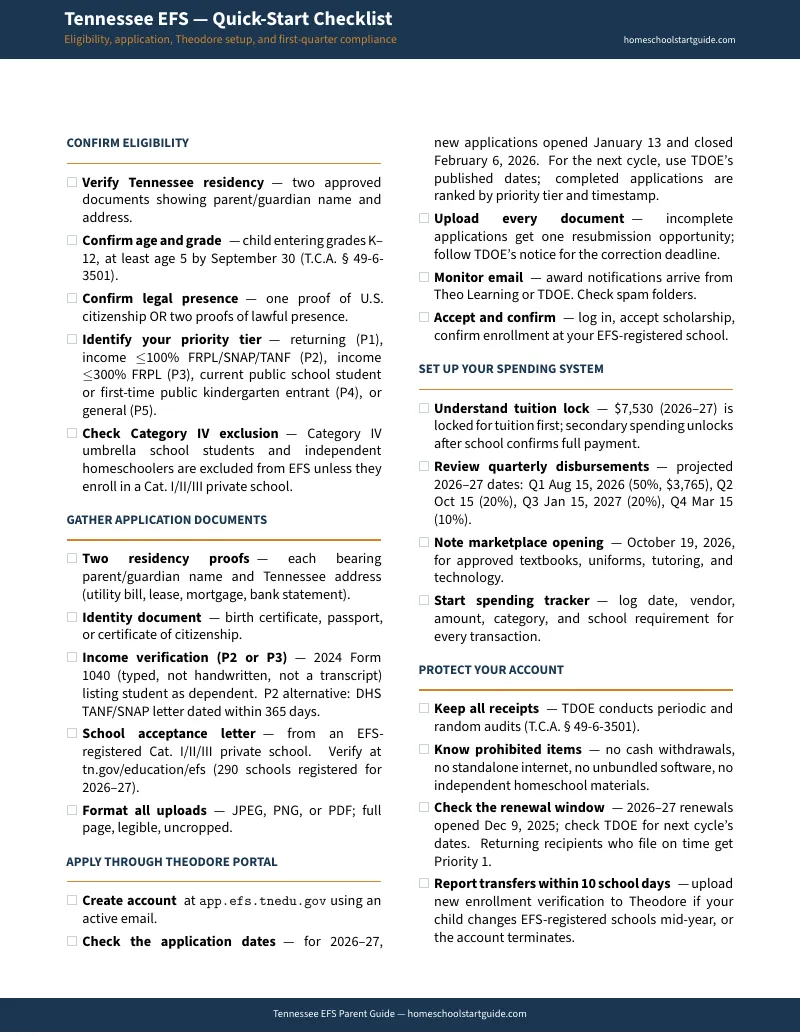
Download the free Tennessee EFS Quick-Start Checklist to see the format and confirm this is what you need. When you're ready for the complete guide — the Decision Matrix, the Priority Tier Optimizer, the Category III Pivot, the spending platform walkthrough, and the full renewal compliance map — get the Tennessee Education Freedom Scholarship (EFS) Parent Guide for and have the entire system in your hands tonight.