The Four-Category Playbook: Launch Your Tennessee Learning Pod with Legal Confidence and a Complete Operational Framework.
Tennessee passed the Learning Pod Protection Act in May 2025. Your city cannot zone you out. Your school district cannot inspect your home. Childcare licensing does not apply. Public Chapter 305 explicitly shields home-based learning pods from municipal regulation, building code enforcement, staff-ratio requirements, and district oversight. Tennessee is now one of the most legally protected states in the country for pod founders. But nobody has packaged that protection into a usable, step-by-step guide — until now.
You want to gather three or four neighborhood families, share the teaching load, and build something that actually fits your children. Maybe you're a Nashville parent priced out of Ensworth or MBA at $25,000–$42,000 per year and looking for a high-quality middle path. Maybe you're a current homeschooler finding solo teaching unsustainable. Maybe you're secular, and every established co-op in your area requires a statement of faith. Maybe you have a neurodivergent child who needs a calmer, self-paced environment. Whatever the reason, you've arrived at the same conclusion: I need to build this myself.
The problem is that Tennessee has four distinct non-public school categories under TCA §49-6-3050 — and the internet gives you fragments. The Tennessee Department of Education defines Category I through V in dense legalese but doesn't explain how five parents gathering in a living room fits into the framework. THEA provides umbrella school directories but is geared toward traditional solo homeschoolers. Classical Conversations costs $661–$1,696 per child per year and demands the parent stay on-site. Prenda charges $2,199 per student per year in platform fees. You need the operational playbook without the institutional overhead and without surrendering your tuition to a network.
The Tennessee Micro-School & Pod Kit — the Four-Category Playbook — is that operational framework.
What's Inside the Four-Category Playbook
The Four-Category Decision Framework
Because choosing Category I when you should be Category IV means mandatory TCAP testing in grades 5, 7, and 9 that your students never needed — and potentially disqualifying your families from $7,295 in annual voucher funding. Tennessee has four distinct non-public school pathways, each with different rules about who can teach, what testing is required, and how much oversight the government has. This section walks you through each with a plain-English decision tree so you choose the right structure for your pod's size, staffing, and philosophy — and understand exactly what each choice requires.
The Learning Pod Protection Act Compliance Guide
Because "can the city shut me down?" is the question that stops most pod founders before their first meeting. This is a detailed breakdown of Public Chapter 305 — what local authorities cannot legally demand, what your rights are if they try, and a single document you can hand to a zoning board, HOA, or school district employee to end the conversation. It also covers the critical distinction most parents miss: a learning pod does not satisfy compulsory attendance on its own. Children in your pod must be separately registered — either as independent homeschoolers or through a Category IV umbrella. This guide ensures you understand both the protections and the requirements.
Family Agreement and Liability Waiver Templates
Because the most common reason pods collapse isn't bad curriculum — it's undefined expectations between adults about money, scheduling, and what happens when someone wants to leave mid-year. Customizable templates covering cost-sharing, curriculum authority, health policies, behavioral expectations, dispute resolution, and withdrawal terms. Written from scratch without religious language or ideological prerequisites. Every participating family signs before the first day.
School Choice Funding Playbook
Because the difference between receiving $7,295 per student per year and receiving nothing is understanding which legal structure qualifies — and most families don't find out until after they've chosen the wrong pathway. Tennessee now offers three distinct funding streams: the Education Freedom Scholarship (~$7,295/student for approved private schools), the ESA pilot (~$9,788/student in Davidson, Shelby, and Hamilton counties), and the Individualized Education Account (~$12,788/student for qualifying disabilities). This section explains exactly which programs your pod can access based on its legal structure, what the eligibility requirements are, and how to position your micro-school to qualify.
The TSSAA Equal Access Sports Guide
Because for many families, the fear of losing Friday Night Lights is the single biggest reason they hesitate to leave the public system — and it's based on outdated information. Tennessee's Equal Access law now allows homeschool students to try out for public school sports teams at their zoned school. This section covers the exact notification deadlines, academic eligibility requirements, and TSSAA registration steps — so your pod students keep their athletic lives without keeping the institution that isn't working for them.
Budget Planning and Cost-Sharing Frameworks
Because splitting costs "evenly" between a family with three kids and a family with one sounds fair until the first invoice arrives — and financial resentment is the second most common reason pods dissolve. Real Tennessee benchmarks for space rental ($200–$800/month for a church classroom), liability insurance ($500–$1,500/year), curriculum ($200–$600/student/year), and teacher compensation ($15–$35/hour). Plus cost-sharing formulas for equal-split, per-child, and sliding-scale models — with a worked example showing how a 6-student pod achieves a 6:1 ratio at a fraction of private school tuition.
The Tennessee Pod Launch Checklist
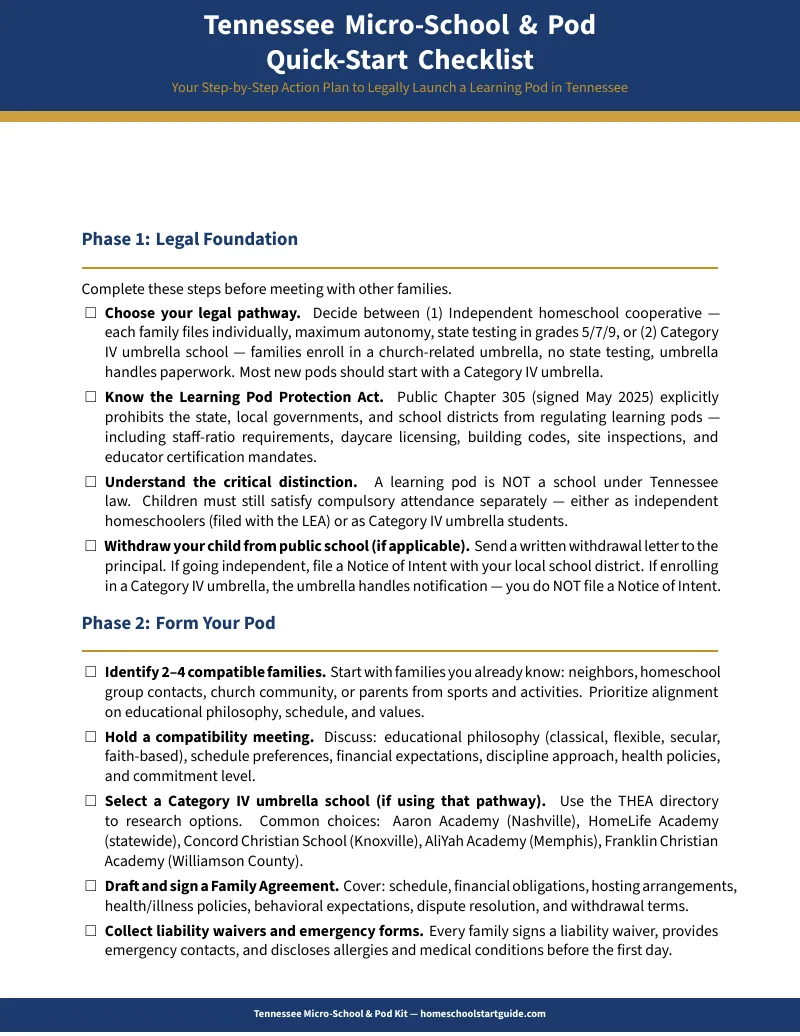
Because most parents spend forty-plus hours stitching together the launch sequence from TCA statutes, THEA directories, HSLDA's paywalled guides, and scattered Facebook threads — and still aren't sure they got the order right. A single-page, print-and-pin document that walks you from "I have an idea" to "the first day of pod school" — covering legal foundation, pod formation, operations, and launch week in the correct sequence.
Who This Kit Is For
- Parents who want to form a small learning community of 3–8 students with two to four families — sharing the teaching load, splitting costs, and building something intentional rather than defaulting to institutions that don't fit
- Nashville, Memphis, Knoxville, and Chattanooga families priced out of elite private schools who want a high-quality 6:1 student-teacher ratio at a fraction of the $25,000–$42,000 annual tuition those institutions charge
- Current homeschoolers who find solo teaching unsustainable and want to share facilitation with other families without losing control of their child's education
- Secular or inclusive families who've been turned away from established co-ops that require statements of faith, and who need a legally sound framework for building a non-denominational pod
- Parents of neurodivergent children (autism, ADHD, dyslexia) who are exhausted by IEP advocacy and want a calmer, self-paced environment with the IEA's $12,788 per student funding to support it
- Military families near Fort Campbell who need educational continuity that survives a PCS move and integrates into Tennessee's homeschool system
- Former educators who want to serve their community by running a small pod or micro-school — without the overhead and control of a franchise network
After Using the Kit, You'll Be Able To
- Choose the right legal pathway for your pod — Category IV umbrella for maximum freedom, Category III for a credentialed teacher model, or independent homeschool cooperative — using the decision framework instead of guessing
- Hand any local official, HOA representative, or school district employee the Learning Pod Protection Act compliance document that legally ends their authority to regulate your pod
- Run your first parent meeting using a signed family agreement and liability waiver that protects every family in the pod — without spending $250+ on an education attorney
- Navigate the ESA, EFS, and IEA funding applications with the specific eligibility requirements, income caps, and structural prerequisites for each program — so you make financial decisions based on accurate numbers
- Register your pod student for public school sports under the TSSAA Equal Access law with the correct notification deadlines and academic eligibility steps
- Facilitate a mixed-age pod of 4–8 children across multiple grade levels without chaos — using scheduling frameworks for full-time, hybrid, and part-time models
- Build a budget that every family agrees on — using real Tennessee cost benchmarks and a cost-sharing formula that prevents resentment and financial surprises
Why Not Just Use the Free Resources?
The Tennessee Department of Education defines the five non-public school categories. THEA provides umbrella school directories. Homeschool blogs explain the Learning Pod Protection Act. Here is exactly what you run into when you try to build a pod from those sources alone:
- The TN DOE website defines the categories but provides zero guidance on pods. You learn that Category I requires DOE approval and Category IV offers umbrella coverage. You do not learn which one fits five families sharing a living room, a tutor, and a budget. No family agreements, no budget templates, no decision tree.
- THEA is built for traditional solo homeschoolers. Their umbrella school directory is invaluable, but their resources assume a single family teaching their own children. They do not offer operational infrastructure for multi-family pods — no co-teaching schedules, no cost-sharing frameworks, no conflict-resolution agreements.
- Generic Etsy templates are legally dangerous in Tennessee. A $13 "Learning Pod Agreement" from Etsy gives you a three-page waiver written for a different state — no Tennessee-specific legal guidance, no Category IV enrollment steps. Worse, generic "Notice of Intent to Homeschool" templates sold for $1.69 can trigger unnecessary bureaucratic entanglement — Category IV families do not file a Notice of Intent, and doing so incorrectly invites truancy scrutiny and superintendent oversight your pod never needed.
- Franchise networks withhold the operational details deliberately. Prenda, KaiPod, and Acton Academy webinars give you the vision. The granular how — the legal structuring, budget templates, scheduling frameworks — is what they sell for thousands per year in platform fees and franchise commitments.
- Most online content predates the 2025 Learning Pod Protection Act. Reddit threads, blog posts, and HSLDA guides written before May 2025 don't reflect the law that changed everything for Tennessee pod founders. The protections you now have — and the specific thing the Act does not cover — aren't in those resources.
Free resources give you the legal baseline and the inspiration. The Four-Category Playbook gives you the templates, checklists, and decision frameworks to execute this week.
— Less Than One Hour with an Education Attorney
A single consultation with a Tennessee education attorney costs $200–$400 per hour. Classical Conversations charges $661–$1,696 per child per year — and requires the parent to attend every session. Prenda charges $2,199 per student per year in platform fees. Acton Academy franchise startup fees run in the tens of thousands. The Kit costs less than a single attorney consultation and gives you the legal clarity, operational templates, and funding guidance those alternatives are designed to sell piecemeal.
Your download includes 7 PDFs: the complete 23-chapter guide, the Quick-Start Checklist, a standalone Family Participation Agreement template, a Liability Waiver with emergency contact form, a fill-in Withdrawal Letter (with both independent and Category IV options), a Learning Pod Protection Act compliance reference card, and a School Choice Funding Playbook covering EFS, ESA, and IEA eligibility. Instant download, no account required.
Money-back guarantee, no time limit. If the Kit doesn't give you the legal clarity and operational confidence to move forward with your pod, email us and we'll refund you. No questions asked.
Not ready for the full Kit? Download the free Tennessee Homeschool Quick-Start Checklist — a one-page summary of the four legal pathways, the Learning Pod Protection Act protections, and the key legal references that apply to your pod from day one. It's enough to understand your rights tonight.
Tennessee passed the Learning Pod Protection Act specifically to protect families like yours. You have the legal right to build this. The Four-Category Playbook makes sure you build it correctly.
Frequently Asked Questions
What if the rules change after I buy?
We update the guide when the rules change. Email us any time, even years later, and we'll send you the current edition free.