
You fought for that support plan. Leaving school should not mean losing it.
Your child is in crisis — autistic burnout, months of school refusal, sensory overload that nobody at school seems willing to accommodate, or an ADHD assessment that has been sitting in an NHS queue for two years. You know home education is the right move. But every time you get close to making it official, the same fear stops you: what happens to the Co-ordinated Support Plan, the therapies, the funding we spent years securing?
The answer is not simple, and the information you find online makes it worse. English SEND advice gets served up for Scottish searches. Facebook groups give conflicting answers about Section 35 consent. Council pages explain what the authority can do, never what you can ask for. And nobody tells you, clearly and in one place, which supports stay, which end, and which you can fight to keep.
The Scotland ASN Home Education Transition System
This guide is a complete, statute-grounded roadmap for families in Scotland who are home educating — or about to home educate — a child with additional support needs. It does not restate what you can already read on mygov.scot. It takes every confusing legal boundary, every discretionary council power, every benefit continuity rule, and organises them into a step-by-step process you can follow from the week you decide to leave through to Qualifications Scotland exams and, if you choose, a return to school with support restored.
What's Inside
- Section 35 consent mapped to ASN families — the general withdrawal process applies, but families with a CSP or specialist placement face additional considerations. This guide covers each exception, the six-week decision target, and what to do if the authority delays or refuses consent.
- Support plan transition framework — a clear breakdown of what happens to a Co-ordinated Support Plan (discontinued, preserved for five years, with a discretionary support request pathway), an Individualised Educational Programme (non-statutory, historical records to keep), and a GIRFEC Child's Plan (may continue across agencies), so you stop guessing and start acting.
- Child Disability Payment and Carer Support Payment continuity — Child Disability Payment is assessed on care and mobility needs. Carer Support Payment has separate eligibility conditions, including care hours and the cared-for person's qualifying benefit. Some claimants aged 16 to 19 also face study rules for specified school or college courses at 21 or more hours per week, including when studying at home. The guide explains the core payment rules and evidence to keep; check Social Security Scotland's current criteria for your circumstances.
- Self-directed Support and community services — SDS options, how to access NHS therapies (speech and language, occupational therapy, CAMHS) through GP and community referral routes once school-managed delivery ends.
- Education authority contact boundaries — the 2025 Home Education Guidance confirms no automatic right of home access, no mandatory monitoring, and no right to insist on interviewing your child. The guide gives you communication templates and clear written boundaries for every stage of council contact.
- Section 37 evidence without the panic — if the authority issues a formal inquiry, the guide walks you through what constitutes a satisfactory response, the timescale, and what an Attendance Order actually means, so you respond proportionately instead of in fear.
- Qualifications Scotland exam access and assessment arrangements — step-by-step guidance on registering as a private candidate for National 5 or Higher exams, gathering independent evidence of your child's normal way of working for extra time, quiet rooms, or a scribe, and exploring direct-entry college pathways.
- School re-entry with support restored — documentation frameworks that keep your child's record ready for a placing request, re-entry assessment, or post-16 transition, whether the break is temporary or permanent.
- Four worked examples — real-world family scenarios (autistic child with a CSP, ADHD child without a diagnosis, child with a Child's Plan and anxiety-driven refusal, teenager approaching National 5s) walked through every decision point in the system.
- Five standalone printable PDFs — Transition and Continuity Planner, Authority Communication Log, Benefit and Services Tracker, Re-Entry Preparation Checklist, and Authority Communication Templates. Each is a separate, fillable PDF you can print and use immediately alongside the main guide.
Who It's For
- Parents in Scotland whose autistic, ADHD, dyslexic, PDA, anxious, or otherwise disabled child has a Co-ordinated Support Plan, an IEP, or a Child's Plan — and who are considering withdrawal or have just withdrawn.
- Families whose child is in crisis at school and who need to know, before they begin, exactly what changes and what stays safe.
- Newly home-educating ASN families who have received their first contact from the education authority and want calm, legally grounded written responses.
- Families planning Qualifications Scotland exams for a neurodivergent teenager, or keeping documentation ready for a future return to school.
Why Not Free Tools?
Statutory council pages explain what the authority can do — from the authority's perspective. They do not give you communication templates, portfolio frameworks for a demand-avoidant child, or a Section 35 exceptions table in Chapter 1 that shows whether consent applies to your situation.
Peer Facebook groups are invaluable for emotional support, but crowdsourced advice routinely confuses English and Scottish law. Parents are told to send a "deregistration letter" (an English concept that does not exist in Scotland), to expect their EHCP to transfer (Scotland does not have EHCPs), or that leaving school automatically ends disability benefits; Child Disability Payment is needs-based, while Carer Support Payment has separate eligibility and study rules for some claimants. One wrong step based on English advice can leave a family without the Section 35 consent required before withdrawing from a public school.
Private advocates and education solicitors charge £150 or more per hour. That level of support is essential for tribunal appeals and contested placements. It is not necessary for the routine process of withdrawing a child and maintaining their support — which is exactly what this guide covers.
The Guarantee
Every purchase is covered by a full refund, no time limit. If the guide is not right for your family, email [email protected] and we will refund you with no questions asked.
Your Child Does Not Have to Stay in a System That Is Not Working
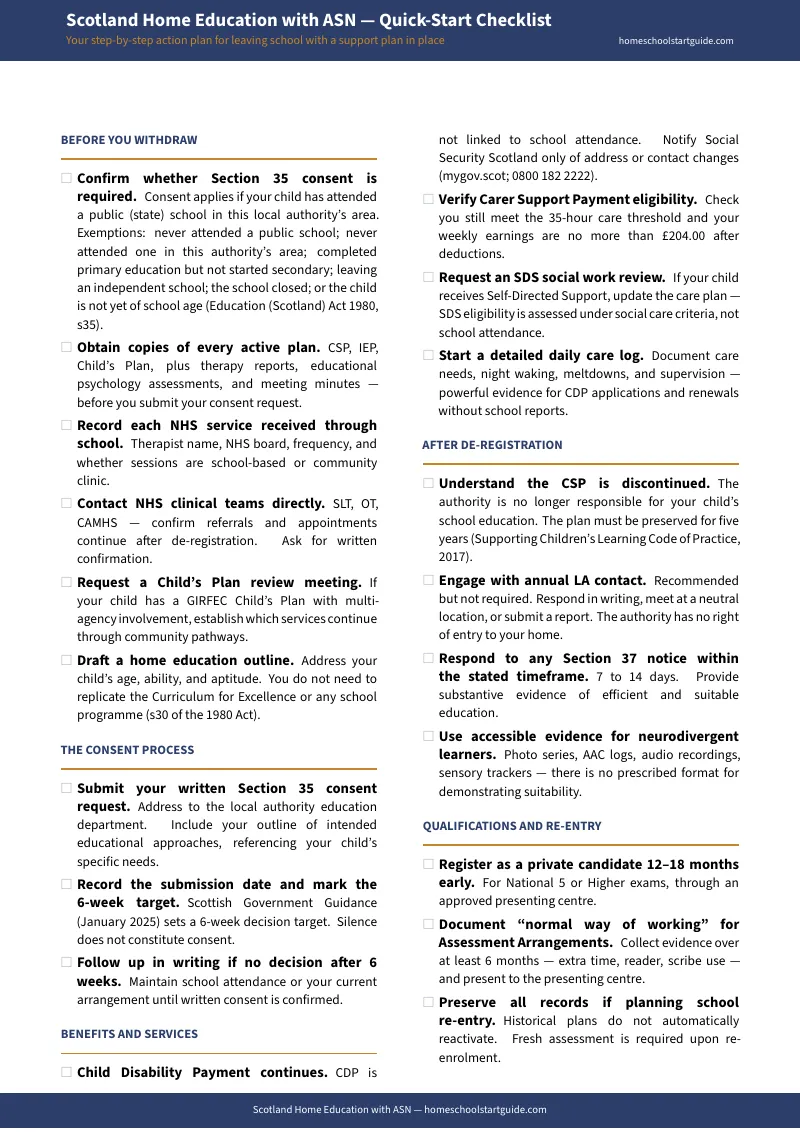
The free Quick-Start Checklist gives you the 21 essential steps in order. The full guide gives you the complete legal framework, five standalone printable PDFs — communication templates, benefit tracker, transition planner, communication log, and re-entry checklist — plus four worked examples to execute every step with confidence.
Get the Scotland ASN Home Education Guide →
Or download the free checklist to start with the 21 steps — no payment required.
Frequently Asked Questions
What if the rules change after I buy?
We update the guide when the rules change. Email us any time, even years later, and we'll send you the current edition free.