Get Through Exams Without a School Behind You — Even When Your Child Needs Access Arrangements
Your teenager has been learning brilliantly at home since you pulled them out of a system that could not meet their needs. But now GCSEs are approaching, and the calm you rebuilt is being replaced by a new kind of dread: "How do I get extra time or a separate room when there is no SENCo who knows my child — and how do I even find an exam centre that will take a private candidate?"
The official JCQ handbook runs to over 100 pages, written for school SENCos, not parents. Free forum threads carry outdated rules, misidentified deadlines, and confident claims about council funding that do not hold up. And every week that passes without action moves you closer to a centre's entry deadline. Check its refund terms before paying any entry fee.
The England Home Education Exams with SEN Guide gives you the Private Candidate Exam Navigation System — a clear, step-by-step process for choosing the right qualifications, vetting an exam centre before you pay, building the Normal Way of Working evidence a centre's SENCo actually needs for JCQ access arrangements, and mapping costs, deadlines, and the routes forward at 16.
What's Inside the Complete Guide
- Qualification Comparison Matrix (GCSEs vs. iGCSEs vs. Functional Skills vs. ELCs) — Because choosing a specification with mandatory Non-Exam Assessment or coursework can trap a private candidate who has no school lab or speaking examiner. The matrix shows assessment structure, NEA requirements, and which routes suit a neurodivergent learner who works best under controlled conditions.
- Exam Centre SEN Pre-Booking Audit — Because paying an entry fee before confirming that a centre can process an access-arrangement request, provide appropriate rooming, and host required science practicals can leave you out of pocket. The audit is a structured screening framework you complete before you commit.
- JCQ Access Arrangements Breakdown (AARA 2025–26, updated March 2026 and still in force for 2026–27, Form 8, Form 9, Centre-Delegated vs. AAO) — Because a clinical diagnosis alone does not grant extra time, and an independent Educational Psychologist report commissioned without the host centre's involvement can be rejected outright. Learn what the centre's SENCo actually needs, which arrangements the centre can approve without JCQ's online system, and how the process works for a home-educated private candidate.
- Normal Way of Working Evidence Framework — Because JCQ requires evidence that a requested adjustment reflects the candidate's normal way of working, and for a home-educated young person there is no school register or SENCo file to draw on. The framework shows how to compile timed mock results, tutor feedback, and home-learning adaptation records into evidence the centre can accept.
- Full Cost Breakdown with Two Worked Budget Examples — Because host centre fees, science lab surcharges, speaking test fees, and specialist assessment costs add up fast, and the awarding body base fee is only the starting point. A centre must not charge a disabled candidate for a reasonable adjustment it has a duty to provide. Includes two five-GCSE plans, one without access arrangements and one with them, so you can estimate total costs before committing.
- 14–16 College Route (State-Funded) — Because some FE colleges in England offer funded part-time courses to home-educated young people aged 14–16. Full-time direct enrolment at an eligible college is a separate route; a young person enrolled full-time is no longer electively home-educated. Learn how to check eligibility and local provision, what SEN and exam support each college offers, and how these routes compare to sitting GCSEs independently.
- Post-16 Pathways, Apprenticeships & EHCP to 25 — Because the duty applies in England to young people who have left compulsory school age, are under 18, and have not attained a Level 3 qualification, and families with an EHCP need to understand how Section 44 reviews, post-16 college funding, and the EHCP extension to 25 fit together.
- Navigating Exams Without a Diagnosis — Because NHS waiting lists for autism or ADHD assessments run to years, and families caught on them need to know which JCQ adjustments are still available through the centre-delegated route without a formal diagnostic report.
- Four Candidate Profiles & Worked Timelines — Because each family's starting point is different. See realistic timelines for an autistic Year 10 starting early, a school refuser entering Year 11 mid-year, a teenager using Functional Skills as a GCSE alternative, and a family exploring the 14–16 college route.
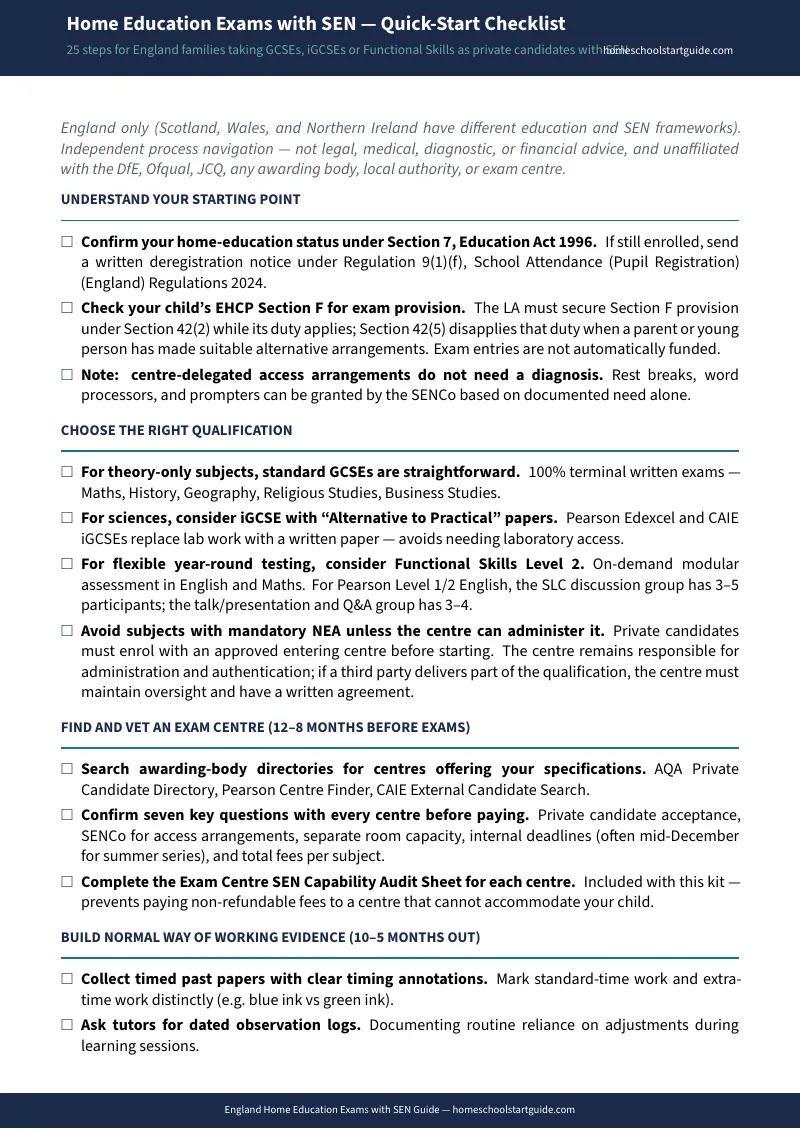
- Six Printable Planning Tools + 25-Item Quick-Start Checklist — Exam Centre SEN Capability Audit, Normal Way of Working Evidence Ledger, Booking-to-Exam Deadline Tracker with the key 2026–27 deadlines, Cost Calculator Worksheet, Centre Comparison Log, Qualification Decision Worksheet, and a 25-step checklist across seven phases so you do not miss a deadline or pay the wrong centre.
Who This Guide Is For
- Parents in England home educating an autistic, ADHD, dyslexic, dyspraxic, anxious (EBSA), or otherwise disabled teenager aged 13–17 who needs to sit formal qualifications as a private candidate.
- Families choosing between GCSEs, International GCSEs, and Functional Skills and unsure which route suits a neurodivergent learner who cannot do coursework-heavy specifications.
- Parents who need JCQ access arrangements — extra time, a reader, a scribe, rest breaks, a separate room — but have no school SENCo to process the application.
- Families on an NHS diagnostic waiting list wondering what exam support is still available without a formal diagnosis.
- Families exploring the state-funded 14–16 college pathway as an alternative to sitting GCSEs independently.
Scope note: This is an independent process-navigation guide for England only (Scotland, Wales, and Northern Ireland have different exam and SEN frameworks). It is not legal, medical, or financial advice and is not affiliated with the Department for Education, Ofqual, JCQ, any awarding body, exam centre, or college. For EHCP legal appeals and SEND Tribunals, see specialedstartguide.com. For the broader SEND home-education process (deregistration, council duties, benefits), see our England SEND Home Education Guide.
Why Not Just Rely on the JCQ Handbook or Free Forums?
The JCQ Access Arrangements and Reasonable Adjustments manual is the definitive regulatory document — and it is over 100 pages written for school SENCos managing hundreds of candidates, not for a parent coordinating one teenager's exams from a home office. It does not explain how a home-educated private candidate establishes Normal Way of Working evidence when there is no school register, no SENCo file, and no teaching assistant to observe daily. Free forum threads fill the gap with peer experience, but they routinely mix up devolved UK rules, circulate outdated deadline dates, and wrongly claim that a clinical diagnosis or an EHCP automatically grants extra time at any centre.
This guide pulls the current JCQ AARA rules, awarding body entry policies, DfE college enrolment guidance, and practical cost data into one clear reference — with structured audit tools, evidence frameworks, and worked timelines you can act on tonight.
Full Refund, No Time Limit
If this guide does not give your family clear, practical footing for navigating exams as a home-educated private candidate with SEN in England, email [email protected] for a full refund, no time limit — no forms, no hassle.
Start With What You Need Today
Not ready for the full guide yet? Download the free Home Education Exams with SEN — Quick-Start Checklist to get the 25 essential steps in order. Ready for the complete JCQ breakdown, worked budget examples, candidate profiles, evidence frameworks, and all six printable planning tools? Grab the full guide now and take the first step tonight.
Frequently Asked Questions
What if the rules change after I buy?
We update the guide when the rules change. Email us any time, even years later, and we'll send you the current edition free.