You're Staring at a Letter That Could Cost You £160 — or Worse
The envelope from the school or the local authority is open. It says something about "unauthorised absence," "penalty notice," or "Section 444." Your child missed some days — maybe they were ill, maybe anxious, maybe you took a family holiday — and now you're facing a fine, a formal warning, or a letter that mentions court.
You Google it. You find council pages written for other councils. Forum posts from 2019 quoting old fine amounts. Template letters from Etsy sellers who don't mention the law changed in August 2024. The DfE guidance is 100 pages of institutional language written for headteachers, not for you.
Meanwhile, the deadline on that letter is counting down.
The Attendance Enforcement Roadmap
The England School Attendance Fines & Prosecution Guide is a complete parent-side walkthrough of every stage of attendance enforcement under the 2024 National Penalty Notice Framework — from the first concern letter through Notices to Improve, penalty notices, attendance contracts, and criminal prosecution in the Magistrates' Court.
It doesn't just explain the rules. It gives you the worksheets, checklists, and preparation frameworks to respond at each stage with the right evidence, in the right format, before the deadline passes.
What's Inside
- Enforcement Stage Map — a visual guide from the first attendance letter through every escalation stage to the courtroom, so you always know exactly where you are and what comes next
- Notice & Letter Decoder — plain-English translations of every document the school or local authority sends, with the deadlines and response options for each one
- 2024 Penalty Notice Rules — the national 10-session threshold, the first and second notice amounts, what happens after a third threshold event for the same parent and child within three years, per-parent per-child maths, and what happens when a notice goes unpaid
- Statutory Absence Defences — the five statutory defences explained in the guide, with the evidence standards for each
- Attendance Code Reference — every code the school uses to record your child's sessions, what each one means for the unauthorised absence threshold, and how to spot a coding error
- Register Audit Worksheet — a structured log for matching the school's register against your GP records, appointment letters, and email correspondence, so you can identify and challenge miscoded absences
- Meeting Preparation Toolkit — agenda framework, key questions, and a record-keeping template for formal attendance meetings and Notice to Improve reviews
- Court Procedure Walkthrough — the difference between Section 444(1) and 444(1A), how the Single Justice Procedure works, what to expect at a full Magistrates' Court hearing, maximum penalties, and the clear point where you need a solicitor
- SEND & Anxiety Section — how to document SEND-related or anxiety-driven absences, request reasonable adjustments, and ensure the school's coding reflects your child's real situation
- Home Education Decision Guide — the deregistration process, what it changes, what it does not change about past absences, and when it is and isn't the right decision
Who It's For
You're a parent in England who has just received — or is about to receive — a penalty notice, a Notice to Improve, an attendance contract, or a warning that the local authority is considering prosecution. You need to understand what the letter means, what your deadlines are, and what options you actually have.
Common situations that bring parents here:
- A term-time holiday triggered a penalty notice and you want to know whether to pay, respond, or both
- Your child has been too anxious or unwell to attend school, the absences have been coded as unauthorised, and enforcement is escalating
- You've received a Notice to Improve and have no idea what it requires or what happens if attendance doesn't change
- A second fine has arrived, or you have reached the threshold again for the same child within three years, and you need to understand what happens next
- A court summons has arrived and you need to know the difference between Section 444(1) and 444(1A) before you respond
- You're considering home education as a way out — and you need to know what it actually changes and what it doesn't
Why Not the Free Information?
The free information exists, and some of it is excellent. The DfE guidance is statutory guidance. Citizens Advice gives a solid overview. IPSEA covers SEND-related absence. Not Fine in School offers template letters for anxiety-driven cases.
The problem is that it's scattered across dozens of council websites, government PDFs, charity pages, and forum threads — each one covering a slice of the picture. The DfE guidance is written for schools and local authorities, not for a parent who just received an £160 fine and has 21 days to decide what to do about it.
This guide brings it together: the law, the deadlines, the defences, the evidence standards, and the practical tools, in the order you need them. No jargon. No institutional language. No assumptions about what you already know.
The Free Checklist
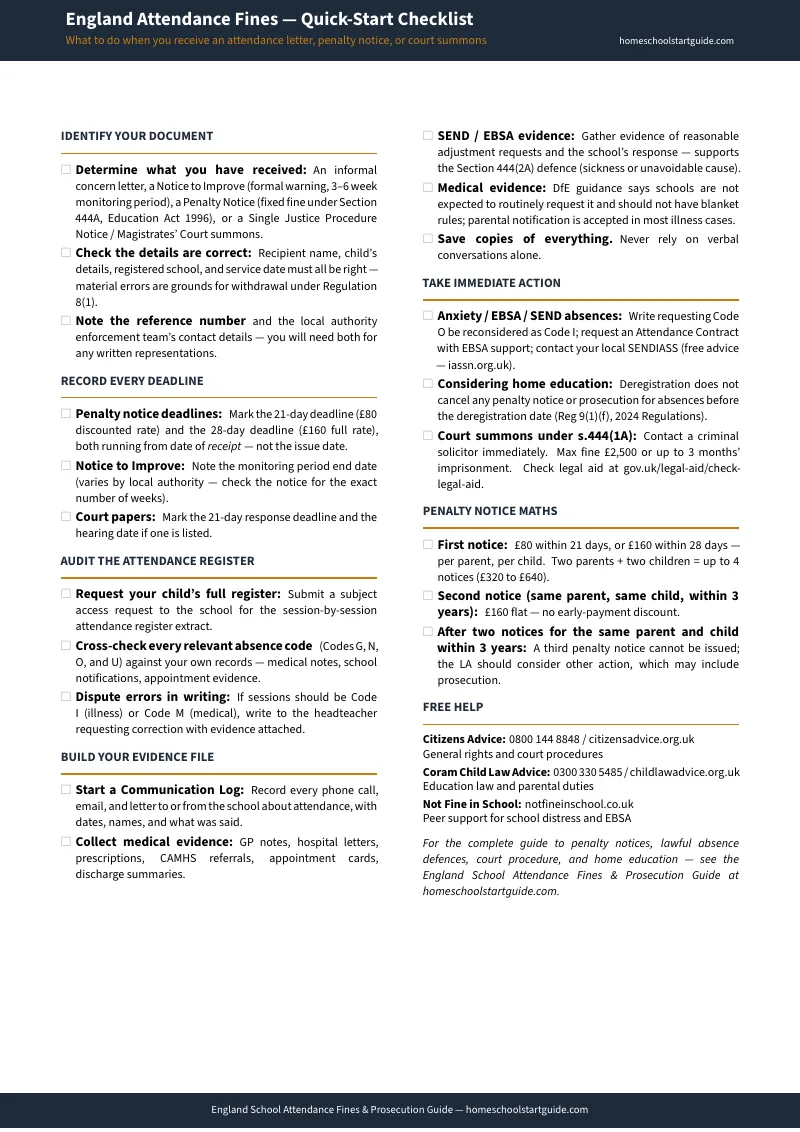
Not sure yet? Start with the free England Attendance Fines — Quick-Start Checklist. It gives you a one-page action plan: identify the letter, note the deadlines, request the register, and start gathering evidence. If you need the full framework, the guide is here when you're ready.
Satisfaction Guarantee
If the guide doesn't help you understand and respond to your attendance situation, email [email protected] for a full refund, no time limit. We read every message.
Frequently Asked Questions
Is this legal advice?
No. This is an independent informational guide — it explains the statutory framework, the enforcement process, and the evidence standards in plain English. It is not legal advice and does not replace a qualified solicitor. The guide includes clear hand-off points explaining when professional legal representation is essential, particularly if you receive a court summons.
Is this guide up to date with the August 2024 changes?
Yes. The guide covers the national penalty notice framework that took effect on 19 August 2024, including the standardised fine amounts, the 10-session rolling threshold, the three-year escalation cap, and the technical updates in the July 2026 DfE guidance revision.
Does paying the fine mean I have a criminal record?
No. A penalty notice is not a conviction. Paying it within the deadline (21 days for the reduced amount, 28 days for the full amount on a first notice) discharges your liability for those specific absences — no court, no criminal record. If a notice goes unpaid, the local authority must decide whether to prosecute or withdraw.
My child is struggling with anxiety or has SEND — will this help?
The guide covers how SEND and anxiety-driven absences interact with the enforcement system, including how to document barriers, request reasonable adjustments under the Equality Act 2010, and ensure your child's absences are coded accurately. For the full school-refusal support pathway, we link to the dedicated School Refusal & Anxiety Withdrawal Blueprint.
Does this cover Scotland or Wales?
No. This guide covers England only. Scotland and Wales have entirely different attendance frameworks with different thresholds, fine amounts, and legal procedures. Applying Welsh or Scottish rules in England will result in missed deadlines and incorrect responses.
What if I'm thinking about home education?
The guide has a dedicated section on deregistering to home educate — the steps involved, what it changes going forward, and critically what it does not change about past absences or existing enforcement. For the full legal withdrawal process, we link to the England Legal Withdrawal Blueprint.
Can I get a refund?
Yes — full refund, no time limit. Email [email protected] and we'll process it promptly.
Frequently Asked Questions
What if the rules change after I buy?
We update the guide when the rules change. Email us any time, even years later, and we'll send you the current edition free.