
The Complete School Exit System for England — From Letter to LA Response
You've made the decision. Your child is in distress — the bullying hasn't stopped, the SEND support never materialised, or the anxiety has reached the point where they physically cannot walk through the school gate. You want to deregister and start home educating. But when you told the headteacher, they said you need to attend a meeting with the SENCO, submit your proposed curriculum for review, wait for the local authority's "approval," and that removing your child mid-term could trigger a safeguarding referral.
None of that is true. Under Regulation 9(1)(f) of the 2024 Pupil Registration Regulations, a parent of a child at a mainstream school in England can deregister by writing a single letter to the headteacher. The school is legally required to remove the child from the admissions register on the date stated in the letter. No meeting. No curriculum review. No approval. No waiting period.
But here's what free websites don't tell you: the letter is the easy part. The hard part is what happens after — when the headteacher's PA rings demanding a meeting, when the SENCO claims your child's EHCP means "the council has to approve the withdrawal," when the Local Authority sends a questionnaire that feels like an interrogation form asking for curriculum samples, daily timetables, and a home visit. The England Legal Withdrawal Blueprint is a complete School Exit System — the deregistration letters, the pushback scripts, the 2026 CNIS compliance guidance, and the LA response templates — so you're never improvising during the most stressful conversation of the process.
What's Inside the School Exit System
Four Deregistration Letter Templates — because the school won't tell you there's more than one pathway
Standard mainstream withdrawal, EHCP at a mainstream school, mid-year immediate withdrawal for urgent situations, and a flexi-schooling request. Each template uses the exact language that triggers the school's non-discretionary legal duty under Regulation 9(1)(f) of the 2024 Regulations — the word "decision," not "intention" or "considering." That single word is the difference between the school being legally compelled to act immediately and the headteacher scheduling a meeting to talk you out of it.
The 2026 CNIS Compliance Matrix — because the new law is real, and the old templates are dangerous
The Children's Wellbeing and Schools Bill has introduced mandatory Children Not in School registers. You are now legally required to provide specific data to the Local Authority — but the legislation also makes clear that certain categories of information are strictly optional. Local authorities will send questionnaires asking for curriculum plans, daily timetables, and home visit access. Most of that is not legally required. Without the Matrix, parents hand over everything out of fear — and open the door to years of ongoing scrutiny they never had to accept. This is the section that makes a 2026 guide essential and a pre-2026 Facebook template actively risky.
The Headteacher Pushback Scripts — because the letter is the easy part
When the headteacher's PA rings saying "we need to arrange a meeting before we can process this," most parents comply. They sit through 45 minutes of being talked out of their decision. Some sign forms that voluntarily submit them to ongoing council oversight they were never legally required to accept. The Blueprint gives you copy-and-paste email responses — citing the specific regulation the school is breaching — so you can respond in under two minutes without composing anything under pressure.
The EHCP & Special School Exit Guide — because the mainstream letter will get your child trapped
If your child has an EHCP and attends a special school named in Section I of the plan, sending a standard deregistration letter does nothing. The school is legally barred from removing your child without Local Authority consent. You need to request amendments to the EHCP under Section B — a different legal pathway with different templates and different timelines. The Blueprint walks through every step, explains your rights if the LA refuses consent, and provides the specific letters for initiating the amendment. Using a mainstream template for a special school is one of the most dangerous legal mistakes a parent can make, and most free resources don't even mention the distinction.
The First 30 Days De-Escalation Protocol — because the LA contact feels like surveillance
After deregistration, the Local Authority will write to you within 6-8 weeks. They will phrase it as "support." It will feel like an inspection. They may request a home visit, ask to interview your child, or send a questionnaire demanding curriculum plans and work samples. You are not legally required to accept a home visit, present your child, or provide information in any prescribed format — but case law says ignoring them entirely gives them grounds to escalate. The Protocol gives you a written response template that satisfies your statutory obligations while declining everything you're not required to provide.
The Re-Enrolment Protection Plan — because some families need a term, not a lifetime
Not every family leaves school permanently. Some need a term of healing while they find a better-fit placement. The Blueprint outlines exactly what records to keep — work samples, a learning log, an Educational Provision Report — so that when your child applies for in-year admission later, the school cannot arbitrarily reassign their year group or claim the home education period was an unaccounted gap.
Who This Blueprint Is For
- Parents whose child is being bullied, experiencing school refusal, or suffering anxiety so severe they physically cannot attend — and who need to execute a legal deregistration this week, not after months of research
- Parents who told the headteacher they want to deregister and were told they need a meeting, a curriculum plan, or local authority approval first — and who need the exact legal language to override those demands
- Parents of children with EHCPs or special educational needs who are terrified of losing provision but whose children are deteriorating faster than the system is acting
- Parents who fear the local authority — who worry that submitting a deregistration letter will trigger a safeguarding investigation, a home visit, or a School Attendance Order
- Parents navigating the new 2026 CNIS register requirements who need to know exactly what data they are legally required to provide and what they can lawfully withhold
- Families who want a clean, private deregistration without paying for a yearly charity membership or joining an activist organisation
After Using the Blueprint, You'll Be Able To
- Send a legally airtight deregistration letter to the headteacher tonight — no appointment, no meeting, no local authority "approval" required
- Respond to every illegal demand from the school with pre-written scripts that cite the exact DfE guidance and statutory provisions — without hiring a solicitor
- Comply fully with the new 2026 CNIS register requirements while protecting your family's privacy from local authority overreach
- Navigate the EHCP special school pathway safely if your child has an Education, Health and Care Plan — without accidentally surrendering legal protections
- Handle the first local authority contact with a template response that satisfies statutory obligations without inviting intrusive home visits
- Keep the records you'll need if your child ever re-enters the school system, preventing arbitrary year group reassignment
Why Not Just Use the Free Resources?
You can. Educational Freedom has a deregistration page. The DfE publishes statutory guidance. Mumsnet and Facebook groups have hundreds of threads from parents who've done it. Here's what actually happens when you try to build a deregistration strategy from these sources:
- Educational Freedom gives you the letter — and a combative tone that escalates the situation. Their advice is legally accurate but reads like a manifesto: "you are not obliged to give any notice," "the LA's role is not one of support or advice." A parent who wants to quietly and calmly extract their child — without starting a bureaucratic war with the headteacher — finds this militant approach alienating. And crucially, if the headteacher refuses to process your letter, demands a meeting, or refers you to the Local Authority, these sites offer no further script. At the exact moment of school pushback, you're on your own.
- The DfE guidance is written to protect the regulator, not the parent. It tells you what the Local Authority's powers are. It does not tell you what to write in the letter, how to respond when the school illegally delays the deregistration, or where the legal boundary sits between mandatory and optional data under the new CNIS register. Council websites like Surrey's frame home visits as "support" while listing requirements for timetables, photographs, curriculum plans, and workbooks — most of which you are not legally required to provide.
- Facebook templates were written before the 2026 law existed. The Children's Wellbeing and Schools Bill introduced mandatory CNIS registers and a 15-day preliminary notice window — the fast-tracked pathway to a School Attendance Order. Templates circulating in Facebook groups and Mumsnet threads don't account for any of this. Using a pre-2026 deregistration approach today doesn't just leave gaps; it can actively trigger enforcement action that wouldn't have existed under the old system.
- Education Otherwise costs more than double and requires you to assemble the strategy yourself. EO membership is £17 per year. Their support is excellent — but it's spread across dozens of separate fact sheets covering everything from child benefit to police interactions. A parent in crisis at 10pm on a Tuesday doesn't need a library of fact sheets; they need a single, linear document that tells them exactly what to send, what to say when the school pushes back, and what to expect from the LA in the first 30 days.
Free resources give you the opening move. The School Exit System gives you the entire sequence — including the counter-moves for when the school doesn't cooperate.
— Less Than One Hour of a Family Solicitor
A family law solicitor charges upwards of £200 per hour. An Education Otherwise membership costs £17 per year. A single School Attendance Order can result in a £2,500 fine, court proceedings, and months of your time. The Blueprint costs less than two coffees — and it gives you the complete School Exit System that would take a solicitor an hour to draft from scratch.
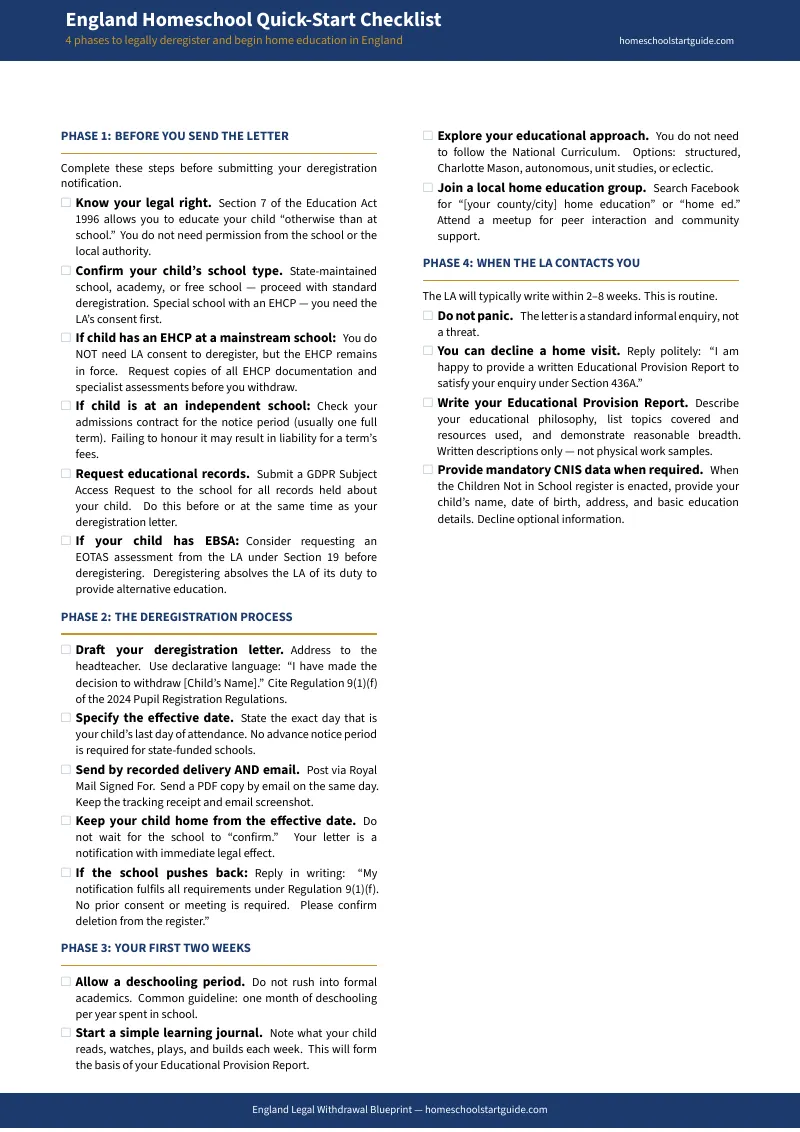
Your download includes 7 PDFs — the complete Blueprint plus five standalone reference documents you can print individually: the Deregistration Letter Templates (four fill-in-the-blank letters), the School Pushback Scripts (six copy-paste email responses), the LA Response Script & First 30 Days Protocol, the EHCP Pathway Guide (mainstream vs special school), and the 2026 CNIS Register Compliance Matrix. Plus the England Homeschool Quick-Start Checklist — a one-page summary of your legal rights, the most common illegal demands schools make, and the single most important word that must appear in your deregistration letter. Instant download, no account required.
Money-back guarantee, no time limit. If the Blueprint doesn't give you the confidence and legal clarity to execute your deregistration, email us and we'll refund you. No questions asked.
Not ready for the full Blueprint? Download the free England Homeschool Quick-Start Checklist — a one-page overview of your legal right to home educate, the three things the school cannot legally demand from you, and the key paragraph that must appear in any deregistration letter. It's enough to understand your rights, and it's free.
Your child doesn't have to go back tomorrow. English law is entirely on your side — the school just hasn't told you that yet. The School Exit System makes sure they can't pretend otherwise.
Frequently Asked Questions
What if the rules change after I buy?
We update the guide when the rules change. Email us any time, even years later, and we'll send you the current edition free.