The letter arrived. Now every search result gives you England's rules instead of Wales's.
You're staring at a letter that says "fixed penalty notice," "Education Welfare Service," or "unauthorised absence" — and your first instinct was to search for what happens next. That's when you discovered the real problem: almost everything online is written for England.
England's fines went up to £80/£160 in August 2024 with a national 10-session threshold. Wales still operates under the Education (Penalty Notices) (Wales) Regulations 2013 — fines of £60 within 28 days, £120 within 42 days — and every local authority writes its own code of conduct with its own thresholds, warning periods, and procedures. Cardiff's rules are different from Newport's. Bridgend's are different from Ceredigion's. The Etsy templates citing England's framework are wrong for your situation, and the forum threads confidently mixing up the two jurisdictions are worse.
The Wales Attendance Enforcement Roadmap is built for one jurisdiction: Wales. It maps every stage of the enforcement process — from the first absence code on the register through to a magistrates' court summons — under the Welsh statutory framework your local authority actually operates within. No English rules mixed in. No generic UK advice. No "loopholes" that don't exist.
What the Guide Covers
The Full Enforcement Pipeline — From Register Code to Court
The timeline that nobody gives you in one place: how absence codes work (including the July 2026 I1/I2 split for illness), when a school refers to the Education Welfare Service, the warning process (Welsh Government guidance recommends allowing 15 school days to improve attendance where feasible), how a fixed penalty notice is issued and served, the two payment deadlines, and the path to prosecution under Section 444 of the Education Act 1996 if the fine goes unpaid. Each stage explains what it means, what your options are, and what happens if you do nothing.
Your Local Authority's Code of Conduct — Translated
Wales has 22 local authorities and each one publishes its own code of conduct under Regulation 14 of the 2013 Regulations. The guide breaks down the operational variations that actually matter: Cardiff's 10-session threshold and its exception to the warning and 15-school-day improvement period for unauthorised holiday absence; Newport's published five-day unauthorised-absence trigger; Bridgend's strict 15-day monitoring period and 10-day response commitment; and Flintshire's 20-session threshold. You'll see how these codes differ and what to check in your own authority's code — not a generic summary that fits nowhere.
Medical Evidence and Register Code Worksheets
When illness or medical appointments are involved, supporting evidence can help the school record the absence accurately. The kit includes the Evidence Checklist and the Absence & Register Tracking Log for building a medical evidence file: appointment letters, prescription records, symptom journals, and GP correspondence. The guide explains when a school can reasonably ask for medical evidence, how to request a register code correction from the applicable unauthorised code to I1 or I2, and what to do if the school questions the reason for an absence or has not received supporting evidence after a suitable period.
Meeting Preparation Sheets
Before you sit down with the headteacher, attendance officer, or Education Welfare Officer, print the Meeting Preparation Sheet and the Meeting Summary Sheet: what to bring, what to write down during the meeting, what questions to ask, and a same-day follow-up that creates a record of what was agreed. The guide covers attendance improvement plans and parenting contracts — what they are, what signing one commits you to, and what your options are if you disagree with the terms.
Court Procedure — The Process, Not Legal Advice
If the case reaches the magistrates' court, the guide explains the procedural stages: the summons, how to enter a plea, the statutory defences available under Section 444, the range of outcomes (fine up to £1,000 for section 444(1); up to £2,500, a community order, or imprisonment for section 444(1A)), and what to include in an evidence bundle for a solicitor. It tells you when to get a lawyer, how to check legal aid eligibility, and how the duty solicitor scheme works. It does not give legal advice — it gives you the procedural map so you arrive at a solicitor's office informed, not panicking.
The Home Education Exit — What It Does and Doesn't Change
If you're considering withdrawing your child from school, the guide covers the deregistration steps under the Education (Pupil Registration) (Wales) Regulations 2010 and the critical fact that most advice gets wrong: deregistering does not cancel a penalty notice already issued or halt a prosecution already started. The enforcement relates to absences that occurred while the child was on the school register. The guide explains what changes, what doesn't, and when deregistration makes sense as part of a larger plan — with a cross-reference to the Wales Legal Withdrawal Blueprint for the full deregistration process.
School Distress, Anxiety, and ALN Support
When absence stems from emotionally based school avoidance, autism, ADHD, or other additional learning needs, the enforcement framework collides with the ALN Act 2018. The guide covers how to request an IDP review through your school's ALNCo, how ALN-related absence should be coded, when to contact SNAP Cymru for free advocacy, and how to prevent an attendance dispute from escalating when the root cause is unmet need — not parental neglect.
Key Resources and Free Support Services
Contact details and descriptions for the free support services covered in the guide: SNAP Cymru (ALN advocacy), Advicelink Cymru (0800 702 2020), the Children's Commissioner for Wales, Not Fine in School (peer support for EBSA families), and guidance on finding a specialist education solicitor if the case reaches court.
Who This Is For
- Parents who've received a fixed penalty notice and need to understand whether to pay, respond, or seek advice — with the correct Welsh amounts and deadlines, not England's
- Parents who've received a warning letter or EWS referral and want to know what the warning and monitoring period means under their local code and what evidence to gather during it
- Parents whose child can't attend because of anxiety, EBSA, or additional learning needs — and who need to connect ALN support to the attendance process before it becomes an enforcement matter
- Separated parents who've received a fine for absence during the other parent's care time and need to understand how Section 576 parental responsibility works with penalty notices
- Parents who took a term-time holiday and want to know the holiday-specific rules, the per-parent-per-child calculation, and when paying promptly is the clearest resolution
- Parents who want to understand the system before it escalates — one conversation with the attendance officer has happened and you want to know the full timeline before you're blindsided
Why Not the Free Resources?
The free resources exist and they're real. The Welsh Government guidance (Belonging, engaging and participating) is authoritative. Your local authority's code of conduct is the actual policy. SNAP Cymru and Citizens Advice Cymru offer genuine free help. None of them need to be replaced.
The problem is that none of them are written for a parent holding a letter at 11pm on a Tuesday. The Welsh Government guidance is dozens of pages of policy language for local authority officers. The council codes of conduct define thresholds and timelines but don't tell you how to present medical evidence or what to say in a meeting. SNAP Cymru specialises in ALN, not attendance fines. Citizens Advice covers debt and welfare but their advisors are generalists. And the search results that come up at midnight mix England and Wales so thoroughly that you can't tell which fine amount, which threshold, and which procedure applies to you.
The guide doesn't replace any free service. It sits between the official policy documents you can't parse at midnight and the solicitor's office you don't need yet. One reference, covering every stage, written for Welsh parents under the Welsh framework, with the worksheets and templates that the official sources don't include.
Satisfaction Guarantee
If the guide isn't what you expected, email [email protected] for a full refund, no time limit. No forms. No explanations required. We read every message.
Get Started Tonight
The guide costs — a one-time download, no subscription, no membership. It includes the 50-page, 13-chapter guide, the two-page checklist, and six printable tools (Absence & Register Tracking Log, Evidence Checklist, Meeting Preparation Sheet, Meeting Summary Sheet, FPN Response Tracker, and Agency Communication Log).
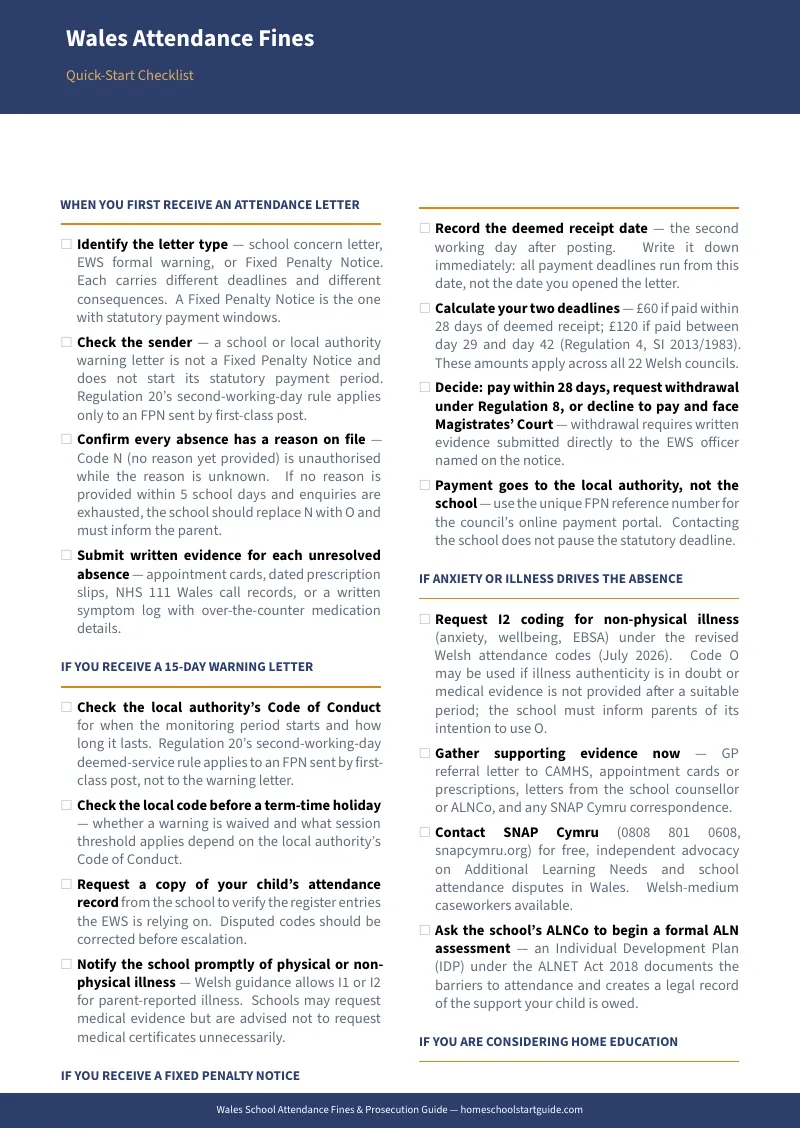
Not ready for the full guide? Download the free Wales Attendance Fines — Quick-Start Checklist — a two-page, 23-item overview of what the letter means, the payment deadlines, and the first things to do this week. It's enough to understand where you stand tonight. The full guide is there when you need the detail.
Frequently Asked Questions
What if the rules change after I buy?
We update the guide when the rules change. Email us any time, even years later, and we'll send you the current edition free.