You fought for that IEP. You waited years for the OAP. Now you're leaving school — and nobody can tell you what happens to any of it.
The school's special education coordinator has never handled a withdrawal where disability funding was in play. The board office sends you a PPM 131 package and an Appendix D questionnaire as though your child is neurotypical. Ontario.ca describes each program on its own ministry page — the OAP page doesn't mention home education, the home education page doesn't mention disability funding, and nobody has written the page where all of it comes together.
You've spent hours in Facebook groups getting five different answers. One parent says the OAP waitlist resets. Another says SSAH stops immediately. A third says the board will send someone to your house every month because your child has an IPRC identification. None of it is accurate, but you can't prove that until you've spent another five hours cross-referencing ministry websites that contradict each other's terminology.
Meanwhile your child is in crisis, the school's solution isn't working, and you need to act this week — not after a 20-hour research project.
The Support Continuity System — every program, every regulation, every notification in one sequence
The Ontario Special Needs Home Education Guide is the document that should exist on Ontario.ca but doesn't: a single, plain-language walkthrough of what happens to every support, funding stream, and legal obligation when an Ontario family withdraws a disabled or neurodivergent child from school to educate at home. Not the law in the abstract. Not a motivational pep talk. The operational sequence — which letters go where, which programs continue unchanged, which ones need a written notification, and what evidence to keep so the board can't create a problem where none exists.
The Legal Foundation
Section 21(2)(a) of the Education Act excuses your child from school attendance when receiving satisfactory instruction at home. No approval, no curriculum submission, no teaching credentials. PPM 131 is ministry policy guiding how boards handle the notification — it is not binding law and cannot impose requirements beyond the statute. The guide explains the precise hierarchy of law so you can tell the difference between a board's legitimate question and a request that exceeds its authority, especially when the board treats a child's disability as a reason to escalate oversight.
The IEP and IPRC Withdrawal Mechanics
Your child's IEP is a school board document governed by O. Reg. 181/98. When you notify the board, the IEP no longer governs home education — but the clinical assessments behind it don't vanish. The guide walks through the document request you need to send before your notification letter: the full IEP, the IPRC Statement of Decision, every psychoeducational assessment, speech-language report, and OT evaluation in the Ontario Student Record. These are your child's records, not the school's. You'll need them for private assessments, AccessOAP documentation, and re-enrolment. The guide tells you what to request, how to request it, and the regulation that entitles you to it.
The Disability Funding Navigator
Five programs across two levels of government, each with its own rules — and the guide maps every one of them to the specific moment your child leaves school:
- Ontario Autism Program (OAP) — Your waitlist position is based on registration date, not school enrolment. It does not change. But AccessOAP and your service providers need written notice when the service location shifts from school to home. The guide includes the notification steps and explains which Core Clinical, Foundational Family, and Urgent Response services continue unchanged.
- Special Services at Home (SSAH) — Personal funding for respite and skill-building. Completely independent of school. The guide explains how to document that home-based expenses qualify under your allocation.
- Assistance for Children with Severe Disabilities (ACSD) — Income-tested support, also independent of school. The guide covers how ACSD and SSAH interact and how both can stack with OAP funding.
- Passport Program (18+) — Transition from child services to adult services has its own paperwork. The guide explains what changes at 18 and what to prepare before your child ages out of the child disability system.
- Federal benefits (DTC, Child Disability Benefit, Canada Disability Benefit) — Entirely separate from provincial education. The guide confirms what changes (nothing) and what to verify with CRA for the first two or Service Canada for the Canada Disability Benefit.
Evidence and Documentation for Neurodivergent Learners
If the board investigates under PPM 131, you need to show "satisfactory instruction." For a child with autism, ADHD, dyslexia, or severe anxiety, learning doesn't look like worksheets and textbook chapters. The guide provides a documentation framework built for neurodivergent learners — capturing verbal responses, sensory regulation progress, interest-led projects, life skills, and functional development alongside any traditional academic work. The standard is that your child is learning and progressing on their own trajectory, not that they're replicating a classroom.
Secondary Qualifications and Accommodations
When your child is ready for OSSD credits, TVO ILC enrolment requires the board's Letter in Response to Parents' Notification. The guide covers how to get it (including when boards delay), EQAO accommodations for home-educated candidates, and the PLAR process for translating home-based learning into credit equivalencies.
Re-Entry Planning
If your family returns to school, the principal determines age-appropriate placement after reviewing relevant records and consulting with the student, family, and school staff. The guide covers how to present a home-learning portfolio, request a new IPRC meeting if warranted, and bring prior records into the school's review. Prior IPRC identifications and historical IEP accommodations are not automatically reinstated in identical form.
Who This Guide Is For
- Parents whose child has an IEP or IPRC identification and is about to leave school — You need the withdrawal sequence that handles the support plan, not just the PPM 131 letter.
- Parents on the OAP waitlist who can't risk losing their spot — You need the regulatory confirmation that the waitlist position is safe, plus the notification checklist so AccessOAP doesn't flag a gap.
- Parents whose child can't attend school due to anxiety, sensory overload, or burnout — You need to move from "not attending" to "legally educated at home" before the attendance counsellor escalates, without accidentally disrupting SSAH or ACSD.
- Parents who've already withdrawn and are unsure about funding — You need a post-withdrawal audit: which programs are still active, which ones need a notification you haven't sent, and what documentation to keep.
- Parents planning a temporary exit with the intention of returning — You need to leave in a way that preserves every record, every funding stream, and every re-entry pathway.
Why This Instead of Free Resources?
Ontario.ca describes each program on its own page — OAP under MCCSS, SSAH under TPON, home education under the Ministry of Education. None reference each other. You're left assembling the picture yourself, hoping you haven't missed a notification requirement.
AccessOAP confirms your waitlist position but doesn't explain what changes when you leave school. The portal's FAQ covers eligibility — not what happens to Foundational Family Services when the service location shifts, or whether your provider needs new authorization.
The OFTP and OCHEC are the gold standard for home education law. They break down Section 21(2)(a) and PPM 131 with statutory precision. They do not cover IEP withdrawal mechanics, IPRC regulations, OAP funding continuity, or SSAH documentation — those belong to special education, not home education.
End The Wait Ontario is the best advocacy voice for OAP families. They don't provide withdrawal letter templates, PPM 131 compliance frameworks, or neurodivergent evidence-logging guidance.
Special education advocates charge $150 to $250 an hour and focus on in-school negotiation — not home education setup.
Facebook groups give you lived experience and emotional support. They also give you outdated advice, board-specific practices presented as provincial law, and confident reassurances from parents in provinces with different rules.
Each free resource covers one piece. None covers the intersection — where home education law, disability funding rules, and neurodivergent documentation all meet. That intersection is the entire point of this guide.
Satisfaction Guarantee
If the guide doesn't deliver what you need, email [email protected] for a full refund, no time limit. We read every message.
One Document Instead of Twenty Ministry Pages
A single consultation with a special education advocate runs $150 to $250 an hour. Twenty hours of research across Ontario.ca, AccessOAP, OFTP, and End The Wait might get you the same information — scattered, undated, and impossible to verify against each other.
The guide costs — once, with no subscription and no ongoing commitment. The withdrawal sequence, the IEP and IPRC regulations, every provincial and federal disability program, the evidence framework, the secondary qualification pathways, and the re-entry plan. One purchase. One document. Every piece in order.
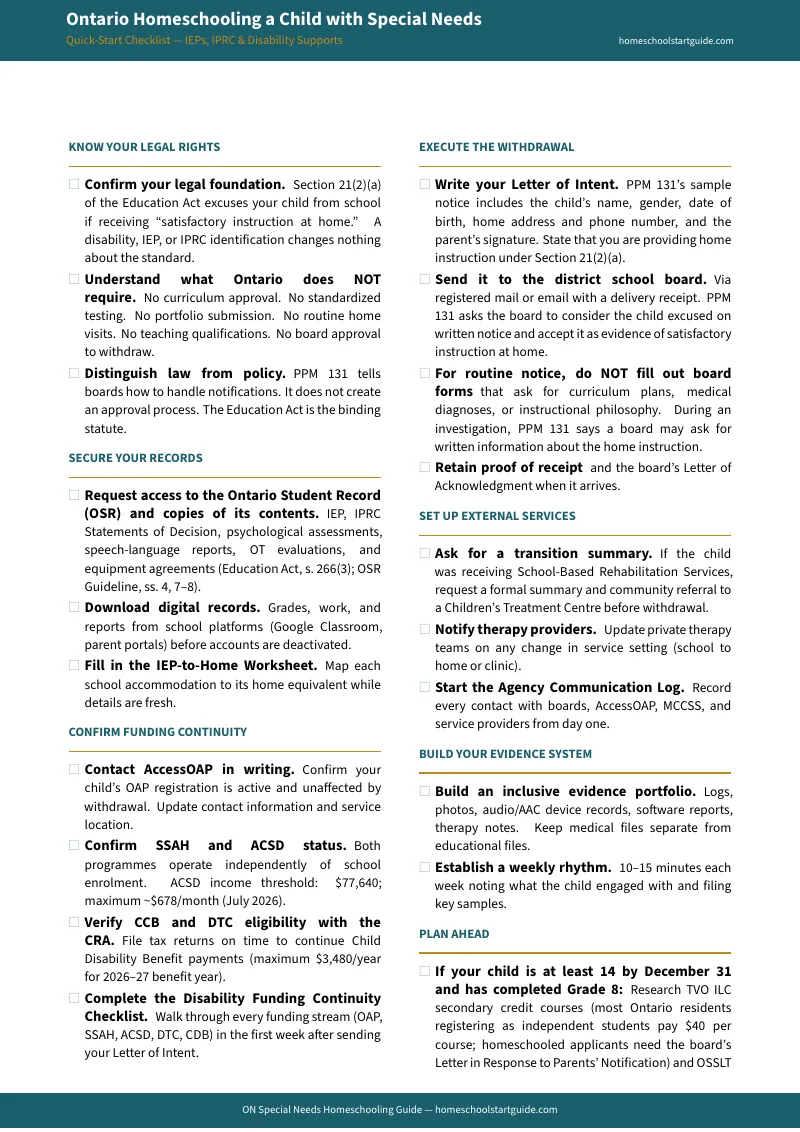
Not ready for the full guide? Download the free Ontario Special Needs Home Education Quick-Start Checklist — a printable action plan covering your legal right under Section 21(2)(a), the withdrawal notification, the IEP and IPRC document request, the funding continuity checks for OAP and SSAH, and the first steps for documenting learning at home.
Your child's support doesn't end when school does. This guide shows you exactly why — and exactly how to make sure.
Frequently Asked Questions
What if the rules change after I buy?
We update the guide when the rules change. Email us any time, even years later, and we'll send you the current edition free.