
Leave School Lawfully in New Zealand Without Guessing What Happens to Your Child's Support
When school breaks down for an autistic, ADHD, dyslexic, anxious, or otherwise disabled child, the fear is rarely just about teaching at home. It is about what you might accidentally break on the way out.
You have sat through months of IEP meetings, informal calls asking you to pick your child up early, or mornings where autistic burnout makes the school gate impossible. Now you are staring at a Ministry of Education Section 38 exemption form and a dozen unanswered questions: Can I keep my child home while we wait 4 to 6 weeks? Does leaving ENROL wipe out ORS verification forever? Do we need a private diagnosis first? Does Te Kura cancel our exemption? Which Work and Income or Disability Support Services pathways actually stay open?
Scattered Facebook threads contradict each other. Official Ministry pages give you a blank form and the statutory wording — then leave you alone to figure out how to translate an IEP into Section 38(1)(b) evidence without making promises you cannot keep.
Meet the Section 38 Support-Transition System
The New Zealand Home Education Exemption with Learning Support Needs Guide is a plain-language, dated process manual built specifically for Aotearoa families home educating a child with special educational needs or a disability. Instead of treating learning support as a two-paragraph footnote inside a general homeschool booklet, it walks you through one joined-up workflow — from retrieving school records before you mention leaving, through submitting a grounded Section 38 application, to navigating post-exemption allowances, community disability supports, and future NCEA accommodations.
What's Inside Your Complete Kit
- 12-Chapter Process Guide (45 pages, dated November 2026) — Separates live law under Section 38 of the Education and Training Act 2020 from paused proposals, so you never act on outdated forum rumours.
- The Legal Exit Sequence & 4–6 Week Waiting Plan — Shows why enrolment and attendance duties stay active until your Certificate of Exemption arrives, and how to communicate with the principal in writing (including attendance code M for qualifying illness or distress) while you wait.
- Section 38 Additional-Needs Evidence Planner (Printable PDF) — Because parents get stuck trying to prove "at least as regularly and well as in a specialist school or special service" without replicating a rigid classroom timetable. Map functional needs, flexible rhythms, and 12-month goals before touching the Ministry form.
- Pre-Withdrawal School Records Request Checklist (Printable PDF) — Because once your child leaves ENROL, chasing IEPs, ORS verification letters, SLT/OT reports, and assistive technology loan terms gets much harder. Request relevant school records under the Privacy Act 2020 as your child's representative before you unenroll.
- Support and Funding Transition Worksheet (Printable PDF) — Untangles what stops on school exit (school-allocated ORS teacher aide and specialist teacher hours) from what stays open (regional Ministry specialist support, the six-monthly Home Education Supervision Allowance, Work and Income's Child Disability Allowance and Disability Allowance, and MSD Disability Support Services via your local NASC or Enabling Good Lives site).
- Regional Ministry & Agency Inquiry Templates (Printable PDF) — Word-for-word written inquiry scripts for requesting school records, confirming regional Ministry ORS/specialist support, checking assistive technology terms, and getting written clarity before any school trial.
- Agency Communication Log (Printable PDF) — A clean landscape tracker for every call, email, officer name, and follow-up date across the Ministry, school, Work and Income, NASC/EGL, Te Kura, and NZQA host schools.
- Accessible Learning and Progress Log & ERO Review Preparation Worksheet (2 Printable PDFs) — Low-demand weekly tracking built for neurodivergent learners (photos, oral notes, therapy carry-over) plus a calm, step-by-step preparation sheet in case you ever receive a concern-based ERO review notice.
- NCEA SAC and School Re-Entry Evidence Tracker (Printable PDF) — Under NZQA's 2026 rules, a school or TEO submits a Special Assessment Conditions application or Level 1 notification on the candidate's behalf, and its Nominee manages the process. For approvals-gateway applications, the school or TEO must provide documented evidence from its own testing or a report from an appropriately qualified independent registered professional. Preserve comparative work samples and accommodation history for a future host.
- 3 Worked Financial & Planning Examples — Real New Zealand numbers showing pro-rata Supervision Allowance calculations, combined annual household resourcing with Child Disability Allowance ($62.43/week from 1 April 2026), and private assessment and ongoing therapy budgeting, with Disability Allowance offset for eligible ongoing costs (up to $82.85/week).
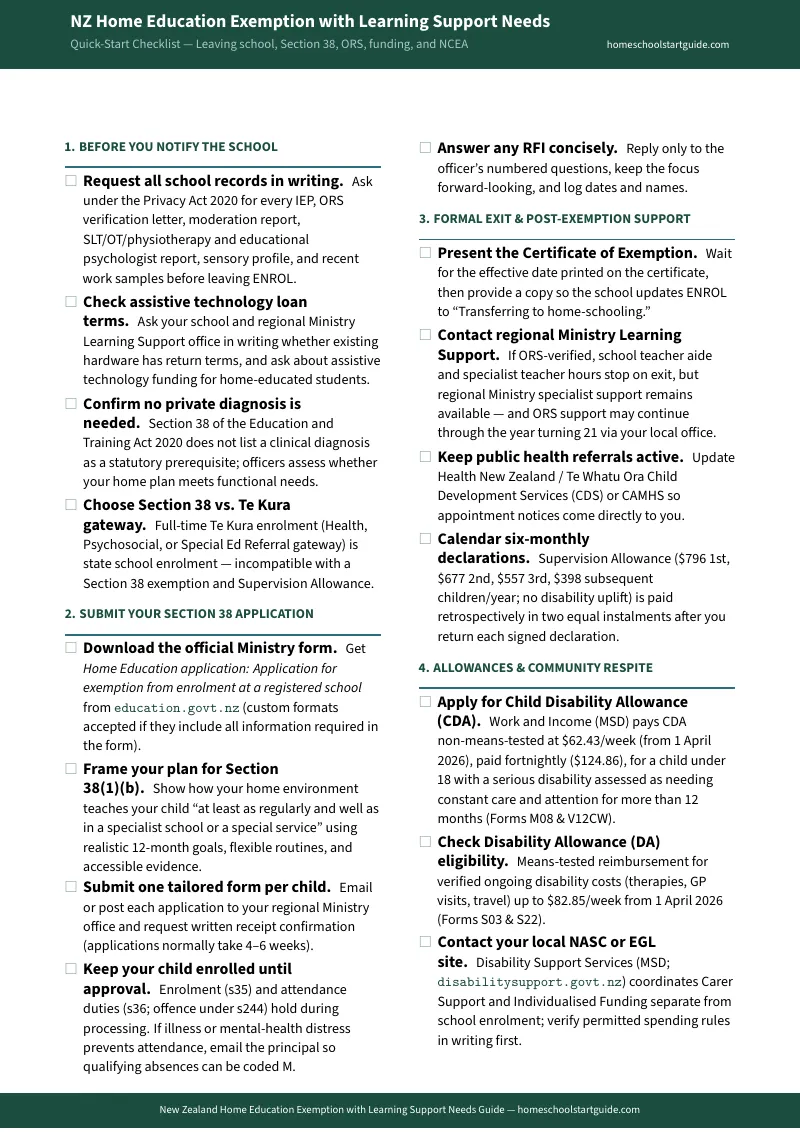
- 2-Page Quick-Start Checklist — All 20 essential steps in strict chronological order, from pre-withdrawal records to compliance binder setup.
Who This Guide Is For
This kit is designed for New Zealand parents and caregivers of autistic, ADHD, dyslexic, anxious, or otherwise disabled children — whether you hold ORS verification, an IEP, Learning Support Coordinator involvement, or have no formal diagnosis yet — who are preparing to leave school or have recently received a Section 38 exemption.
Honest scope boundaries: Homeschool Start Guide is an independent publisher, not a law firm, medical provider, or government agency, and is not affiliated with the Ministry of Education, Work and Income, MSD Disability Support Services, NZQA, or any school board. No guide can guarantee an exemption approval or preserve school-allocated ORS teacher aide hours after de-enrolment. If you are in an active school-side dispute or legal appeal, seek support from YouthLaw Aotearoa or a specialist advocate.
Why Not Just Use Free Government Pages or General Guides?
- Ministry of Education and Work and Income websites publish the statutory forms and rates for free, but they do not show you how to frame neurodivergent adaptations for Section 38(1)(b), how to answer a Request for Further Information without panic, or how Ministry, WINZ, and MSD Disability Support Services fit together.
- Parent Facebook groups and forums offer genuine warmth, yet advice is frequently outdated, contradictory, or mixes up Te Kura gateway enrolments with Section 38 exemptions — exhausting to sort through during a family crisis.
- General NZ exemption packs and custom writing services either cover special educational needs as a brief side-section (missing post-exemption MSD/DSS workflows and 2026 NZQA SAC Nominee rules) or charge NZ$130–NZ$200+ for a single application draft without ongoing records or re-entry tools.
This guide puts the entire learning-support transition into one calm, verified reference manual with eight ready-to-print worksheets — at a one-time price , with no membership or recurring fees.
Backed by Our Full Refund, No Time Limit Guarantee
Every guide we publish comes with a full refund, no time limit. Download the manual, read the chapters, and look through the printable worksheets. If it does not save your family hours of stress and give you a clearer path forward, email [email protected] and we will refund every cent.
Start Where You Are Today
Not ready for the full manual yet? Grab the free 2-page Quick-Start Checklist using the form on this page to see the exact 20-step sequence. When you want the complete 45-page guide, worked examples, agency inquiry templates, and all eight printable worksheets, select the full guide and download everything immediately.
Frequently Asked Questions
What if the rules change after I buy?
We update the guide when the rules change. Email us any time, even years later, and we'll send you the current edition free.