
Five Agencies. Zero Coordination. One Decision That Could Cost Every Support You Fought For.
Withdrawing a child with special educational needs from an Irish school means dealing with Tusla AEARS for registration, the NCSE and your SENO for the supports that are about to end, the DSP for the disability payments you need to keep, the HSE for therapy services on a separate waiting list, and the SEC for exam accommodations built around a school coordinator you no longer have.
Each agency publishes its own rules. None of them tells you how those rules interact when a child with an Assessment of Need, a Continuum of Support plan, or a special class placement leaves the school roll. That gap — the space between five sets of correct-but-siloed information — is where families lose services, miss deadlines, and make decisions based on forum threads that mix Irish law with English EHCPs and American attendance rules.
The Ireland SEN Home Education Guide is a Support-Continuity Navigator: a single operational manual that maps how all five systems interact when a child with SEN leaves school. It tells you what to do before you write the withdrawal letter, what happens to every support and payment once the child is off-roll, how to satisfy Tusla's assessment while respecting the way your child actually learns, and how the door back to school stays open with support restored.
What's Inside the Guide
The Support-Continuity Map
A complete matrix showing which state supports survive a school exit and which terminate. Domiciliary Care Allowance, Carer's Allowance, Carer's Support Grant, HSE Children's Disability Network Team services, and your Medical Card all continue on their own eligibility criteria — independent of school enrolment. SNA hours, SET allocations, and school-based assistive technology end. The Home Tuition Grant Scheme has separate eligibility criteria and is not an elective home education allowance. The map shows you exactly what to expect before you act, so you stop making withdrawal decisions based on false fears about losing everything.
The Legal Foundation — Specific to SEN
Article 42 of the Constitution and Section 14 of the Education (Welfare) Act 2000, and the "certain minimum education" standard — explained for a family whose child has an existing support plan. What changes and what stays the same when the child has an Assessment of Need under the Disability Act 2005, a SENO allocation, or Continuum of Support documentation. No legal jargon, no ambiguity, no imported UK or US terminology.
Leaving School with SEN Support in Place
The withdrawal sequence when your child has school-based supports. What to request from the school before you send the withdrawal letter. How the SENO's role changes once the child is off-roll. What happens to Continuum of Support documentation, SET hours, SNA allocations, and school-based assistive technology — and what records to carry forward. Because the order matters: get it wrong and you lose documentation you cannot reconstruct.
AEARS Registration Adapted to Your Child
How to register with Tusla AEARS when the child has additional needs. Form R1 and a certified copy of the birth certificate or, if it is unavailable, a valid passport. Approved certifiers include a practising solicitor, Commissioner for Oaths, member of An Garda Síochána, Notary Public, Peace Commissioner, Teaching Council-registered school principal, vice principal or teacher, doctor, accountant, or Chartered Engineer. What the preliminary assessment looks like for a neurodivergent child. How to present evidence of a "certain minimum education" when your child's learning is sensory-adapted, interest-led, or paced to regulation — not structured around classroom subjects. Preparation for the direct child meeting as part of the assessment process, including strategies for children who find interaction with unfamiliar adults distressing.
The Home Tuition Grant Scheme Reality Check
The HTGS is not an elective home education allowance. For 2025/26, Circular 0047/2025 covered preschool children meeting its autism criteria, children aged 4 and over seeking an unavailable special-school or special-class placement, and school-enrolled students whose significant medical condition or school phobia/anxiety had caused, and was likely to continue causing, major disruption to attendance. A child who did not take an available placement was ineligible for any provision under the scheme during that academic year. The guide explains the 2025/26 eligibility categories and what they mean for your family.
Disability Funding and Services Outside School
How DCA (full rate €380/month; half rate €190/month), Carer's Allowance, Carer's Support Grant (€2,000 annually), and CDNT therapy services work once your child is home educated. The transition when DCA ends at 16 and Disability Allowance may apply — a separate application with its own eligibility test, not an automatic transfer. What to tell the DSP case officer, what documentation to keep, and how to avoid the most common administrative errors families make at each stage.
Monitoring and Reports Adapted to the Child
How to satisfy Tusla's assessment requirements without forcing your neurodivergent child into rigid classroom evidence. Adapting Tusla's five assessment areas — intellectual development (including literacy, numeracy, and other learning), social, emotional, moral, and physical development — and the learning environment to sensory-safe, interest-led, and regulation-paced learning. Evidence strategies that work for children whose best learning does not look like worksheets.
State Exams and RACE Accommodations as an External Candidate
How to sit Junior Cycle or Leaving Certificate as an external candidate. The SEC's Reasonable Accommodations at Certificate Examinations (RACE) scheme — application deadlines, the evidence required without a school examination coordinator, and the accommodations available for specific learning differences and disabilities. The process that existing SEC guidance writes entirely for school coordinators, translated for a family doing it alone.
Returning to School with Support Restored
If your child is ready to go back, how to re-enter the school system with SEN support restored. Re-applying for a SENO allocation, requesting Continuum of Support documentation from the new school, and re-enrolling in a special class or special school if that is the right fit. The re-entry pathway is part of the decision — knowing the door stays open changes the calculation.
Printable Worksheets and Planning Tools
SEN support-status matrix. Agency communication log. AEARS assessment preparation sheet. Home Tuition eligibility decision tree. SEC RACE application checklist. Re-entry planning worksheet. Six standalone printable PDFs — fillable, designed for a parent who needs to document everything and has no administrative support.
Who This Guide Is For
- Parents about to withdraw a child with school SEN support — your child has a Continuum of Support plan, a special class place, or an SNA allocation, and you need to know what happens to those supports when the child leaves the roll, in what order to act, and what to have in place before you send the letter.
- Parents facing the AEARS assessment with a neurodivergent child — you have submitted Form R1 and the preliminary assessment is approaching, and you need to present evidence of education in a way that respects how your child learns.
- Parents navigating disability funding after leaving school — you need to know which payments continue on their own eligibility criteria and which school-funded supports stop.
- Parents of teenagers approaching State exams as external candidates — your home-educated teenager needs Junior Cycle or Leaving Certificate with RACE accommodations, and the SEC's guidance is written for school coordinators.
Why Free Resources Don't Cover This
The state resources are accurate. Tusla explains Section 14 registration. Citizens Information summarises the legal standard. The DSP publishes DCA eligibility rules. The SEC publishes the RACE handbook. The NCSE explains school-based SEN allocations.
But each agency answers only its own questions. Tusla does not explain what happens to your child's disability funding. The DSP does not mention school enrolment status. The SEC does not publish an external candidate walkthrough. The NCSE's Continuum of Support is written for teachers in recognised schools. No state page connects these systems for a family whose child has SEN and is leaving school.
Facebook groups and Reddit threads try to fill that gap, but they routinely import English terminology (EHCPs, Local Authority reviews), misstate HTGS eligibility ("you can claim Home Tuition if you home educate"), and share advice that was accurate three circulars ago. The guide replaces dozens of hours of fragmented searching with one verified, dated decision sequence.
Satisfaction Guarantee
Full refund, no time limit. If the guide does not deliver the operational clarity it promises, email [email protected] and we will refund your purchase in full. No forms, no waiting period.
Start with the Free Checklist — Or Get the Full Guide
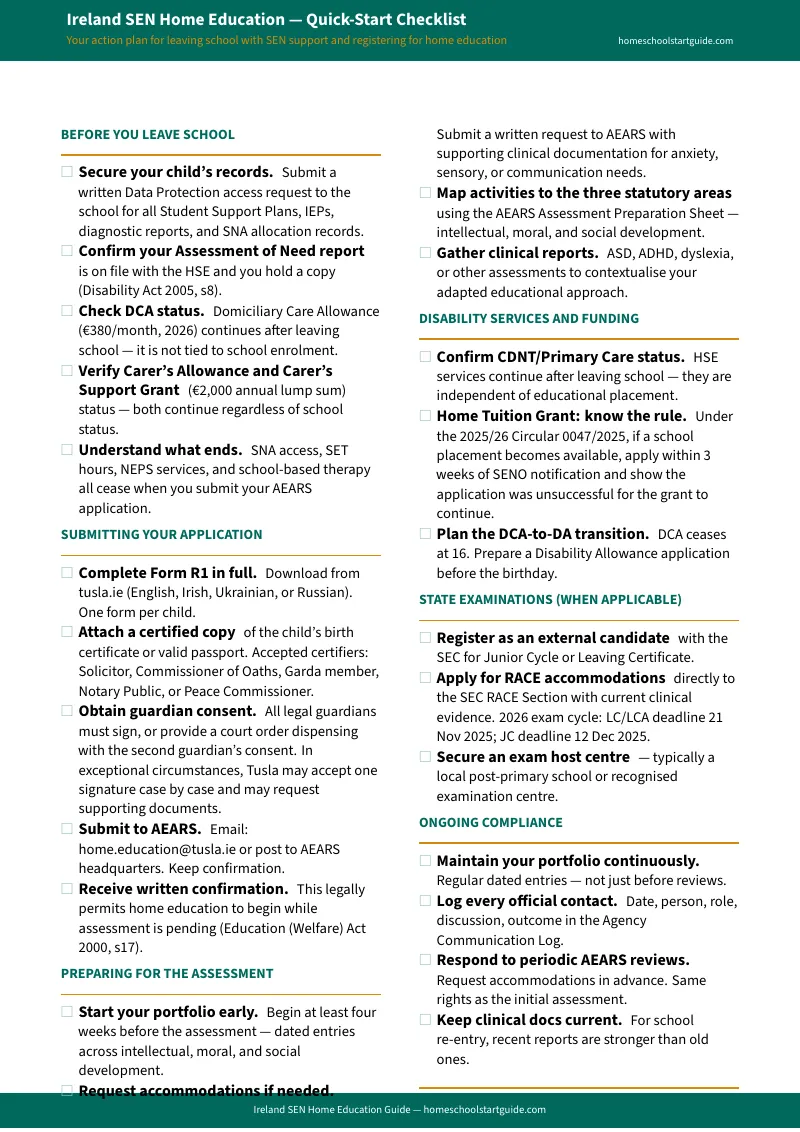
The Quick-Start Checklist is free — it gives you the withdrawal steps in order, the support-continuity snapshot, and the key records to keep. Download it now and start with the basics.
When you need the full legal foundation, the complete support-continuity map, the AEARS evidence framework, the RACE external candidate process, the worksheets, and the school re-entry pathway, the full guide is waiting. For less than a single hour with a special education consultant, you get a system that covers every step from the day you decide to leave school to the day your child sits an exam or walks back through the school gate.
Frequently Asked Questions
What if the rules change after I buy?
We update the guide when the rules change. Email us any time, even years later, and we'll send you the current edition free.