You Left School to Protect Your Child. Now You Need to Know What Stays, What Stops, and What the Department Expects.
Your child's school placement stopped working — maybe the accommodations never materialised, maybe the Education Support Centre couldn't hold what your child needs, or maybe your child's nervous system collapsed under demands nobody adjusted. You pulled them out, or you're about to. And now the administrative reality hits: a 14-day registration window, a moderator visit within three months, and a terrifying uncertainty about whether your child's NDIS plan, Carer Allowance, and disability supports survive the transition.
The free resources tell you that you need to register. They don't tell you how to present a home education programme built around therapy, sensory regulation, and non-linear progress to a Department moderator who is evaluating "satisfactory educational progress" under a statute that never mentions autism, ADHD, or anxiety by name.
The Disability Transition System
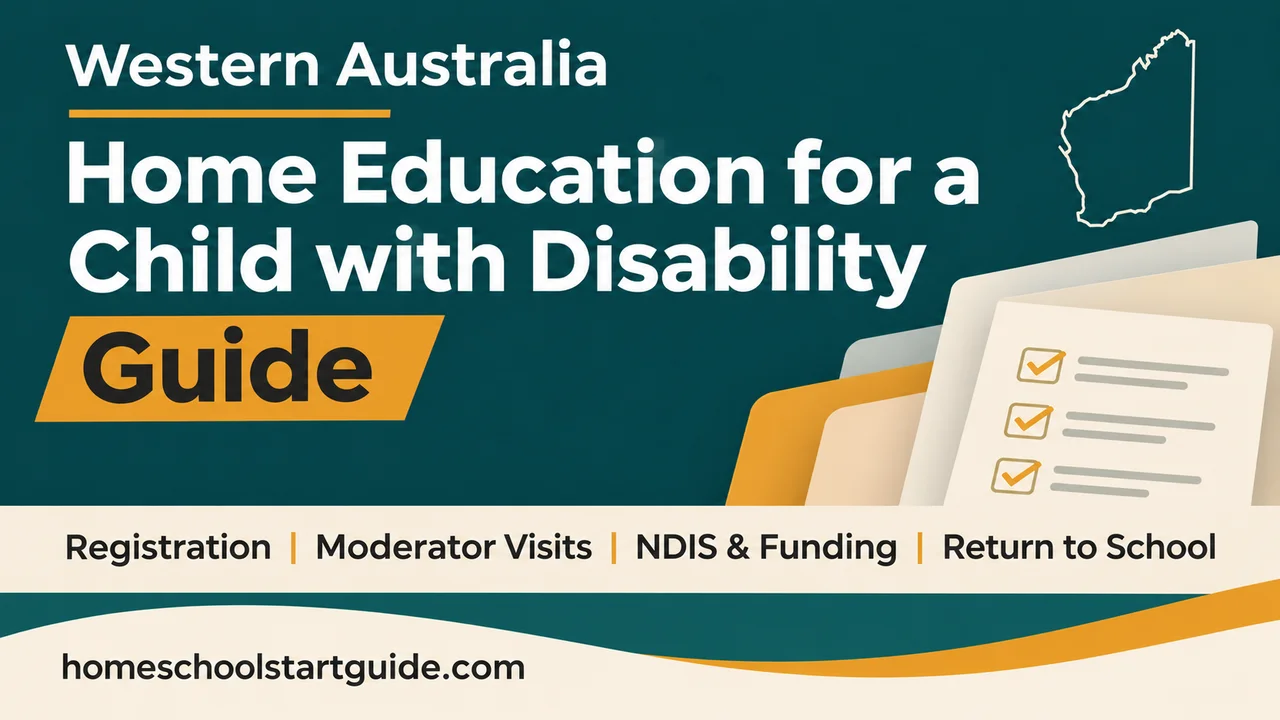
The Western Australia Home Education for a Child with Disability Guide is an administrative bridge between three systems that don't talk to each other: the WA Department of Education's home education registration and moderation framework, the NDIS and its post-October 2024 operational boundaries, and Services Australia's carer payment rules. It puts the steps in the right order, maps the funding boundaries, and gives you evidence templates to help prepare for moderator evaluations.
This is not a curriculum. It is not teaching advice. It is the organisational framework that makes everything else possible — the step before the first lesson.
What's Inside
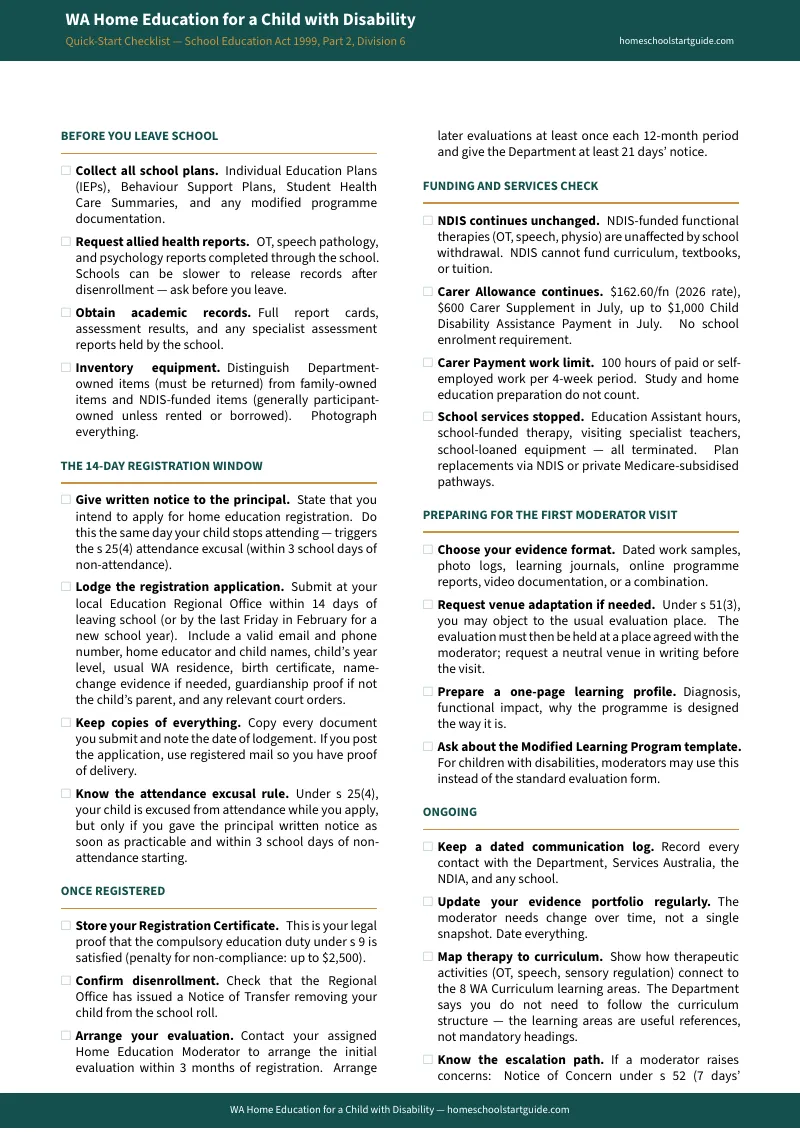
- 14-Day Registration Sequence — the registration steps under Part 2, Division 6 of the School Education Act 1999 (WA), plus the separate section 25(4) written notice under Part 2, Division 3. If you have applied or intend to apply for home educator registration, notify the principal in writing as soon as practicable and within 3 school days after non-attendance starts.
- Education Support Withdrawal Protocol — what to collect before leaving an Education Support School or Centre, how to inventory Department-owned equipment versus NDIS-funded and family-owned items, and the records (IEPs, behaviour plans, allied health reports) you'll need for your first moderator meeting
- Therapy-to-Curriculum Cross-Walk — a structured matrix that maps occupational therapy, speech pathology, psychology sessions, and daily regulation activities to the eight WA Curriculum learning areas, which the Department describes as an optional reference for planning and discussing learning
- Moderator Visit Preparation Suite — checklists for the initial three-month evaluation and every annual visit, a neutral-venue request template under section 51(3), guidance on evaluation scope and evidence requests, and what to do if a Notice of Concern is issued under section 52
- Funding Boundary Map — how to distinguish NDIS disability supports from education-related supports the NDIS cannot fund, how WA school-based support services change after home education registration, and how to check separate Carer Allowance and Carer Payment eligibility. The guide covers the October 2024 NDIA changes it discusses; newer budget reductions apply to some budgets in two NDIS categories for new or reassessed plans from 1 October 2026 and renewed plans from 1 February 2027, with impacts varying by participant.
- Senior Secondary & Exam Accommodations — eligible non-school candidates can apply directly to SCSA for Equitable Access to Assessment adjustments. The 2026 non-school ATAR candidate categories are limited to mature-age applicants (19 or older on 1 March 2026), people who have previously completed Year 12, and specified Year 12 language candidates; non-school exam marks do not count toward WACE. Includes a Years 10–12 documentation trail and a comparison of SIDE and TAFE options.
- Return-to-School Transition Portfolio — a re-entry record template that documents what the child worked on, what accommodations were effective, and what a new school needs to build a fresh support plan
- Worked Examples — scenario walkthroughs for an autistic child leaving an Education Support Centre with an NDIS plan, a child with ADHD and anxiety leaving a mainstream school without a formal diagnosis, and a teenager transferring to home education mid-Year 11
Who This Is For
- Parents in Western Australia pulling a child with autism, ADHD, dyslexia, anxiety, or another disability out of school — or who have just left
- Families leaving an Education Support School or Centre who need to know what happens to equipment, specialist support, and institutional plans
- Parents receiving Carer Allowance or Carer Payment who need to check how home education relates to each payment's eligibility rules
- Families with an NDIS plan who need the funding boundary between disability supports and educational delivery spelled out
- Parents preparing for their first moderator evaluation and unsure how to show progress for a child who learns through therapy, regulation, and interest-led exploration rather than grade-level workbooks
Why Not Just Use the Free Resources?
The WA Department of Education publishes the registration form and policy documents for free. Home Education WA and peer Facebook groups offer registration overviews and emotional support. The NDIS and Services Australia websites explain their own eligibility rules. All of that is valuable, and none of it is a reason not to use those resources.
What none of them does is put the three systems together for a family navigating a disability. The Department's forms don't explain how to document non-linear therapeutic progress for a moderator. The NDIS website doesn't explain how its support rules interact with school-based services and the separate Services Australia payment criteria. The peer groups circulate advice that is sometimes two legislative amendments behind. And nobody publishes a template that converts an OT session into evidence a moderator can evaluate.
This guide sits in the gap between those sources. It doesn't replace them — it organises them into a sequence you can follow on the worst week of your year.
Satisfaction Guarantee
Full refund, no time limit. If the guide doesn't help, email [email protected] and you'll get your money back. No form, no waiting period, no questions.
Frequently Asked Questions
Is this a Department of Education guide?
No. This is an independent guide with no affiliation to the WA Department of Education, SCSA, NDIA, Services Australia, or any school. Every statutory reference is cited by section number and checked against the current Act. It is process navigation, not legal, medical, or financial advice.
Does my child's NDIS plan get cancelled when we leave school?
Home education does not automatically cancel an NDIS plan. The NDIA lists leaving school as a life change to consider at reassessment; a significant change may lead to reassessment or plan variation, and the plan may stay the same or change. Funding depends on the current plan and NDIS rules. Some budgets in the Social, Economic and Community Participation and Improved Daily Living Skills categories are reduced for new or reassessed plans from 1 October 2026 and renewed plans from 1 February 2027; the impact varies by participant. The guide covers the October 2024 changes it discusses, so check current NDIA information for your plan.
Will I lose Carer Allowance if I home educate?
School enrolment is not listed as an eligibility requirement in Services Australia's current criteria for Carer Allowance or Carer Payment. Each payment has separate eligibility rules, including care needs and other checks, so meeting daily care obligations alone does not ensure payment continues.
What if the moderator doesn't understand my child's disability?
The guide includes a moderator meeting preparation suite with evidence presentation checklists, a therapy-to-curriculum cross-walk that maps therapeutic activities to the eight WA Curriculum learning areas as an optional planning reference, and a neutral-venue request template under section 51(3). Your job is to present evidence of an appropriate programme and satisfactory progress — the guide gives you the structure to do that.
What about teaching methods and curriculum?
This guide covers the legal and administrative framework, not teaching approaches. For condition-specific strategies, the Neurodivergent Homeschooling Hack, Autism Homeschooling Blueprint, and ADHD Homeschooling Blueprint cover pedagogy, daily structure, and accommodation strategies. This guide handles the paperwork that makes all of that legally possible.
What if I need help with school-side disputes before leaving?
School-based IEP disputes, exclusion appeals, and advocacy within the school system are outside the scope of this guide. Those are specialist territory. This guide begins where you have decided to leave.
How is this different from the free checklist?
The free checklist gives you the registration steps in order and the five questions to ask your moderator. The full guide gives you the complete administrative framework: the funding boundary map, the therapy-to-curriculum cross-walk, the moderator preparation suite, the worked examples, and the return-to-school transition portfolio. The checklist tells you what to do first. The guide covers every step from registration through re-entry.
Frequently Asked Questions
What if the rules change after I buy?
We update the guide when the rules change. Email us any time, even years later, and we'll send you the current edition free.