Your child needs out of school. You need to know what happens to every support.
Your child has an NDIS plan, Disability Inclusion funding, a Student Support Group, or a specialist school place. School has stopped working — the meltdowns, the reduced timetable, the meetings that go nowhere — and you need a way out. But every time you search for answers, you hit a wall: the VRQA explains registration, Services Australia explains allowances, the NDIS explains its rules, and none of them talk to each other.
Meanwhile, Facebook groups are full of contradictory advice from parents in other states, forum posts referencing rules that changed in 2024, and NDIS consultants implying they can fund home-school tuition (they cannot, under the Section 10 Supports rules).
You are exhausted, afraid of losing the support you fought for, and running out of time to make a decision.
The Disability Transition Roadmap — every system mapped, one document
The Victoria Home Schooling a Child with Disability Guide is a cross-system roadmap that connects what the VRQA, NDIS, Services Australia, VCAA, and the Department of Education each expect — in the order you need to do things, with the boundary between each system marked clearly.
This is not a registration form (the VRQA gives those away free) and not a curriculum plan. It is the operational layer between those systems: what happens to your child's disability supports when you leave school, how to register with VRQA using the learning-area exemption rules, and how to keep funding running during the transition.
What's inside
- Support Transition Matrix — a system-by-system map of what continues, what stops, and what changes when your child leaves school. Covers NDIS Section 10 supports, Disability Inclusion Tier 2/3 funding, Carer Allowance, the Assistance for Isolated Children Distance Education Allowance, specialist transport, and assistive equipment.
- VRQA disability registration walkthrough — the full application process tailored for a child with additional needs, including how to request exemptions from up to seven learning areas under the updated September 2026 policy, without needing formal medical certificates.
- Exemption wording guidance — how to frame disability, health, or recovery-based exemptions in language the VRQA expects, without disclosing more than you need to.
- Learning-area translation — how to map therapy sessions, sensory regulation, interest-based projects, and daily-living skills into the eight Schedule 1 learning areas so your plan demonstrates regular instruction.
- NDIS boundary map — a clear line between what the NDIS funds (functional supports like OT, speech therapy, personal care) and what it does not (tuition, curriculum, paying a parent to teach), with the Section 10 rules explained in plain language.
- AIC claim walkthrough — step-by-step instructions for the Assistance for Isolated Children Distance Education Allowance (up to $5,278 per year, 2026 rate), including who qualifies, the isolation conditions, and how to complete form SY040 and, if claiming under the Students with special needs criteria, form SY099.
- VRQA review preparation — how to assemble a portfolio that shows regular instruction without exposing private medical, therapy, or psychological records. Includes what to have ready if your registration is selected for a compliance review.
- Senior secondary decision framework — VCE, VCE Vocational Major, and Victorian Pathways Certificate options for home-educated students, including Virtual School Victoria eligibility (the 12-month prior registration requirement for senior entry), VCAA Special Examination Arrangements, and re-entry timelines.
- School re-entry process — how your child can re-enter school and request a new Disability Inclusion assessment; previous funding allocations are not automatically restored.
- 6 printable standalone tools — School Exit Documentation Checklist, VRQA Application Preparation Worksheet, Learning Area Mapping Worksheet, Funding Transition Tracker, VRQA Review Evidence Organizer, and Agency Communication Log. Print and fill in as you go through the transition.
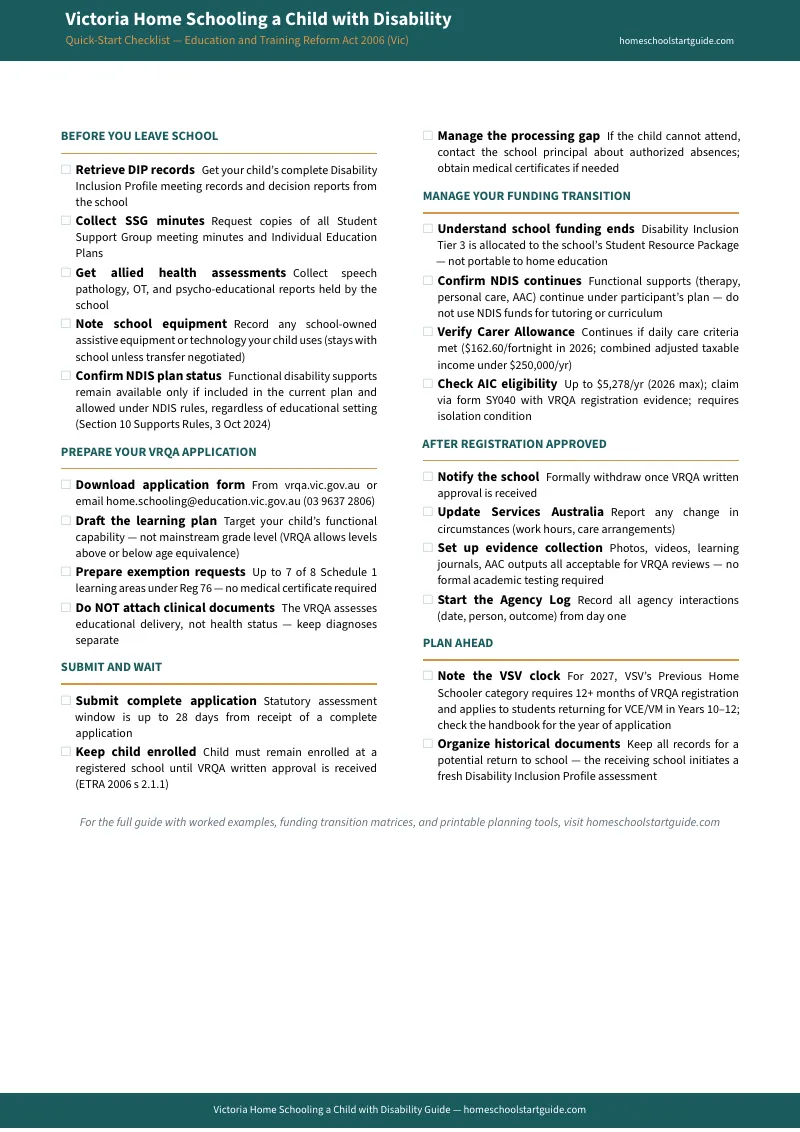
- Quick-Start Checklist (free) — a 22-item checklist covering the withdrawal steps in order, the support status at a glance, and the first week's records to keep.
Who this guide is for
- Parents in Victoria with a child who has an NDIS plan, Disability Inclusion funding, a Student Support Group, or a specialist school placement — and school is no longer working.
- Families who have already left school and need to understand what happened to their child's supports, or how to claim allowances they may be missing.
- Parents of a neurodivergent child (autism, ADHD, dyslexia, anxiety, or other conditions) who want to home educate without losing therapeutic and financial support.
- Carers preparing for a VRQA review and unsure how to present disability-related learning without disclosing private medical information.
- Families of secondary-aged students who need to understand VCE, VSV, and exam provision options while home educating.
Why not free resources?
The official information is not wrong — it is fragmented. The VRQA explains registration but says nothing about Carer Allowance. Services Australia explains the AIC but does not connect it to VRQA timelines. The NDIS explains what it funds and excludes, but not how those rules interact with VRQA registration. The VCAA publishes exam deadlines but does not explain how home-educated students access them.
Peak disability bodies like Amaze, ACD, and Yellow Ladybugs provide strong school-based advocacy resources, but their operational guidance on VRQA home education registration is minimal. The Home Education Network (HEN) gives accurate registration advice and checks member plans, but its information is spread across web pages, leaflets, and forum posts without the cross-system funding maps.
This guide takes every official source that matters and puts them into one operational sequence — from the day you decide to leave to the year your child sits a VCE exam — so you are not Googling at midnight wondering if you just lost your child's therapy funding.
What this guide is not
This is not legal advice, not a curriculum, not a teaching plan, and not affiliated with the VRQA, any school, the NDIS, or Services Australia. It does not promise that your registration will be approved, that you will receive a particular funding amount, or that any outcome is guaranteed. If your child is in a custody dispute, a school attendance enforcement proceeding, or a formal legal matter, you need a lawyer — not a guide.
The guide covers the administrative process and funding boundaries. For in-school advocacy and IEP or Student Support Group disputes, see the Special Ed Start Guide. For general withdrawal steps without the disability layer, see the Victoria Legal Withdrawal Blueprint. For teaching approaches tailored to specific conditions, see the Neurodivergent Homeschooling Hack.
Satisfaction guarantee
Full refund, no time limit. If the guide does not help, email [email protected] and you will get your money back.
Start tonight
Download the free Quick-Start Checklist to see the withdrawal steps, support status, and first-week records at a glance. When you are ready for the full cross-system roadmap — every funding boundary, every VRQA exemption approach, every senior pathway decision — get the complete guide for .
Frequently Asked Questions
What if the rules change after I buy?
We update the guide when the rules change. Email us any time, even years later, and we'll send you the current edition free.