You fought for a support plan. Now you need to leave — without losing it.
Your child has an Individual Curriculum Plan, a Special Education Program placement, a special school enrolment, or an NDIS plan. School stopped working months ago — maybe the adjustments were never made, maybe the meetings went nowhere, maybe your child simply cannot walk through the door any more. You are ready to bring them home.
But the system that was supposed to help now feels like a trap. Leave school and the ICP disappears. The SEP placement ends. The advisory visiting teacher, the classroom aide, the assistive equipment — none of it follows you home. And NDIS funding? You have heard it covers homeschooling, and you have heard it does not, often in the same forum thread.
Meanwhile the Home Education Unit wants a written program, evidence of progress, and an annual report — all designed for a neurotypical child hitting age-level benchmarks. Your child has never hit age-level benchmarks. The official templates do not explain how to show progress when progress looks different.
The Cross-Agency Navigation System
This is the problem: the information you need sits across four agencies (Queensland Home Education, the NDIS, Services Australia, and the QCAA), each with its own forms, its own language, and its own definition of what your child is entitled to. No single agency will tell you how the other three work. Free government pages tell you what the law requires. They do not tell you how to meet those requirements when your child has complex needs, or in what order to do it so nothing falls through the gap between agencies.
The Queensland Home Education for a Child with Disability Guide is a Cross-Agency Navigation System: one document that maps the withdrawal sequence, the registration process, the funding boundaries, and the reporting requirements across all four agencies, in the order you actually need them, written for a child who does not fit the standard template.
What's inside the guide
- The withdrawal sequence for a child with support plans — what happens to each school-based plan (ICP, SEP, special school enrolment) when you leave, how to submit the home-education application while your child is still enrolled and then coordinate the school withdrawal date, and the records to collect before you go
- Both types of provisional registration explained — the ongoing application (provisional from receipt until QHE decides) and the separate 60-day short-term option, with the eligibility rule that catches most families off guard
- Educational Program Summary for a child with disability — the eight "high-quality education" criteria, how to write goals using functional profiles instead of medical labels, and how to frame progress for a child working below age-level benchmarks using the Australian Curriculum's student diversity guidelines
- What the Home Education Unit still owes, checks, and may ask — departmental entitlements for registered home educators (including the 2026 Back to School Boost and Textbook and Resource Allowance), what QHE can and cannot do during monitoring, and anti-discrimination protections
- NDIS funding boundaries mapped line by line — which disability-related supports may continue if they remain in your child's plan and meet NDIS rules, what NDIS will not fund (education fees, educational supports for home schooling, school-age supervision), and the difference between functional support and educational delivery
- Carer Allowance and Carer Payment — the current Carer Allowance rate, the income and asset rules, and how home education interacts with eligibility
- Assessments and therapies outside school — clinical reassessment, allied health access, the Medicare allied health plan, and how to align therapy goals with QHE reporting
- Annual report evidence for a child with additional needs — non-traditional evidence formats (audio recordings, visual portfolios, assistive-technology outputs), modified progress framing, and how the tenth-month submission works
- Distance education as the alternative — how state Schools of Distance Education differ from home education, the eligibility criteria for medical or disability reasons, and when to choose which
- Senior pathways and QCAA AARA exam accommodations — the QCE and ATAR restriction for home-educated candidates, how to contact QCAA about Access Arrangements and Reasonable Adjustments for eligible assessments, NAPLAN, and TAFE and VET entry
- Returning to school with support restored — the re-enrolment process, why support does not automatically resume, and managing the transition for an anxious or traumatised child
- Disputes, appeals, and external oversight — the show-cause process, internal review, QCAT external review, oversight bodies, and when to get a lawyer
- Five planning worksheets — Transition Planning Worksheet, Services and Funding Audit, Educational Program Planning Template, Annual Report Evidence Tracker, and Agency Communication Log
Who this is for
Parents in Queensland of an autistic, ADHD, dyslexic, anxious, or otherwise disabled child who has an ICP, an SEP placement, a special school enrolment, or an NDIS plan — and who need to know how leaving school works with that support in place, what happens to funding and services, and how to demonstrate educational progress when progress looks different.
If your child does not have a disability-related support plan and you need the general Queensland withdrawal process, see the Queensland Legal Withdrawal Blueprint. If you need portfolio templates and evidence-logging tools, see the Queensland Portfolio and Assessment Templates.
Why not free government pages?
Queensland Home Education publishes the registration forms and a generic planning guide. The NDIS publishes its support lists. Services Australia publishes Carer Allowance rates. The QCAA publishes the AARA framework. All of it is free.
What none of them does is connect the dots across agencies for a family in crisis. The QHE templates assume a neurotypical child. The NDIS support lists do not explain how functional supports interact with educational reporting. Services Australia publishes payment rates and eligibility rules; the guide brings those details together with QHE registration, NDIS boundaries, and school withdrawal. The QCAA pathway assumes the student is enrolled in a school.
This guide exists because you should not have to read four agencies' websites, reconcile their contradictions, and work out the correct order while your child is in distress and your household income is about to drop.
Satisfaction guarantee
Full refund, no time limit. If the guide does not help, email [email protected] and you will get your money back.
Start now
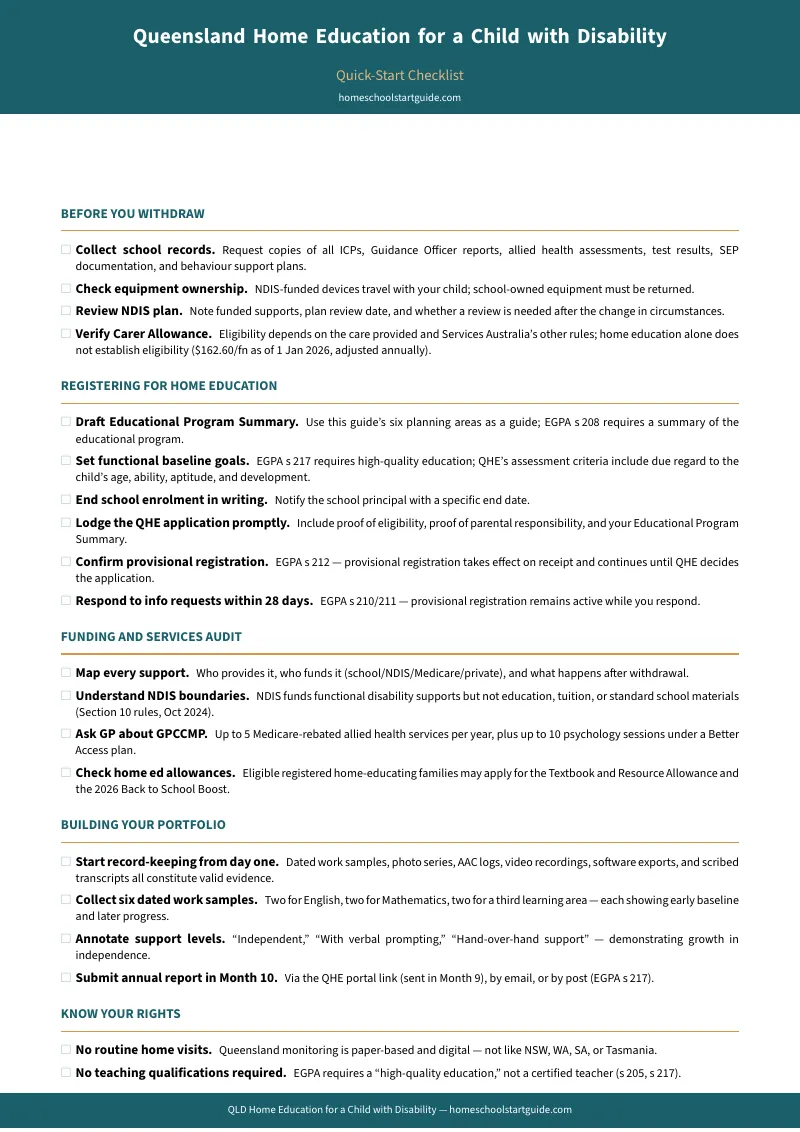
Download the free Quick-Start Checklist — the withdrawal steps, what happens to the support plan and funding, and the records to keep. Ready for the full system? Get the Queensland Home Education for a Child with Disability Guide — one-time, no subscription, full refund if it does not help.
Frequently Asked Questions
What if the rules change after I buy?
We update the guide when the rules change. Email us any time, even years later, and we'll send you the current edition free.