You fought for that support plan. Now you need to know what happens to it.
Your child has a Personalised Learning and Support Plan, a support class place, an SSP placement, an NDIS plan — maybe all of them. School was supposed to work because of that support. But it didn't. Now you're looking at home education, and the first question isn't about curriculum. It's about whether everything you fought for disappears the moment you withdraw.
The government websites tell you what the rules are. They don't tell you how those rules interact when a child with disability leaves school — which NDIS supports may be funded, what the Authorised Person actually checks for a neurodivergent learner, or what to do about compulsory attendance while registration takes up to 12 weeks.
The NSW Disability Home Education Navigator is the guide that connects those systems. It maps the withdrawal sequence when a support plan is in place, walks you through registration with evidence that fits your child, draws the line between NDIS-funded therapy and Department-of-Education curriculum duties, and helps you build a record to share if your child later seeks school enrolment or a specialised placement.
What's Inside the Guide
- The Withdrawal Sequence When a Support Plan Is in Place — the guide maps records to gather before notifying the school, the notifications, and the administrative steps to take before applying for home schooling.
- Registration Through the Home Schooling Platform — the documents the Department asks for, the identity and address requirements, the processing timeline, and what to arrange with the school about attendance while you wait for your certificate.
- The Authorised Person Visit — Adapted for Disability — the AP assesses whether your program is "suitable to the child's needs." The guide explains what that means in practice for a neurodivergent or disabled child: how adjustments are allowed under the Disability Standards for Education 2005, when NESA Life Skills outcomes apply, and how to present a program that reflects your child's actual capacity.
- Accessible Evidence Frameworks — when your child can't produce standard written work, you need a different way to show learning. The Department does not mandate a particular evidence format; the guide includes structured approaches for annotated photographs, digital evidence, oral transcriptions, and therapy-integrated records.
- The NDIS Boundary Map — after the October 2024 Section 10 rules, the line between disability support and education funding shifted. The guide maps which education-related supports are excluded and explains that disability-related therapy depends on NDIS criteria and the participant's plan.
- Carer Allowance & AIC Scheme Continuity — what changes when school enrolment ends, what stays, and how to handle the interaction between the Assistance for Isolated Children Distance Education Allowance and your registration status.
- Exams & Post-School Pathways — HSC exams by self-tuition, NAPLAN participation, TAFE or VET study options, and university entry pathways that vary by institution.
- The Return-to-School Record — if your child later seeks school enrolment, the guide helps you organise records to share with the enrolling school. The school decides eligibility and year or stage; specialised support class placements require an access request and panel decision.
Who This Guide Is For
You're a parent in New South Wales. Your child has a diagnosed disability, learning difficulty, or mental health condition — autism, ADHD, dyslexia, severe anxiety, a physical disability. Your child has (or had) a school support plan, and school has stopped working. You need to know:
- How leaving school affects your child's supports and what records to gather before withdrawal
- How to register for home schooling when your child doesn't fit the standard mould
- What happens to NDIS funding, Carer Allowance, and school transport
- How to prepare for the Authorised Person visit with evidence your child can actually produce
- How to prepare records to share if your child later returns to school
This is not a teaching guide. It does not tell you how to teach a dyslexic child to read or structure a sensory-friendly learning day. Those belong to the condition-specific guides (the Neurodivergent Homeschooling Hack, the Autism Blueprint, and others — all linked inside). This guide is the administrative bridge: it helps you navigate the transition and keep a record of your child's learning and support needs.
Why Not Just Use the Free Information?
The NSW Department of Education website explains the registration rules. The NDIS website explains the funding rules. Services Australia explains the payment rules. Each one is accurate for its own domain — and none of them tells you what happens at the intersection.
When you withdraw a child with an active PLSP and an NDIS plan, you're dealing with three separate agencies, each with its own rules, its own timelines, and its own definition of what counts as "education." The Department's registration guidelines don't mention NDIS boundaries. The NDIS website doesn't address Authorised Person visits. Services Australia doesn't tell you how Carer Allowance interacts with home schooling registration status.
The free information is scattered across those agencies, mixed with outdated forum advice, and assumes your child fits the standard pathway. This guide is the cross-agency map that connects them — written for the child who doesn't fit.
Satisfaction Guarantee
Full refund, no time limit. If the guide isn't what you need, email [email protected] and it's done.
Printable Tools Included
The guide comes with 10 standalone PDFs you can print and use alongside it: a registration readiness checklist, a pre-exit document request letter, an interim attendance planner, an AP visit preparation checklist, a weekly evidence collection framework mapped to NESA Key Learning Areas, an NDIS boundary audit worksheet, a therapy-curriculum integration planner, an agency communication log, a renewal evidence organiser, and a school re-entry portfolio builder. Each one is designed to be filled in by hand as you go.
Start Here
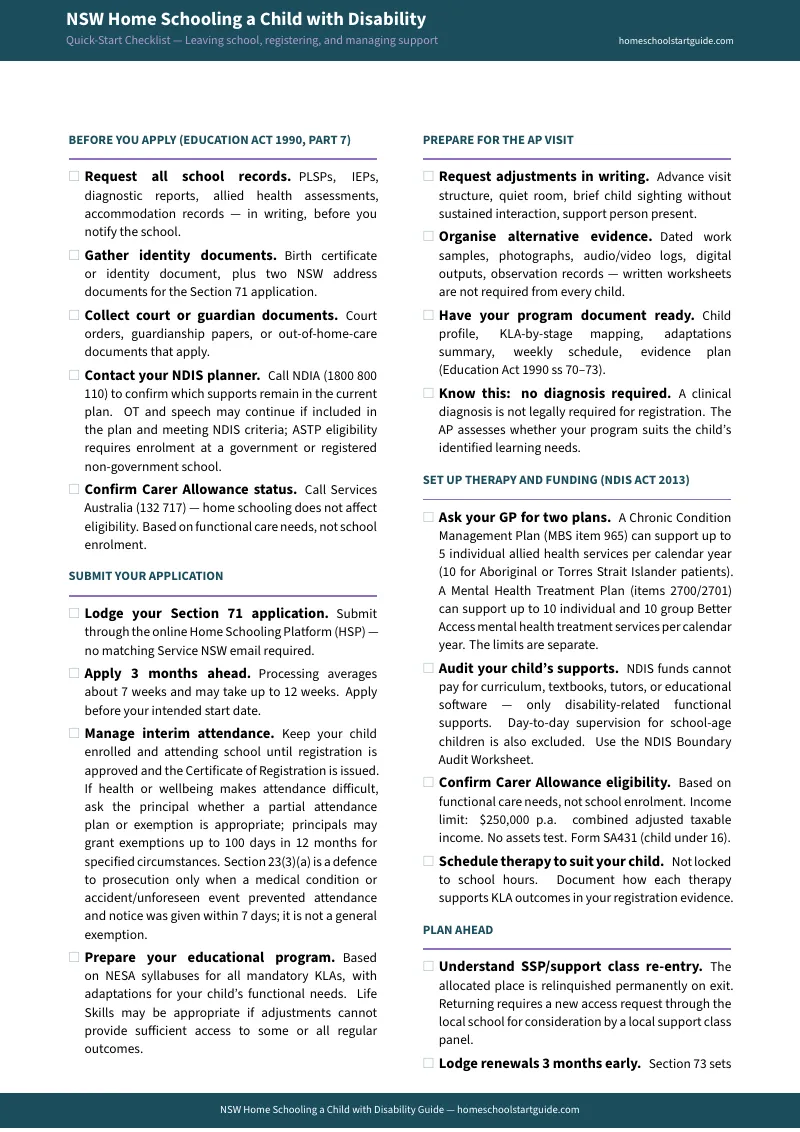
Download the free quick-start checklist to see every step on one page — then get the full guide when you're ready for the detail behind each one.
The guide costs less than a single hour with a registration consultant. And you keep it forever.
Frequently Asked Questions
What if the rules change after I buy?
We update the guide when the rules change. Email us any time, even years later, and we'll send you the current edition free.