You got the letter. Now what?
An attendance letter from your child's school or the NSW Department of Education can feel like the ground has shifted. Headlines about $11,000 fines make it worse. But here is what those headlines leave out: NSW does not issue on-the-spot fines for school absence. Those figures are the maximum a Local Court can impose after a formal prosecution — the last stage of a long process, not the first.
The guide maps six pre-court stages of escalation, each with its own rules, deadlines, and opportunities for a parent to act. The problem is that official resources explain the rules for schools and courts, not for the parent standing in the middle of them.
The NSW Attendance Enforcement Roadmap is a plain-English toolkit that puts you in control of the process instead of reacting to it. It translates every stage — from an unexplained-absence SMS to a Children's Court application — into concrete steps, evidence checklists, and meeting preparation tools that keep you organised and clear-headed.
What's inside the guide
- The Eight-Stage Escalation Map — a side-by-side reference for placing your child's situation on the guide's simplified pathway and understanding what each letter, meeting, and stage involves
- 7-Day Evidence Log — for NSW public schools, Department policy asks parents to explain an absence within seven calendar days. If no explanation is received in time, the absence is recorded as unexplained; late explanations are kept on file, but the roll is not amended. This structured log tracks dates, reasons, medical evidence, and submission timestamps
- Meeting and Conference Preparation Worksheets — checklists and agenda planners for school-level meetings, Intensive Attendance Support sessions, and Section 22C Compulsory Schooling Conferences, including how undertakings work and what to record
- Medical Evidence Framework — how to organise GP letters, psychologist reports, and learning support documentation for a principal to review, with guidance on what to do when an explanation is not accepted
- Court Procedure Walkthrough — a stage-by-stage explanation of Children's Court Compulsory Schooling Orders (Section 22D) and Local Court prosecution (Section 23), including when to contact Legal Aid NSW and how to organise documents for a duty solicitor
- Home Education Transition Roadmap — the realistic steps, timing, and paperwork for registering with the NSW Department of Education Home Schooling Directorate (the authority since May 2025), including processing that averages around 7 weeks and may take up to 12 weeks, and what registration does and does not change about absences already on the record
- Legal Aid and Escalation Triage Sheet — a decision-tree that tells you exactly when to stop using self-navigation tools and call LawAccess NSW (1300 888 529), apply for Legal Aid, or instruct a solicitor
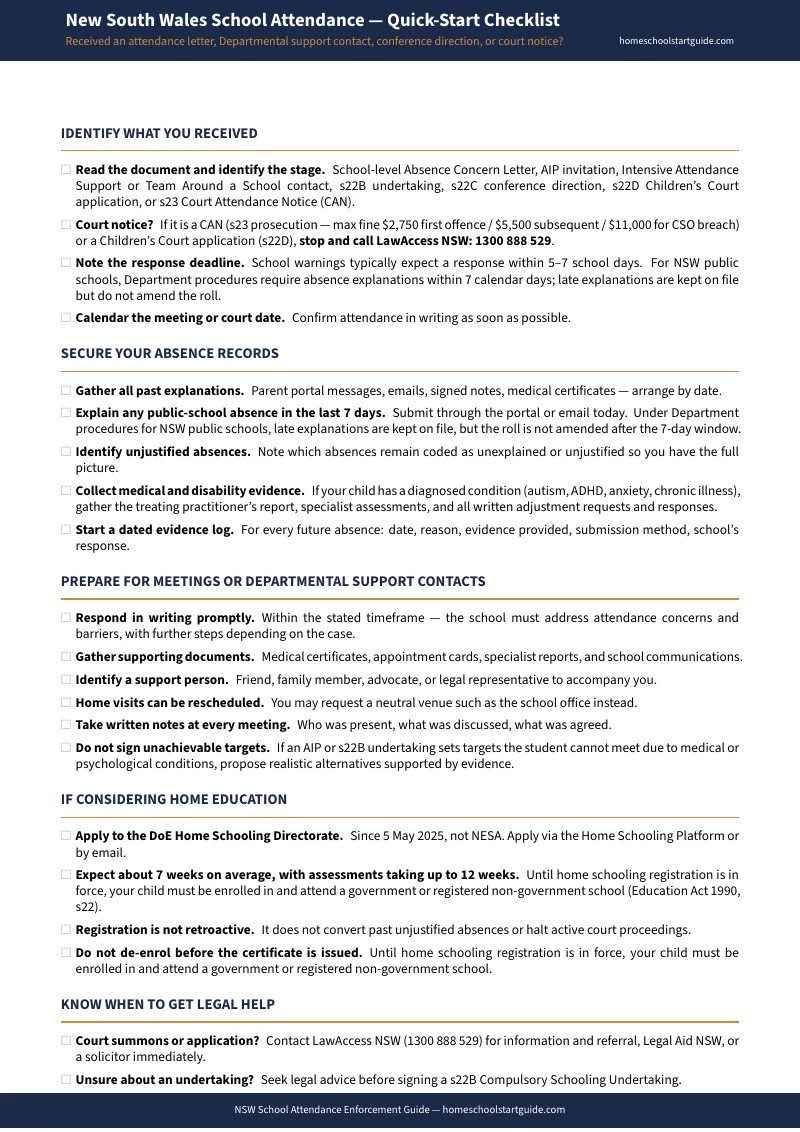
- Printable Quick-Reference Checklist — a free checklist covering the first steps after receiving any attendance notice, the contacts to have ready, and the evidence to start gathering tonight
Who this guide is for
- Parents who have received an attendance letter, an Absence Concern Notice, or an invitation to a school attendance meeting — and are not sure what it means or what happens next
- Families dealing with an HSLO or Intensive Attendance Support visit and wanting to understand their rights and the process
- Parents of children with anxiety, a disability, or a chronic health condition whose absences are being coded as unjustified despite medical evidence
- Families who took term-time travel and had a leave application declined by the principal
- Parents considering home education as a lawful alternative and wanting to understand the registration timeline and what it does and does not resolve
Why not just use the free government pages?
The NSW Department of Education's attendance policy and procedures are written for school staff — they describe what teachers and principals must do, not what a parent should do. The Children's Court publishes statutory brochures in dense legal language. Neither source provides a parent-centred organisation tool.
This guide gives you the missing layer: a structured system for tracking your deadlines, documenting your evidence, preparing for meetings, and understanding which stage you are at — so you are not Googling in a panic at midnight, piecing together fragments from law firm blogs that are trying to sell you a $295 consultation.
What this guide is not
This is an independent process navigation resource. It is not legal advice, and it is not affiliated with the NSW Department of Education, NESA, or any court. If you are facing a Local Court prosecution or a Children's Court summons, you need a solicitor. The guide includes contact details for Legal Aid NSW and free legal information services, and it is designed to work alongside a lawyer — not replace one.
Satisfaction guarantee
If this guide does not help you understand the attendance enforcement process and organise your next steps, email [email protected] for a full refund, no time limit.
Get the NSW Attendance Enforcement Guide — or start with the free Quick-Start Checklist to see the first steps tonight.
Frequently Asked Questions
What if the rules change after I buy?
We update the guide when the rules change. Email us any time, even years later, and we'll send you the current edition free.