NSW Has the Most Structured Home Education Process in Australia. That's Not the Same as the Hardest.
You've made the decision. Your child is struggling — the bullying the school keeps calling "a phase," the IEP meetings where nothing changes, the morning panic attacks that have become the daily routine. You know you need to withdraw your child and start home educating. So you googled "home education NSW" and landed on the Department of Education website.
That's where the confidence evaporated. Registration application. Educational plan covering the "minimum curriculum." Six key learning areas for primary, eight for secondary. An Authorised Person will visit your home. Biennial renewal. Show-cause provisions. The Education Act 1990, Part 7, Sections 70 through 74. A processing window stretching up to twelve weeks — and your child is supposed to keep attending school the entire time.
Then you found a Facebook group. One parent says the Authorised Person "went through everything with a fine-tooth comb." Another says theirs "was lovely and left in twenty minutes." Someone warns you never to mention unschooling. Someone else says they unschool and have been registered for six years. A parent in Queensland says to move north — "it's easier up there." Half the advice still references NESA as the registering body, which hasn't been accurate since May 2025.
You still don't know what to actually write on the application, what the Authorised Person is really assessing, or how to legally manage the gap period between withdrawing from school and receiving your registration certificate.
The NSW Registration Navigation System
The New South Wales Legal Withdrawal Blueprint is a complete Registration Navigation System — every document, template, and strategy you need from the moment you decide to withdraw through registration approval and beyond. Not a generic Australian guide with a paragraph about NSW. Every legal citation, every template, every strategy is specific to the Education Act 1990 and the current Department of Education registration process (updated for the May 2025 NESA-to-DoE administrative transfer).
Government guides tell you what the regulations require. This Blueprint shows you how to navigate them — how to protect your family's privacy during the AP visit, how to legally bridge the processing window using Section 25 exemptions, and how to translate real-world learning into the academic language the assessor needs to see.
What's Inside the Blueprint
The Department of Education Registration Walkthrough
The DoE application is not complicated — it's poorly explained. The Blueprint walks through every section, tells you exactly what the Home Schooling Directorate is looking for in each field, and flags the common mistakes that delay applications. Complete the form confidently in one sitting, not three anxious attempts spread across two weeks.
The Educational Plan Builder
This is where most NSW parents freeze. The DoE requires an educational plan demonstrating coverage of the "minimum curriculum" — six key learning areas for primary, eight for secondary. But the official website doesn't explain what "minimum curriculum" actually means in practice. The Blueprint provides an educational plan outline that satisfies the assessor whether you use a structured curriculum, an eclectic approach, or child-led learning — and shows you how to translate everyday activities (baking bread, building a cubby house, visiting the Powerhouse Museum) into the formal educational terminology the DoE needs to see.
The Authorised Person Visit Preparation Guide
The AP visit generates more anxiety than any other part of the NSW process — and almost none of that anxiety is warranted. The Blueprint tells you exactly what APs are trained to assess, what they report, what they cannot require, and how to set physical boundaries so the visit stays professional. It covers the legal sighting requirement for neurodivergent or highly anxious children — including scheduling options, medical exemptions, and low-stress strategies for selectively mute children. Includes a pre-visit checklist and common AP questions with suggested responses.
The Withdrawal Letter Templates (Ready to Send)
Pre-written withdrawal letters for NSW government, Catholic, and independent schools — citing the correct provisions of the Education Act 1990. Not blank templates you have to figure out — ready-to-personalise documents with clear instructions on what to include, what to leave out, and who to send them to. Email one tonight; the school gets notified first thing tomorrow.
The Gap Period Strategy
Between withdrawing from school and receiving registration, your child is technically not enrolled anywhere. This gap — typically seven to twelve weeks — is the period that causes the most legal anxiety for NSW parents. The Blueprint provides two legal strategies: applying for a Section 25 exemption from attendance (up to 99 days) through the school principal, or obtaining a GP stress-leave certificate to formally excuse absences during the processing window. It covers what protections apply, how to respond if the school or Department of Education contacts you, and how to document your child's learning from day one.
The School Pushback Protocol
Some schools accept withdrawal letters without comment. Others demand meetings, threaten truancy reports, or refuse to release academic records. The Blueprint includes email scripts for every common pushback scenario — the principal who insists on a face-to-face meeting, the school that won't hand over reports, the attendance officer who mentions "mandatory reporting." Every script cites the relevant section of the Education Act so you respond with law, not emotion.
The Special Situations Section
Mid-year withdrawal timing. Children with disabilities and existing IEPs. NDIS-funded therapies and whether they continue after you leave the school system. Neurodivergent children and the AP "sighting" requirement. Conscientious objection to specific curriculum areas. NCAT appeals if registration is refused. The Blueprint covers every scenario the generic guides ignore because they're trying to cover all of Australia in twenty pages.
Who This Blueprint Is For
- Parents withdrawing mid-year because their child is in crisis — bullying, school refusal, anxiety, unmet special needs — and who need to act this week, not after months of research
- Parents overwhelmed by the registration process who need someone to walk them through the application form, the educational plan, and the Authorised Person visit step by step
- Parents terrified of the AP visit who've read horror stories in Facebook groups and need the facts — what the AP actually does, what they report, and what they cannot demand
- Parents of neurodivergent children worried about the AP "sighting" requirement, sensory overwhelm during the visit, or losing NDIS-funded therapies when they withdraw
- Parents getting pushback from the school — demands for meetings, truancy threats, refusal to release records — who need the exact legal language to shut it down
- Parents still reading guides that reference NESA as the registering body and need current, post-2025 information
Why Not Just Use the Free Resources?
You can research NSW home education registration for free. The information exists. Here's what that process actually looks like:
- The DoE website. The authoritative source. It provides the application form, a list of key learning areas, and some guidance notes. What it doesn't provide is a plain-English explanation of what the minimum curriculum means in practice, how to write an educational plan without triggering follow-up questions, or how to legally manage the twelve-week gap period. The language is clinical and compliance-focused — written from an enforcement perspective, not a parent's.
- The Home Education Association (HEA). A valuable advocacy organisation with experienced volunteers. But the HEA serves home educators across all of Australia. When your question is "what exactly do I write in this section of the NSW application?" or "can I refuse to let the AP see my child's workbooks?", you need NSW-specific procedural detail, not general encouragement.
- Facebook groups. High on lived experience, dangerously variable on accuracy. In the same thread, one parent says the AP visit is "just a chat" and another says they were grilled for two hours. One insists you need a dedicated learning space; another says the AP didn't look at the room. Much of the advice still references NESA as the registering body — outdated since May 2025. Every answer is one person's experience presented as universal truth.
- Generic Australian homeschool guides. The low-cost Etsy downloads cover "Australian home education" as if it were one system. NSW's registration process is fundamentally different from Queensland, Victoria, and every other state. A guide that devotes two paragraphs to "NSW requires registration" is a footnote dressed up as a product.
- Registration consultants. A one-hour session with a home education consultant in Sydney costs A$150–A$250. Full registration packages from services like Coach House start at A$2,310. Most families don't need someone to do it for them — they need someone to explain exactly what to do, step by step, with the documents ready to fill in.
Free resources tell you that registration exists. The Blueprint walks you through every section of the application, every paragraph of the educational plan, and every minute of the AP visit.
— Less Than a Single Consultation Session
Your download includes the complete Blueprint guide (14 chapters), the NSW Homeschool Quick-Start Checklist, and 4 standalone printable PDFs you can use immediately:
- Withdrawal letter templates (standalone PDF) — ready-to-personalise letters for government, Catholic, independent, and mid-year crisis withdrawal, citing the Education Act 1990
- School pushback scripts (standalone PDF) — copy-paste email responses for when the school demands meetings, threatens reports, or refuses to process your withdrawal
- AP visit preparation guide (standalone PDF) — what the Authorised Person assesses, the visit timeline, a pre-visit checklist, boundary-setting scripts, and common questions with suggested responses
- NSW quick reference card (standalone PDF) — what NSW requires and what it does not, key learning areas, and legal citations on one printable page
- DoE registration walkthrough — every section of the application form explained in plain English
- Educational plan builder — an outline covering all six primary or eight secondary KLAs that works for structured, eclectic, or child-led approaches
- Gap period strategy — Section 25 exemption templates and GP stress-leave briefing to legally keep your child home during the processing window
- Special situations guide — mid-year withdrawal, IEP transition, NDIS continuation, neurodivergent AP sighting, NCAT appeals
Instant download, no account required.
Money-back guarantee, no time limit. If the Blueprint doesn't give you the confidence and clarity to execute your withdrawal and registration, email us and we'll refund you. No questions asked.
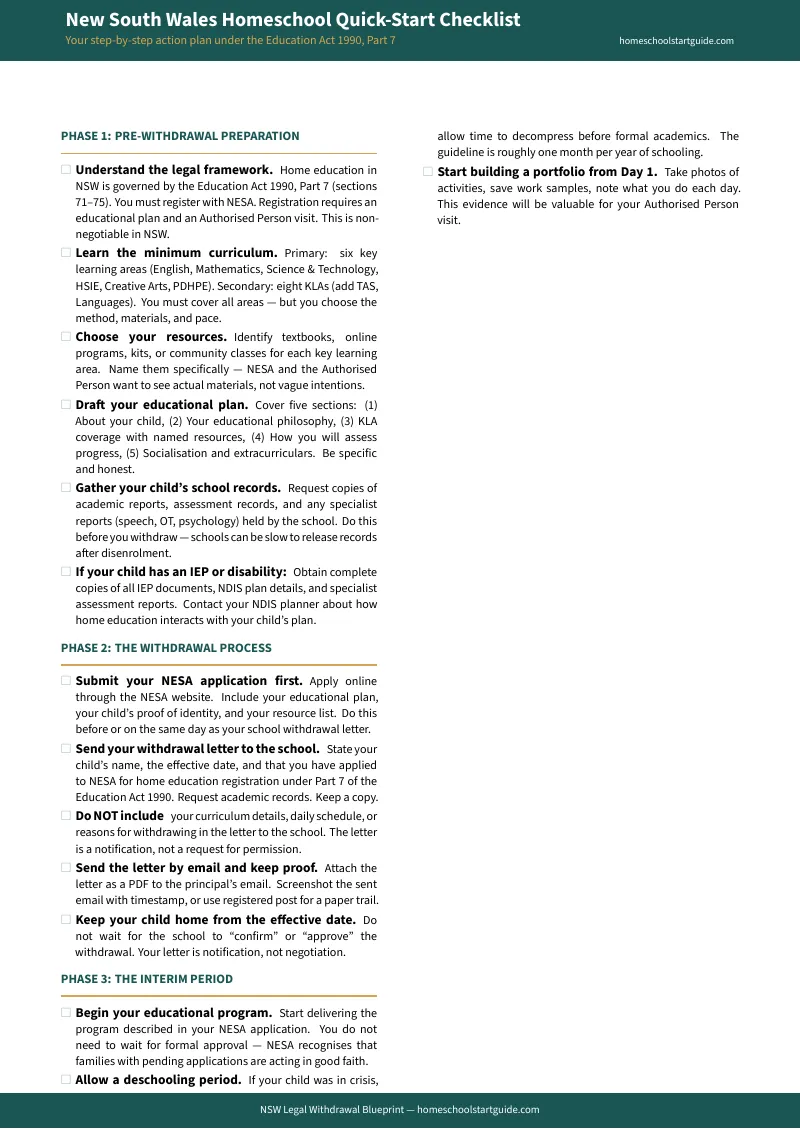
Not ready for the full Blueprint? Download the free New South Wales Homeschool Quick-Start Checklist — a printable overview of the registration process, the key learning areas you need to cover, and the steps from withdrawal through Authorised Person visit. It's enough to understand your rights tonight. The full Blueprint is there when you're ready to act.
Thousands of NSW families register successfully every year. The process is structured, not impossible — you just need someone to walk you through it. That's exactly what this Blueprint does.