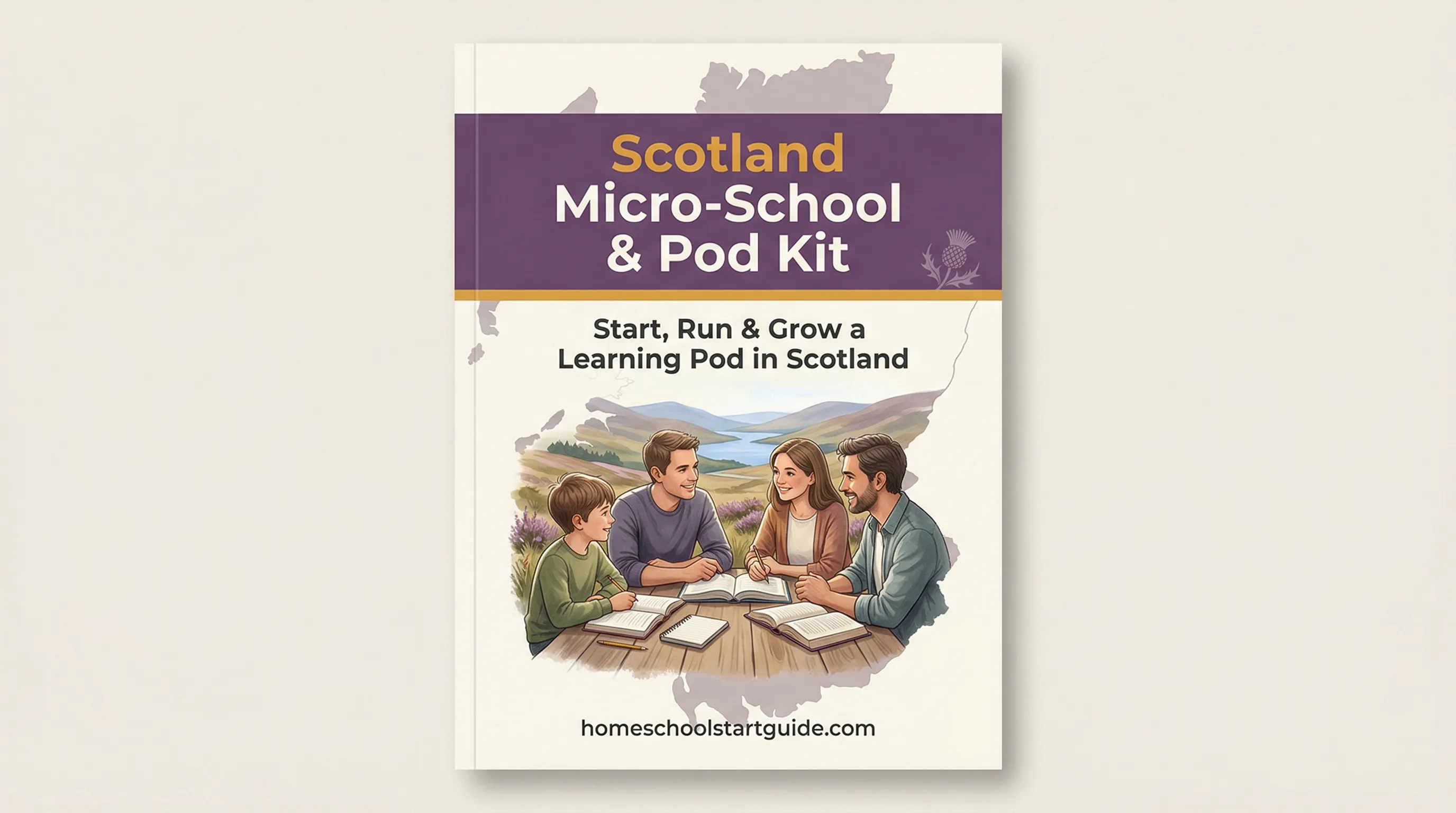
The Scotland Pod Setup System — From First Family to Legal, Running Micro-School
You want to stop home educating alone. Your child needs other children to learn alongside, a facilitator who can teach the subjects you can't, a schedule that gives you breathing room. You've been searching Facebook groups, asking in Home Education Scotland threads, reading everything you can find. And every time you get close to actually starting a pod, you hit the same wall: is this even legal?
You've heard stories. A group in Edinburgh that got a letter from the council about running an "unregistered school." A Glasgow parent told by the local authority that sharing a tutor crosses the line. A well-meaning post in a Home Ed Scotland group claiming you need GTCS registration for anyone teaching in a pod. The Scottish Government's guidance is scattered across MyGov.scot, Education Scotland, Disclosure Scotland, and the Care Inspectorate — thousands of pages of bureaucratic language written for institutional administrators, not for parents trying to organise three families and a rented church hall.
Here's what the confusion comes down to: in Scotland, you must register with the Registrar of Independent Schools if you provide full-time education to pupils of school age. Scotland does not have the same specific 5-pupil rule as England. The threshold is "pupils" (plural) receiving "full-time education" — approximately 25 hours per week for primary, 27.5 hours for secondary. And from April 2025, any adult in a regulated role with children must be a member of the PVG Scheme through Disclosure Scotland — not DBS. From July 2025, operating without PVG membership is a criminal offence. No generic UK or English guide covers this. Most don't even mention Education Scotland as the inspection body, or that GTCS registration is required for teachers in registered independent schools — completely different from England's system.
The Scotland Micro-School & Pod Kit is a complete Scotland Pod Setup System — the legal frameworks, the templates, the budget models, the safeguarding policies, and the step-by-step operational manual — so you can build a compliant learning community without deciphering thousands of pages of Scottish legislation or relying on contradictory Facebook advice.
What's Inside the Scotland Pod Setup System
The Registration Threshold Framework — the one thing every Scottish pod organiser must understand
Five operating models mapped out clearly: the unregistered part-time cooperative, the structured cooperative below the full-time threshold, the enrichment-only model, the registered independent school pathway, and the flexi-schooling hybrid. Each model includes exactly how many hours, what "full-time" means under Scottish law, and how the Education (Scotland) Act 1980 defines the registration trigger. You'll know precisely which model fits your group — and what would push you across the line into requiring registration with the Registrar of Independent Schools, Education Scotland inspection, and full independent school standards compliance.
Parent Agreement, Facilitator Contract & Budget Templates — because informal arrangements fall apart
Ready-to-use templates drafted for Scots law. The parent agreement covers financial contributions, notice periods, trial terms, behaviour expectations, illness policy, safeguarding responsibilities, and language provision (English, Gaelic, or bilingual). The facilitator contract template addresses employment status (the HMRC CEST tool distinction that most pods get wrong), PAYE obligations, GTCS registration requirements for the independent school pathway, and PVG Scheme membership. The budget planner covers four scenarios from a parent-led model at approximately £40 per family per week to a facilitator-led model at approximately £175 per family per week — all in GBP with realistic Scottish venue and tutor rates.
Safeguarding Policy Template — built on GIRFEC, not England's KCSIE
Scotland has its own safeguarding framework. The template is based on the GIRFEC National Practice Model (Getting It Right for Every Child) and the SHANARRI wellbeing indicators, not England's Keeping Children Safe in Education. It covers the designated safeguarding lead role, the PVG Scheme application process through Disclosure Scotland, reporting duties to Police Scotland and local authority social work, Prevent duty, photography consent protocols, and record-keeping. If your pod ever scales to a registered independent school, this policy already aligns with what Education Scotland inspectors expect to see.
PVG Scheme Compliance Guide — mandatory from April 2025, criminal offence from July 2025
The Protecting Vulnerable Groups Scheme is Scotland's safeguarding check — completely separate from England's DBS system. A DBS check is legally invalid for regulated work in Scotland. The guide walks through PVG membership applications (£59 to join, £18 to add a role, free for volunteers), the Scheme Record and Scheme Record Update processes, what constitutes "regulated work" for a pod facilitator, and the criminal offence provisions that took effect in July 2025. Every England-focused guide gets this wrong.
Gaelic-Medium Micro-School Setup Guide — because no other resource covers this
How to build a Gaelic-medium or bilingual pod even if your own Gaelic is limited. Covers Bòrd na Gàidhlig grants (Taic Freumhan community language initiative, Colmcille fund for cross-border projects), Storlann Nàiseanta na Gàidhlig curriculum resources, Gaelic-medium facilitator recruitment through Comann nam Pàrant and local cròileagan networks, e-Sgoil digital provision for secondary subjects, and Gaelic learner pathways. For families where the council cannot provide Gaelic-medium education due to the 420-teacher national shortage, a micro-school may be the only viable route to immersive Gaelic education.
Forest School & Outdoor Learning Under Scotland's Right to Roam
Scotland's Land Reform (Scotland) Act 2003 gives everyone — including learning groups — statutory access rights to most land and inland water. This creates outdoor learning opportunities that simply don't exist in England or Wales. The guide covers access rights and responsibilities under the Scottish Outdoor Access Code, risk-benefit assessments for woodland and coastal sessions, the John Muir Award as a structured outdoor learning framework, and how to integrate forest school sessions into your pod's weekly schedule.
SQA Private Candidate & University Pathway Guide
When micro-school learners reach exam age, they need to sit SQA qualifications — National 5, Highers, and Advanced Highers. Not GCSEs, not A-levels, not the WJEC. Finding SQA presenting centres that accept external candidates requires specific knowledge of the Scottish exam system. The guide covers the SQA external candidate process, presenting centre relationships, the Scottish Credit and Qualifications Framework, UCAS tariff points for Highers, and applications to Edinburgh, Glasgow, St Andrews, Aberdeen, and Dundee.
Who This Kit Is For
- Parents who are burned out on solo home education and want to share the teaching load with other families — but need to know the legal boundaries before they commit
- Parents of children with additional support needs who need a small-group, neuro-affirming learning environment — and who need to understand Scotland's registration threshold and PVG requirements
- Families priced out of private school by the 20% VAT who want to replicate a small-class, high-quality education by pooling resources — but have no idea how to structure it legally under Scottish law
- Gaelic-medium families in areas where the local authority cannot provide GME teachers — who want to create community-led Gaelic immersion education for their children
- Rural and island families across the Highlands, Shetland, Orkney, the Outer Hebrides, Skye, and Mull where solo home education is isolating and forming a local pod is the only practical option for peer interaction
- Parents who have already been contacted by a local authority education officer about their informal group arrangement — and who need clarity on what is and isn't legal in Scotland
Why Not Just Use the Free Resources?
You can. Education Otherwise has guidance on home education rights. The Scottish Government publishes independent school registration requirements. Facebook groups like Home Education Scotland have hundreds of threads from parents who have formed pods. Here's what actually happens when you try to build a micro-school strategy from these sources:
- Most free micro-school guides are American. They reference LLC formation, 501(c)(3) non-profit status, state-specific charter school frameworks, and US liability waivers. None of this applies to Scotland. The legal structure, the safeguarding requirements, the employment law, and the curriculum framework are entirely different.
- Generic UK guides reference England, not Scotland. They mention Ofsted instead of Education Scotland. They reference EHCPs instead of Scotland's CSPs and ASN Act. They cite the English National Curriculum instead of Curriculum for Excellence. They advise DBS checks instead of PVG. They have never heard of the GTCS or the Registrar of Independent Schools. Following English advice in Scotland is not just unhelpful — using a DBS check instead of PVG membership after April 2025 means your facilitator is operating illegally.
- Scottish Government guidance is written for established institutions, not parents. The Education (Scotland) Act 1980, the Care Inspectorate registration framework, and the PVG Scheme guidance tell you what the law requires. They do not tell you how to structure a pod to stay below the threshold, how to draft a parent agreement under Scots law, how to budget for a facilitator, or how to handle the consent-to-withdraw process with a hostile local authority.
- Facebook groups are emotionally supportive but legally imprecise. The advice is well-meaning but contradictory. One post says you need GTCS registration for any tutor. Another says the registration threshold doesn't apply to part-time groups. A third says PVG isn't required if children are supervised by parents. None of these are reliably correct under current Scottish law, and the consequences of getting it wrong range from forced closure to criminal charges under the PVG Act.
Free resources tell you that pods exist. The Scotland Pod Setup System gives you the legal structure, the templates, and the operational blueprint to actually build one — in Scotland, under Scottish law, without accidentally operating an unregistered school.
— Less Than Half an Hour With a Private Tutor
A private tutor in Scotland charges £25-50 per hour. Private school fees now run over £22,000 per year after the 20% VAT. An education solicitor charges £200+ per hour. The Kit costs less than 30 minutes of tutoring — and it gives you the complete legal and operational framework to share that tutor's cost across multiple families, potentially saving thousands of pounds per year.
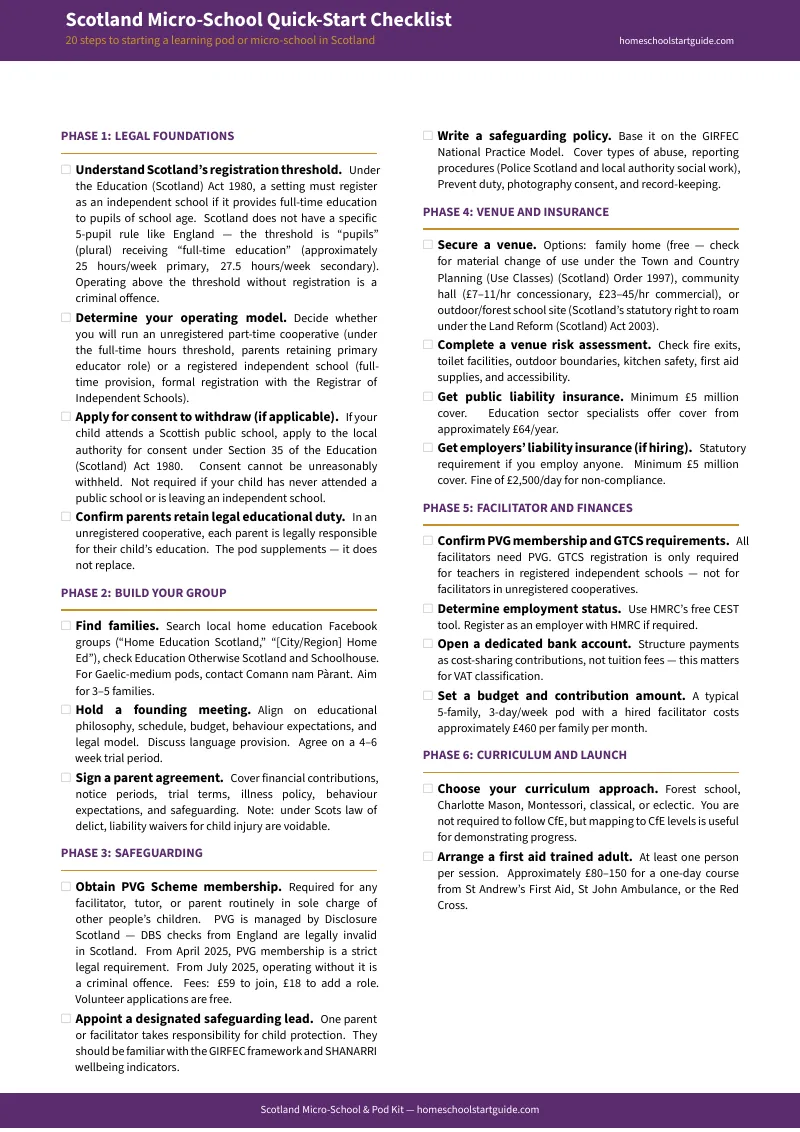
Your download includes 8 PDFs — the complete 20-chapter guide, a quick-start checklist, and 6 standalone printable templates you can fill in, sign, and share without opening the main guide. The guide covers legal structures, parent agreements, facilitator contracts, safeguarding policies, PVG Scheme compliance, budget models, Curriculum for Excellence mapping, Gaelic-medium setup, SQA exam pathways, venue risk assessments, insurance requirements, SCIO and CIC structures, forest school risk-benefit assessments, and the John Muir Award. The standalone templates include the parent agreement, budget tracker, facilitator agreement, safeguarding policy, venue risk assessment, and forest school risk-benefit assessment — ready to print and use from day one. Plus the Scotland Micro-School Quick-Start Checklist — a 20-step action plan that takes you from finding families to launching your first session. Instant download, no account required.
30-day money-back guarantee. If the Kit doesn't give you the clarity and confidence to set up your learning pod or micro-school legally in Scotland, email us and we'll refund you. No questions asked.
Not ready for the full Kit? Download the free Scotland Homeschool Quick-Start Checklist — a 20-step overview of the entire pod setup process, from understanding the registration threshold to launching your first session. It's enough to understand the legal landscape, and it's free.
Your child doesn't have to learn alone. Scottish law gives you every right to build a learning community — the Pod Setup System makes sure you do it without accidentally breaking it.